


This story was written by Kim Asarta.
Our pets capture our hearts, and what we love often teaches us the most. When learning is tied to emotion, ideas become more meaningful and memorable. That concept is at the heart of Econ Dinner and a Movie: Call of the Wild, a professional development program offered by the University of Delaware’s Center for Economic Education and Entrepreneurship (CEEE) in the Alfred Lerner College of Business and Economics.
Originally created by Scott Bacon, assistant director of CEEE, and now led by the center’s team under his guidance, Econ Dinner and a Movie launched in April 2017 to help Delaware’s K-12 teachers make economics engaging and accessible through stories students care about. Today, Econ Dinner and a Movie is a popular offering that regularly sells out, drawing educators eager to connect real-world economics to themes such as students’ relationships with their pets.
“Exploring economic concepts such as scarcity, choices, incentives and opportunity cost through a story students enjoy makes these ideas meaningful and accessible at the elementary level,” said Jenny McIntyre, a teacher at Wilson Elementary School. “This experience strengthened my ability to design engaging, real-world lessons that help students see economics beyond the textbook.”
At the Call of the Wild screening, educators enjoyed a catered dinner sponsored by YourMoney101.org and the Delaware Council on Economic Education, with funding from Robinhood. UD professors Anuradha Sivaraman and Kathryn Bender led a discussion on how the bond between people and their pets helps students connect economics and marketing concepts to everyday experiences.
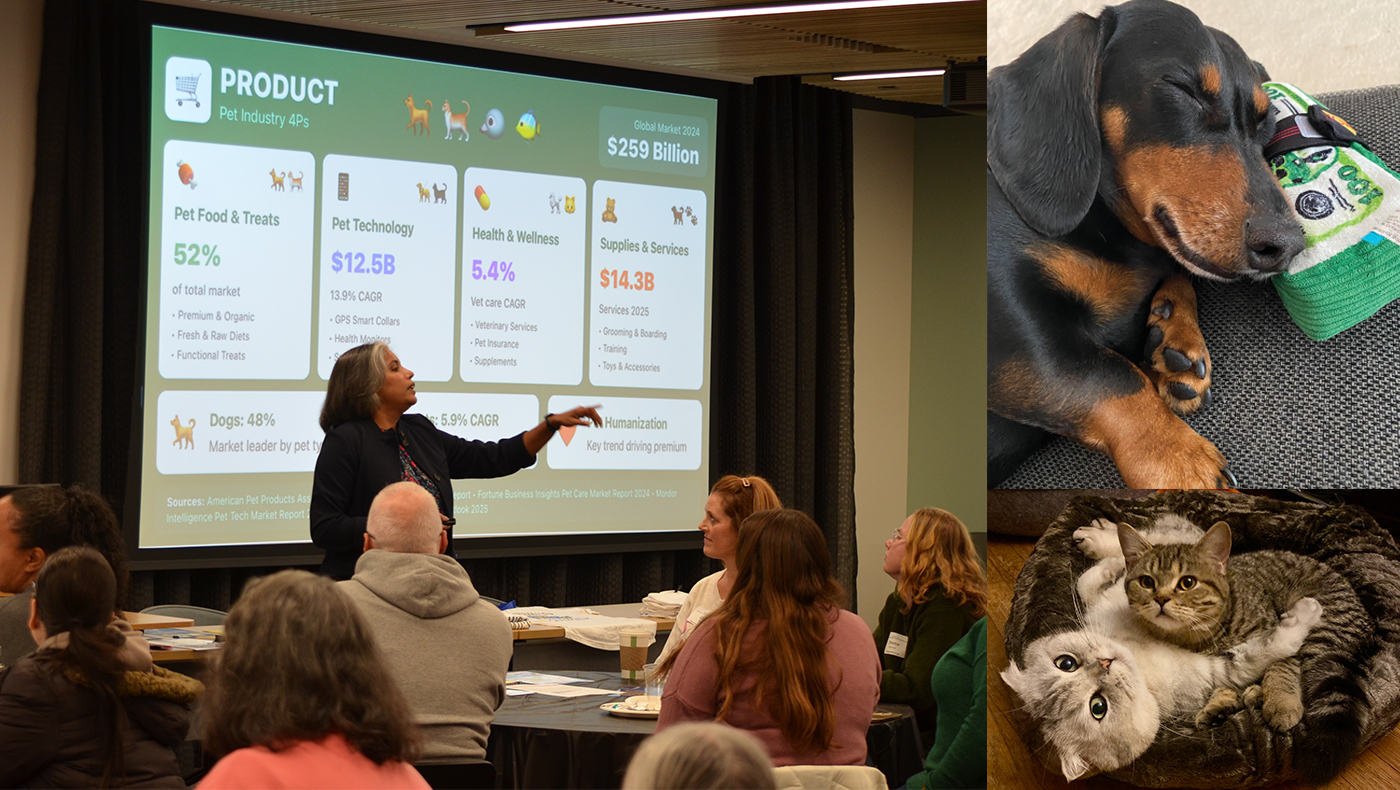
Sivaraman encouraged teachers to view the film’s protagonist, Buck, through a marketing lens, examining the evolution of the modern pet industry. Buck’s journey, from pampered pet to survival and loyalty, mirrors the rise of pet humanization, as animals have increasingly been viewed as family members over the past 30 years. Nearly everyone in the room admitted they speak to their pets as family. Today, 84 percent of dog owners view their pets as children, and the marketplace has evolved alongside that emotional bond.
Teachers also explored how early products, from branded dog biscuits in the 1860s to national brands such as Milk-Bone and Ken-L Ration, helped shape the industry. As consumer expectations changed, marketing strategies evolved alongside suburbanization, mass media and packaging innovations. Sivaraman highlighted how the four Ps of marketing—product, price, promotion and place—give students a framework for linking personal interests to core economic and marketing concepts.
That sense of connection resonated with educators.
“The humanistic connection between economics and pets was powerful,” said Tammi Schweizer, a teacher at West Park Place Elementary School. “It’s difficult to get students interested in required content, but pets are something nearly everyone cares about. When curriculum embraces what students love, they connect—even if they don’t realize they’re learning economics.”
Building on that foundation, Bender examined the scale of the modern pet economy and the economic decisions it drives. With approximately 90 million dogs in U.S. households and an estimated 23 million new pets adopted during the pandemic, pet ownership offers a relatable way to discuss demand, spending and trade-offs. Bender also noted that pet spending is highly inelastic, with owners willing to pay thousands of dollars for medical care, providing real-world examples of risk, decision-making and moral hazard.
“The information presented was useful and included data I wasn’t aware of,” said Claudia Harris, a teacher at Milford Central Academy Middle School. “It’s something I’ll be sharing in my classroom and with my own children.”
By the end of the evening, it was clear why Econ Dinner and a Movie remains a teacher favorite. Through Buck’s story and discussions of marketing, pet ownership and economic decision-making, educators left with practical strategies to help students see themselves in economic lessons—making abstract concepts meaningful, relatable and memorable.