


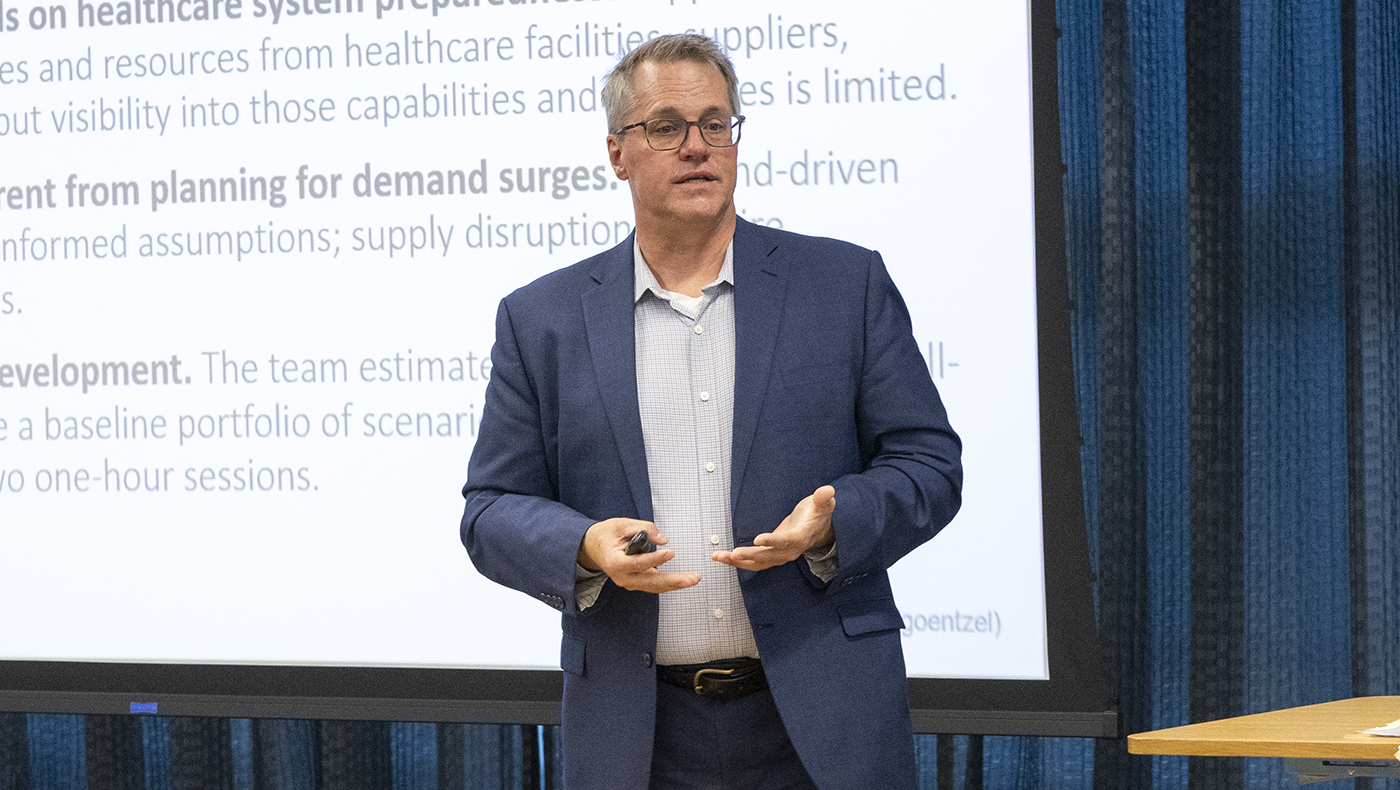
Jarrod Goentzel, founder and director of the MIT Humanitarian Supply Chain Lab and principal research scientist at the MIT Center for Transportation and Logistics, presented “Shaping Supply Systems to Meet Human Needs” during this fall’s W.L. Gore Lecture Series. Drawing on research involving health care, humanitarian relief, fuel and housing, he demonstrated how supply systems can be designed to deliver greater social value.
Goentzel explained that his research increasingly centers on social outcomes and noted that many of the same analytical tools that businesses use to improve efficiency and profitability can also help solve humanitarian challenges.
“We always have to ground ourselves in the individual who’s going to benefit from the work we’re doing,” Goentzel said, establishing a central theme of the presentation: effective supply chains must begin with the people and communities they are intended to serve.
“You start with demand to drive the shape of the system,” he added, describing an approach that considers human needs first and then examines how supply, transportation, distribution and public policy can work together to meet them.
Goentzel illustrated that approach through four case studies.
Preparing health care systems for a crisis
His first example focused on personal protective equipment during the COVID-19 pandemic. Working with the Massachusetts Department of Public Health and health care partners, Goentzel and his colleagues examined how hospitals and other facilities could better anticipate demand for masks, gowns, gloves and other essential supplies.
The research explored strategies beyond simply building larger government stockpiles. Modeling showed that increasing the amount of PPE held by individual facilities and establishing stronger, more direct relationships with suppliers could significantly reduce the need for state emergency inventory.
In one scenario, combining higher facility stock levels with improved supplier relationships meant Massachusetts health care facilities would not have run out of supplies under the modeled pandemic conditions.
Goentzel also discussed using artificial intelligence to help government officials prepare for future emergencies. Large language models generated potential crisis scenarios in approximately two hours, compared with an estimated two days of workshops. Experts remained involved in evaluating scenarios and making inventory decisions.
The experience demonstrated how AI can make sophisticated management science tools more accessible while keeping people responsible for critical decisions.
Improving humanitarian distribution
Goentzel next discussed research with the United Nations Logistics Cluster, which coordinates transportation and logistics support during major humanitarian emergencies.
Using the 2010 floods in Pakistan as an example, he described the challenges of delivering food and other essential supplies when roads, bridges and infrastructure are damaged. Relief organizations must determine how to use available resources, including trucks, helicopters and boats, while responding to changing conditions.
The research examined how decision-makers could balance competing priorities, including delivery speed, the number of people reached and the importance of particular goods and destinations.
Although mathematical optimization could identify efficient distribution strategies, Goentzel said the best solution was not necessarily to have a computer dictate every decision.
“I love OR, but we ended up recommending not using optimization to make the decisions, instead use optimization to teach you how to make decisions,” he explained.
The goal was to help humanitarian logisticians develop better judgment and understand which approaches work best under different conditions. In a crisis, circumstances change constantly, making flexibility and practical decision-making essential.
Understanding fuel supply after disasters
The third case study examined fuel availability following major hurricanes in 2017, including Hurricanes Harvey, Irma and Maria.
Fuel is essential to disaster response, supporting emergency vehicles, evacuations, transportation and the delivery of supplies. Goentzel’s research examined how the fuel supply system responded when refineries, pipelines, terminals and distribution networks faced major disruptions.
The findings showed that the system could be more resilient than expected. Although Hurricane Harvey forced the shutdown of significant Gulf Coast refining capacity, other refineries increased production to help compensate.
However, the research also identified bottlenecks between fuel terminals and individual gas stations. Even when fuel was available in the broader distribution system, transportation and delivery challenges left some locations without supplies.
Goentzel and his colleagues examined potential improvements involving terminal operations, truck access, loading capacity and operating hours. Their work demonstrated that strengthening a supply chain requires looking beyond production to understand how products actually reach the people who need them.
Rethinking disaster housing
Goentzel’s final example focused on housing following the devastating 2023 Maui wildfires.
Traditionally, disaster recovery efforts have relied heavily on temporary trailers to provide housing for displaced residents. Goentzel described research exploring whether factory-built, wood-frame homes could offer a higher-quality alternative that could eventually become permanent housing.
The effort brought together government agencies, manufacturers, construction experts and community stakeholders. The result was a groundbreaking FEMA procurement of factory-built homes, offering improved quality control through factory construction and the possibility of repurposing homes after the immediate emergency.
The impact extended beyond temporary disaster relief. Goentzel explained that Maui County ultimately took ownership of 167 FEMA-built homes at no cost, making them available for affordable housing.
“One hundred sixty-seven families will now have affordable housing through FEMA money,” he said, describing how a different approach to disaster procurement could create a lasting community benefit.
Goentzel also discussed the potential to expand industrialized home construction to address broader housing shortages and improve resilience in communities vulnerable to natural disasters. Accomplishing this will require collaboration among manufacturers, government agencies, insurers, researchers and local communities.
Creating systems that serve society
Across the four examples, Goentzel returned to the importance of collaboration and systems thinking. Improving outcomes often requires more than changing one organization or one part of a supply chain. It requires bringing together stakeholders and identifying the policies, technologies and operational changes that can make an entire system work better.
He highlighted the value of interdisciplinary research, combining management science with engineering, social science and public policy to address complex human problems. Universities can help bring those groups together, using research and academic partnerships to develop practical solutions that extend beyond the classroom.
As Goentzel concluded, the work represents an opportunity to use research and collaboration to create meaningful change. His message was that supply chains are about more than moving products efficiently. When designed around human needs, they can help communities prepare for crises, respond to disasters and build more resilient futures.