


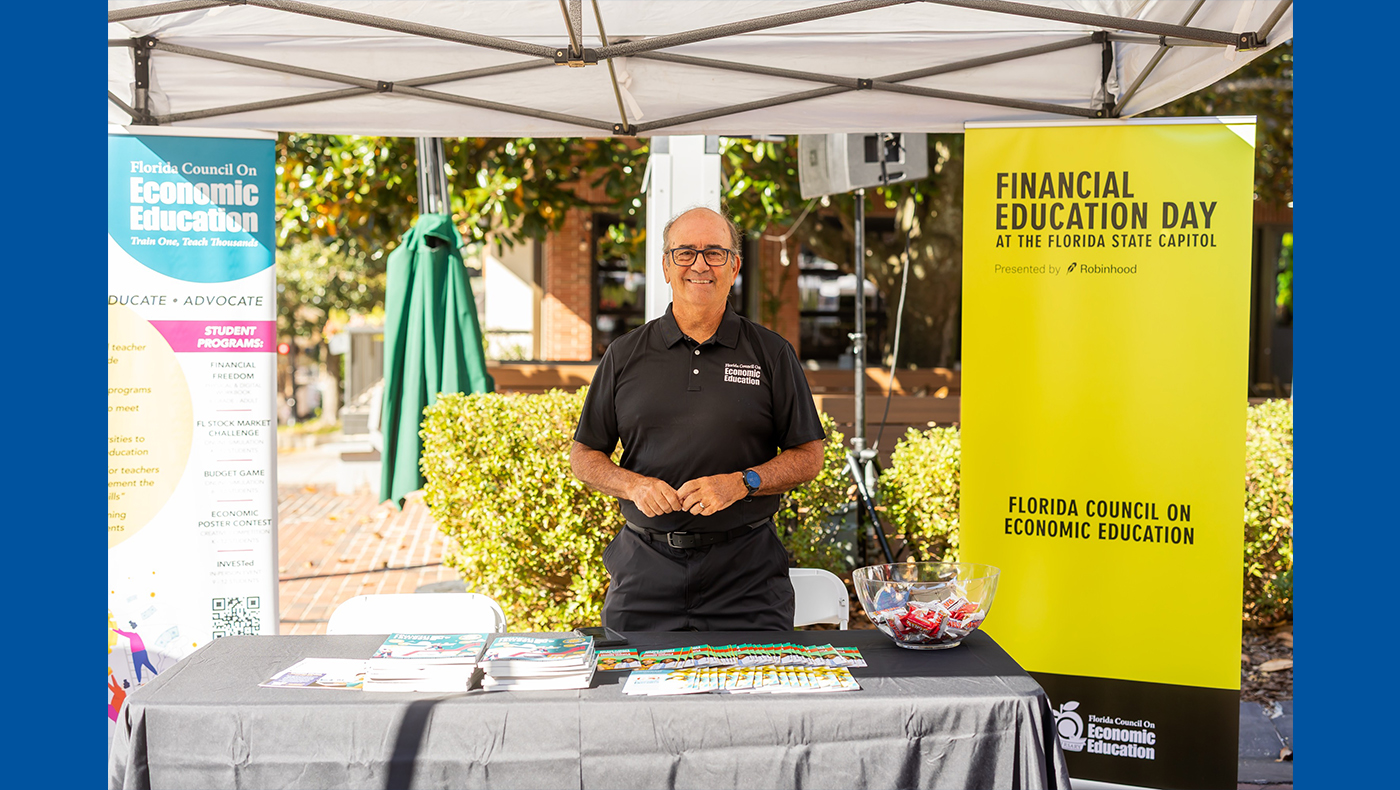
Brett Burkey, a 2009 graduate of the Lerner College’s Master of Arts in Economics and Entrepreneurship for Educators (MAEEE) program currently resides in Boca Raton, Fla. Over the past decade, he has led the development of widely used financial literacy resources, including the Financial Freedom workbook, and expanded economic and personal finance education to under-supported populations across the state. Burkey reflects on how the MAEEE program shaped his approach to curriculum development, professional development and teaching, as well as the network and mentorships that continue to guide his work.
What is your job title and name of school, district, or organization?
Director of Education for the Florida Council on Economic Education
What exciting news or accomplishments have you been a part of?
I have been the Project Manager and lead writer of a consumable workbook addressing the financial literacy standards in Florida for over ten years. It is titled Financial Freedom. The FCEE makes the book available to Florida teachers at no cost. It is widely used in classrooms across the state and is also the primary tool for instruction in the state’s penal system. Two exciting things have happened this year as related to the book. First, we were successful in securing the funds and have now digitized the book as an interactive resource compatible with all LMS’s across the state. It serves as the centerpiece of a broad online resource we are building out for students and teachers of Economics and Personal Finance. The site will eventually house a course for teachers to tackle for classroom certification, and a digital warehouse of resources teachers can draw from to supplement instruction. Second, we have entered into a multi-year agreement with the Department of Corrections to develop a rich personal finance curriculum that will be used throughout incarceration and as an exit assessment as inmates prepare to leave. This is an integral part of our broadening mission to serve under-supported populations. I have trained advocates for the survivors of domestic violence and worked closely with the Boys and Girls Club across the state.
Why is this news valuable to your colleagues or educators considering the MAEEE program?
One great thing of value is the recognition that the parameters of what we do aren’t limited to the classroom. It has become increasingly frustrating to work with school districts and I’m grateful for alternative avenues to direct my energy.
What did you learn through your MAEEE experience that you wouldn’t have learned anywhere else?
I often say that I’m the “poster child” for what the MAEEE program was created to produce. I learned to write curriculum, organize and deliver professional development, and most importantly to be responsive to the needs of teachers. My goal has always been to support teachers who may be novices in this field and challenge those that are not. Since leaving the program, I have been the “Johnny Appleseed” of econ and personal finance education.
Describe an important connection you have made through your graduate program (personal, professional, peers, mentors, professors, etc.)
I feel blessed to have had the opportunity to work through the MAEEE program and will always give back in a hopeless attempt to repay it. I consider Bonnie Mezaros and Jim O’Neill to be mentors and great friends. I cherish my friendship with Carlos Asarta and have the utmost respect for what he has accomplished. I marvel at the growth and maturity of the Delaware program under Scott Bacon’s leadership and the great team that has assembled there.
What other opportunities has the MAEEE degree provided you?
The MAEEE degree has provided me with a provenance unrivaled in this field. When I meet an extraordinary colleague at a workshop or conference, they are almost always graduates of the MAEEE program. More than once, while addressing an audience of my peers, I have asked for a show of hands, “how many of you are graduates of UD’s MAEEE program”. it always startles me at the number. The network has been greatly nourished by the MAEEE program.
If you were to describe your classmates in one word, what would that be?
Accomplished. So many of the class of 2009 have gone on to do great things.
Fill in this sentence: “The MAEEE graduate program helped me become…”
A better teacher, a more organized human being, more observant of the world around me, more adherent to the Economic Way of Thinking, a more serious professional, more creative, and more empathetic to the struggles we face in public education.
What piece(s) of advice would you give to current MAEEE students or prospective applicants?
I wish you to see your MAEEE experience as a springboard to an endless array of opportunities. The world of economic education is a rich one that will offer you endless ways to express yourself. Most of the world is uncomfortable with this subject matter. It is misunderstood and maligned. You know better and belong to a club of folks that share a very glorious secret. Use this to your advantage, you have become invaluable.