


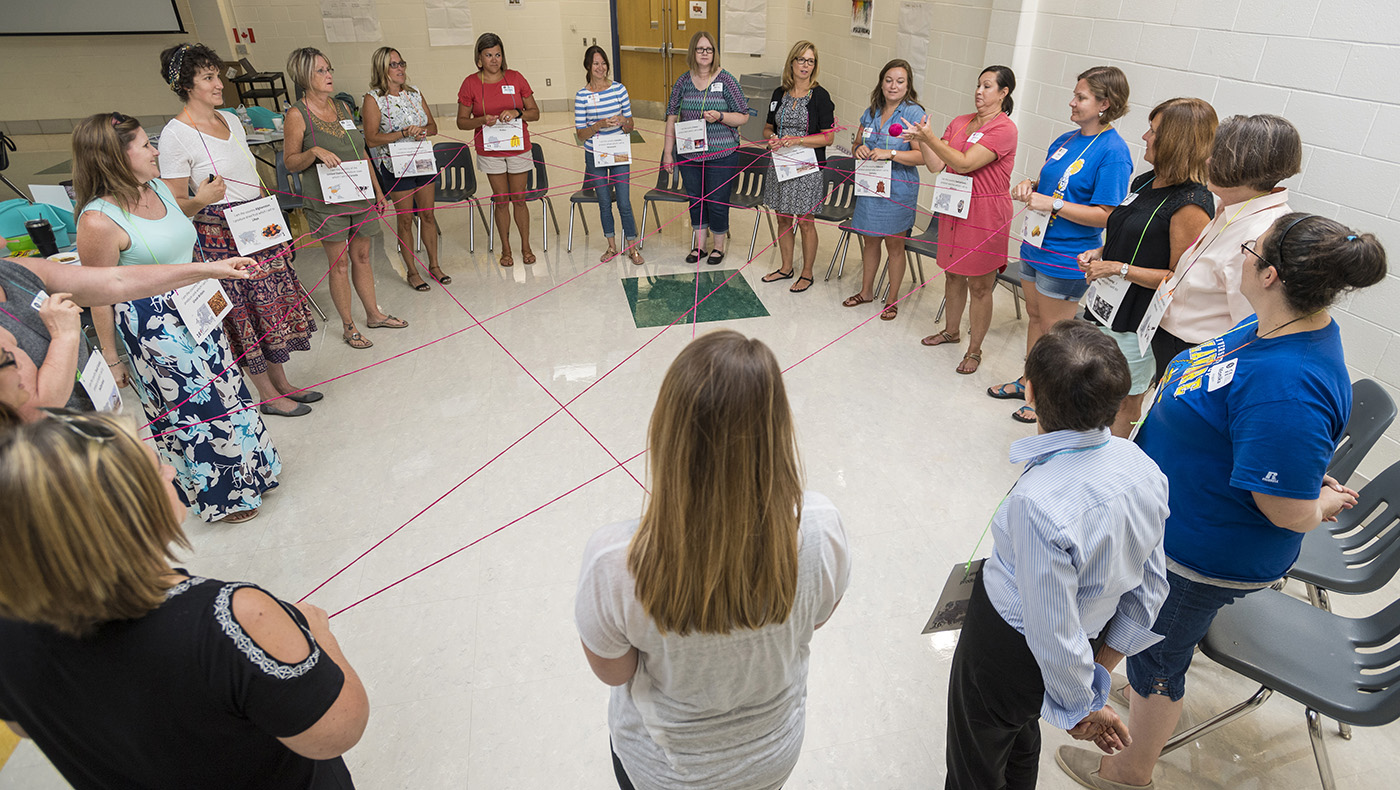
Since 2012, Economics for Kids (EFK), one of the signature programs of the Center for Economic Education and Entrepreneurship (CEEE) at the University of Delaware’s Alfred Lerner College of Business and Economics, has successfully taught critical economic concepts to more than 3,000 kindergarteners and first graders across Delaware.
Administrators whose schools were using EFK in kindergarten and first grade realized that, without EFK curricula for each grade moving forward, students could lose grasp on their comprehension of the standards. The state of Delaware tests specific economic standards, which outline what students should be learning in each grade, as part of the social studies curriculum requirements for public schools.
According to the supervisor of curriculum and instruction for the Colonial School District, Nicholas J. Baker, “The goal of these resources [(EFK)] is to help kids in each grade to prepare for those assessments. Really, preparation should start at an early age and continue building over time.”
For classroom teachers, the need for this program in second grade went beyond meeting the state standards. Virginia Sylvester, a second grade teacher at William F. Cooke, Jr. Elementary School in Hockessin, Delaware noted that, “As an elementary school teacher, I feel that economics is so important for them [students] — not only to understand the standards, but also to build a foundation in economics early on because it’s a part of their everyday lives.”
The challenge that now faced the CEEE team was how to approach creating an effective EFK program for this additional grade. Second grade economic standards include concepts significantly more complex than those presented in kindergarten and first grade. The new program would need to explore previously taught concepts in greater depth as well as introduce new content.
Bringing EFK to the second grade
CEEE’s associate director Bonnie Meszaros collaborated with researcher Amanda B. Jennings to create lessons for second grade to build on what EFK teaches in kindergarten and first grade. Their goal for the program, in addition to meeting state standards, would give students a well-rounded understanding of economics that would be applicable in their lives outside of the classroom. The Delaware Department of Justice’s Investor Protection Unit and Consumer Fraud Divisions and a gift from UD alumna and trustee Donna M. Fontana, class of ’85, also supported their work.
Meszaros, assistant professor of economics, and Jennings, a recent UD grad with a Ph.D. in economic education and master’s in economics and entrepreneurship for educators, identified that existing economics programs for second grade were built primarily on best practice, but not necessarily proven research. They wanted EFK to have a more academic basis to support its lessons and therefore chose to use a research practice partnership approach in the development of the new second grade program. Their approach used a design-research variant of the partnership, where co-design and collaboration took place throughout the entire process, with teachers not only implementing the curriculum in their classrooms but also providing feedback before and after the lessons. All of this refined the final product.
Jennings said that she wanted the program to be user-friendly: “We viewed the districts as partners in developing this. We were able to identify what their needs were: a readily available curriculum package that they are able to easily learn and use. Our goal was to make sure that we were developing lessons that addressed both students’ learning needs and teachers’ teaching needs.”
The CEEE team began the research practice partnership process by identifying the prioritized benchmarks for second grade within the state standards for economics. They built a set of six lessons around grade-appropriate children’s books that provided an opportunity to teach the benchmark concepts. Once they prepared these lesson sets, they piloted them in Delaware classrooms.
Piloting the programs in Delaware classrooms
The CEEE offered a select group of teachers extensive professional development training on the EFK program, delivering to them complete kits of books, lessons, activities and student assessments. Those teachers then taught the lessons in their classrooms while Jennings and Meszaros observed and recorded them. After each class, together they discussed the teacher’s experience working with the curriculum and closely evaluated the student assessments.
“Amanda and Bonnie truly wanted my feedback; not only did they listen to me afterwards, but they would sit down with me beforehand to go over the lessons I was about to deliver,” said Margaret Brady, a second grade teacher at Richey Elementary School in Newport, DE who piloted the program. “It was very refreshing to have that relationship with them– to not only reflect on how things went but to also be given the opportunity to help make things better along the way.”
Sylvester, who also piloted the program, added, “They were very prepared, bringing materials and well thought out presentations. They made the piloting process very easy for me. It was amazing to have such knowledgeable professionals effectively model how to teach these economics lessons. It was so beneficial for me personally, growing and getting a better handle on the standards…They were willing to accommodate any requests I had and were responsive in welcoming my feedback.”
Pilots show progress
With each new phase of the piloting process, students answered more questions correctly in post versus pre-testing. Baker said that in his district, the results of the program went beyond positive assessments. “One thing I can say is that I’ll be attending activities across our district and I’m observing kids actually discussing economic concepts. They’re going home and talking about their economic wants, or types of money, or trade or topics like interdependence and so on. The kids are comfortable discussing these concepts because they understand them.”
Teachers are now using EFK in the City of Wilmington and City of Newark– both UD Community Engagement Partnership areas– with eight schools currently using the curriculum and with plans to partner with additional schools in the coming year.
Some district leaders have also requested a third grade EFK program. Using the same research practice partnership approach, the CEEE expects to be able to successfully work with teachers and districts to create lessons that meet state, school, teacher, and most importantly, student needs. The program is already in development with plans to introduce the curriculum to third grade teachers in the spring of 2019. In the meantime, Jennings and Meszaros are focused on and excited about training more teachers throughout Delaware on the recently released second grade program.