


Working in a team of people with different backgrounds and individual objectives is often a difficult but necessary part of being a professional. Add into the mix the competitive and high-pressure environment of a drone company, and you have quite the challenge.
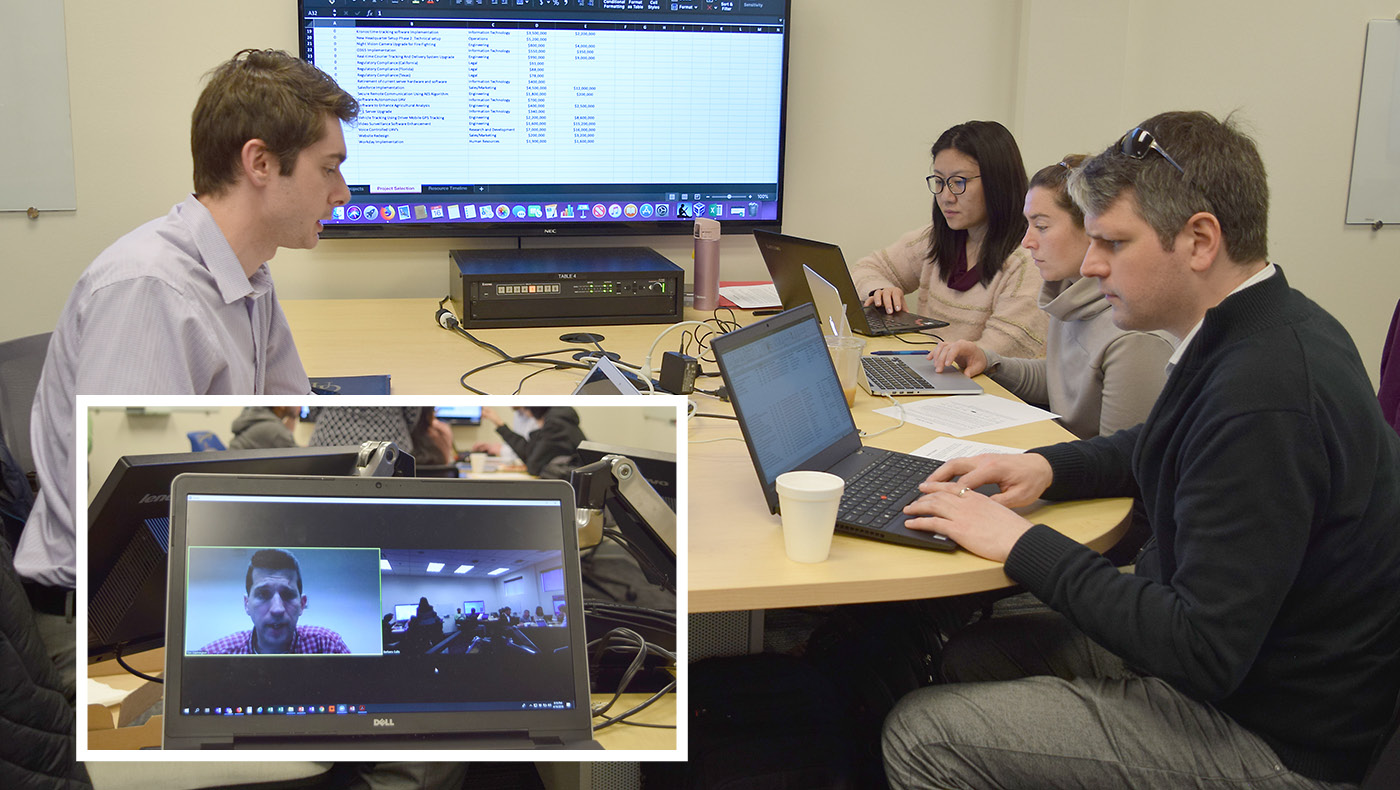
That is exactly what MISY840, a graduate course on IT Project Management at the University of Delaware’s Alfred Lerner College of Business and Economics, tasked its MBA and M.S. in information systems and technology management (ISTM) students with for a Project Portfolio Management (PPM) workshop. PPM is the management of one or more project portfolios in a centralized manner to accomplish strategic goals in order to move easily between strategy and implementation. In the workshop, students formed teams and used a project management software, developed by Acuity PPM, to manage portfolios for a hypothetical mid-market drone manufacturing company.
Founder and CEO of Acuity PPM Tim Washington joined the class remotely from Seattle, WA each week to co-lead the workshop with Barbara Cullis, faculty program director of the Global Enterprise Technology (GET) program GET and MIS and instructor of the MISY840 course.
“We want to promote the importance of teaching PPM skills for MBAs, ISTM and other graduate programs,” Cullis said. “[These skills] can be directly applied by the graduate students in the workplace. Some have leveraged the knowledge in job interviews, and others who are currently employed will be applying the skills at their companies and collaborating with all of the key players.”
Washington is also a senior associate with Point B, an integrated management consulting firm. Acuity PPM provides light-weight portfolio management software to early-stage project teams.
“The first time the simulation was offered was in spring 2018, and it was 100% Microsoft Excel-based,” Cullis explained. “Tim started developing the Acuity product to meet market demands later in 2018… Now we are using Acuity PPM for round one of the simulation. This lifts the quality of simulation from Excel to a professional PPM software product now used in industry.”
“This tool is pretty cool actually if you have to go and make a portfolio,” said Amit Dahra, who will graduate in 2019 with an MBA. “In a portfolio there are a lot of projects and it’s not easy to see, ‘What are the problems?’ or, ‘How do the projects overlap?’ ‘What are the priorities?’ ‘How are the departments coming together?’ and looking at one picture in this tool, you can see fully the dashboard of all of the projects, which is so helpful.”
During this project, students took on the role of different executives within a hypothetical drone manufacturing company. They received individual profiles that included backgrounds and agendas for each executive to help them take on the persona. Students also started with a company background, strategic objectives and a budget.
“The ISTM students have their own perspective… and I have my own perspective,” Dahra noted. “I have over 19 years of work experience as well, so I bring my experience into this work, and they bring their fresh perspective looking at things. I think it’s a good collaboration. We are able to come to a better conclusion moving forward, so it’s a great program working together.”
“It’s definitely fun [working with MBA students] because it provides a little more context,” Melissa Ann Gartland, M.S. in ISTM Class of 2019, said. “A lot of us in the ISTM program are very technically minded and we tend to think about just the hardware or just the software, and that’s our tunnel vision. Bringing in the MBA students, from their perspective you can start to see how those decisions will affect the larger business where you’re working.”
As an executive team, students decided how to operationalize their strategic plan. This took negotiation as each executive had specific needs and interests assigned to their role. Additionally, in round one, their budgets were constrained with a cap on research and development. Then, in round two, both their budgets and human resources were constrained, which made portfolio creation much more difficult.
“Hope is not a plan; I like that saying, Washington said as he introduced round two to the class. “I think given the project management portion of [MISY840] you understand about having the right people on your team and creating a plan, but at the portfolio level it’s about taking those plans and realizing ‘How realistic is it?’ and ‘What adjustments do we need to make to realistically execute the portfolio?’”
The students overcame the obstacles of each round to create strategic objectives relevant to drone companies today, including objectives such as supporting delivery for Amazon, national security and surveillance for the Department of Defense, applications in agriculture and more. Using the PPM software, each team planned a corporate portfolio and juggled risk and resources to achieve their strategic plan.
“Stepping into the role and having to keep your project in contention, in addition to keeping in mind other people’s [projects], while having tightening constrictions, it’s almost like a puzzle getting everything to fit the right way, so that part’s really cool,” Gartland said. “It’s almost like a ‘day in the life,’ but without all of the pressure. So, it’s been just really good exposure to something we’ll need to know how to do once we’re out in the workforce.”