


This article was written by Kim Asarta.
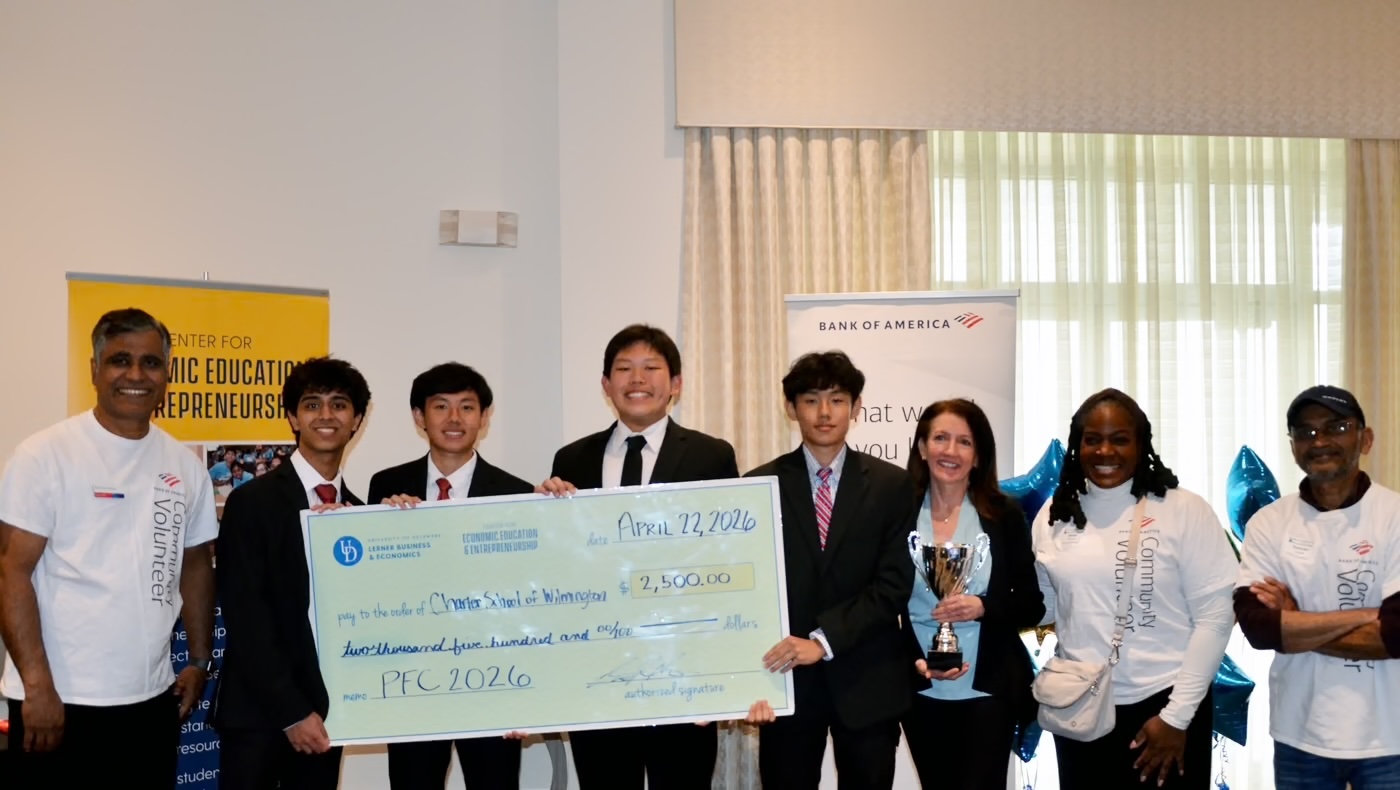
When students from The Charter School of Wilmington won the 2026 Delaware Personal Finance Challenge, they didn’t just earn a state championship; they demonstrated the financial knowledge and decision-making skills needed to navigate life’s biggest financial decisions.
Coached by Susan Clough, the championship team of Andy Lee, Jason Lee, Rishab Arora and Ethan Xie advanced to the National Personal Finance Challenge in Atlanta, where they placed second among 37 teams. After entering the final question tied for first place, the team narrowly missed capturing the national championship.
Hosted by the University of Delaware’s Center for Economic Education and Entrepreneurship (CEEE) and sponsored by the Delaware Council on Economic Education through financial and volunteer support from Bank of America, the Personal Finance Challenge allows Delaware high school students to apply classroom knowledge to realistic financial situations. Through written case studies, financial trivia and a championship quiz bowl, students develop practical skills they will use throughout their lives.
The competition comes at a time when financial literacy has become increasingly important. Rising housing costs, student loan debt, healthcare expenses and everyday living costs require young adults to make informed financial decisions earlier than ever before.
Michelina Irons, a teacher at Cab Calloway School of the Arts, said many students underestimate the long-term impact of major financial decisions.
“Students are often unprepared for the impact of large purchases and student loans,” Irons said. “The program helps them understand the consequences of those decisions.”
Elizabeth Bear, also a teacher at Cab Calloway School of the Arts, said the competition encourages students to think critically about financial choices before making them.
At The Charter School of Wilmington, Clough said students gain a deeper understanding of how economic factors affect everyday life.
“Personal Finance helps prepare students for the realities of living independently and managing their financial responsibilities,” Clough said.
Chris Holler of Odyssey Charter School said he sees a noticeable change in students after participating in the program.
“Students approach financial decisions with their eyes open,” Holler said. “They develop a stronger appreciation for avoiding unnecessary debt and understanding the long-term effects of saving and borrowing.”
Beyond building financial knowledge, teachers said the competition encourages conversations that extend beyond the classroom.
Irons said students become more confident discussing financial topics with their families, helping reinforce healthy financial habits at home.
Each year, teams from schools across Delaware begin with an online qualifying round before advancing to the in-person state competition. The experience challenges students to analyze financial scenarios, solve complex problems and demonstrate their understanding of personal finance concepts under pressure.
For Bear, the competition complements classroom instruction by giving students an opportunity to apply what they have learned.
“The content in the Personal Finance Challenge reinforces and extends what students learn in financial literacy classes,” Bear said. “The competition format keeps students engaged.”
William Penn High School teacher Jessica Sawyer believed those lessons have lasting value.
“Students learn skills and topics that they can take into the real world and beyond,” Sawyer said.
Irons agreed.
“It’s the single most important course a student will ever take,” she said. “The knowledge students gain benefits not only them, but their families as well.”
As financial decisions become increasingly complex, programs like the Delaware Personal Finance Challenge help equip students with the knowledge, confidence and critical thinking skills needed to make informed decisions throughout their lives.