


This article was written by Kim Asarta.
Before arriving at the University of Delaware for the Siegfried Youth Leadership Program (SYLP) Economics Camp, Joseph Bratteson hoped to better understand economics, leadership and himself.
Bratteson was one of many students who arrived with clear goals for the week. Ayaan Shah wanted to explore how economics shapes everyday life, while Jovanna Parrish hoped to build knowledge that would support her interest in corporate law. By the end of the week, each student had gained something different and more than expected.
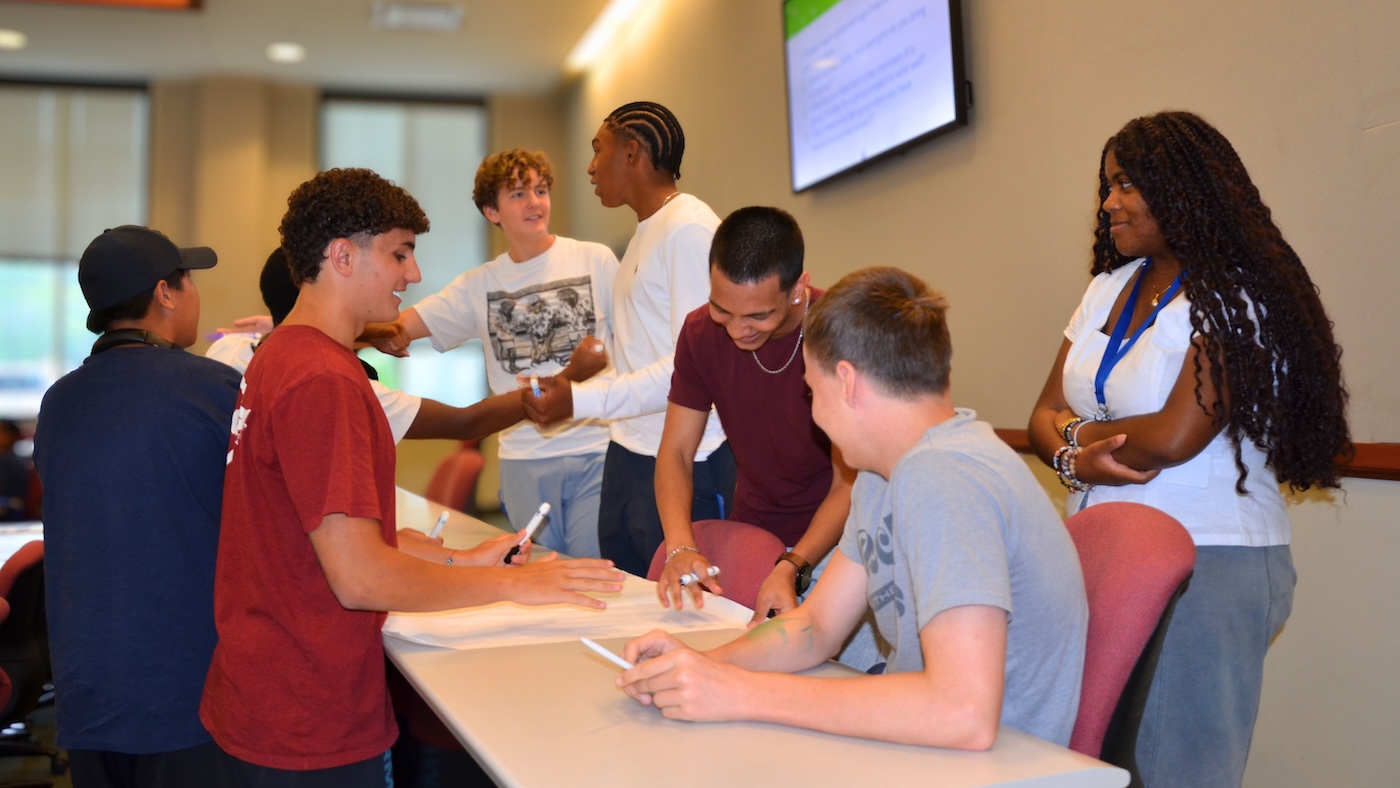
Hosted by the University of Delaware’s Center for Economic Education and Entrepreneurship (CEEE) and sponsored by Rob and Kathy Siegfried, the camp combines economics and leadership instruction with hands-on simulations, discussions with business and community leaders, and an opportunity to experience college life.
CEEE Instructional Designer Kylee Holliday said students demonstrated that enthusiasm throughout the week.
“I was blown away by the engagement of the students that attended the SYLP camp this year,” she said. “During lectures and simulations, they asked intriguing questions, added great insight to discussions, and were clearly eager to learn.”
That engagement took different forms for each student.
Personal growth and college life
For Bratteson, attending the SYLP camp was an opportunity to learn more about economics, college life and himself.
“I feel the SYLP program will help me become the best version of myself,” he wrote in his application. “It is my hope that this summer camp will help me deeply understand economics, leadership and most importantly, myself. This could be the first step to finding my place in the world both personally and professionally.”
By the end of the program, Bratteson said SYLP “gave me knowledge and it opened my eyes to so many aspects of life that I had never seen.”
The experience extended beyond the classroom. Living on campus gave him his first look at what college life might be like.
“I loved staying in the dorms so much because it gave me an opportunity to see what college dorms are like for the first time.”
A new perspective on leadership
Shah arrived interested in how economics can explain the decisions people make and why opportunities differ among communities.
“I am interested in economics because it explains the reasoning behind decisions that shape everyday experiences. Why certain opportunities exist in some places and not others, how trade-offs are made, and how policies impact people differently. At the same time, I see leadership as the ability to take those ideas and communicate them clearly, listen to different perspectives, and contribute meaningfully in a group setting.”
After participating in SYLP, Shah said the experience made him more confident about taking risks. It also broadened his definition of leadership.
“Always be open to take risks. Being a leader doesn’t always mean being in the front, sometimes it means taking a step into another role.”
Connecting financial knowledge to future goals
For Parrish, the opportunity to study economics and leadership connected directly to her professional goals.
“I hope to gain a stronger foundation in economics while refining my leadership skills. I plan to pursue a career in law, particularly corporate law, where economic literacy is essential. A deeper understanding of financial incentives and strategic decision-making would allow for approaching complex situations with greater insight.”
By the end of the week, Parrish said she had gained a deeper understanding of financial independence and economics while expanding her professional network.
“Over the course of this week, I accrued more knowledge in financial independence and economic freedom, more than I ever did in my finance literacy class. What a great program! I also had many opportunities to network.”
Josh Dalton, a University of Delaware alumnus and professor of economics at the University of Tennessee, Knoxville, said students’ growth extended beyond economics and financial literacy.
“Students show growth in how intentional they will be as they finish high school, how they commit to comparing their actions to their priorities and to realign them when they differ.”
Although students arrived at SYLP with different goals, they left with greater confidence, stronger leadership skills and a deeper understanding of economics and financial literacy. Their experiences illustrate how the program helps young people connect classroom concepts to future careers and personal growth.