


This article is written by Cori Buchman.
Posters in hand and pitches prepared, a team of four fourth graders approached a panel of judges before breaking into a jingle.
“Recycle every day and you also get to play with the Fidget Cube!” said team 423 from West Park Place Elementary School in Newark.
“It’s a cube made out of plastic bread tags. On one side it has a pop-it, on another a fidget spinner, a light switch and a squishy. It can keep you entertained for hours,” said one student, with all the showmanship in a real commercial.
Successful entrepreneurial ideas rarely appear fully formed. They emerge through collaboration, creativity and repeated problem solving. The University of Delaware‘s 38th annual Meaningful Economics (ME) Competition, hosted by the Center for Economic Education and Entrepreneurship (CEEE), gives Delaware elementary students an opportunity to apply concepts in economics, personal finance and entrepreneurship to real-world challenges.
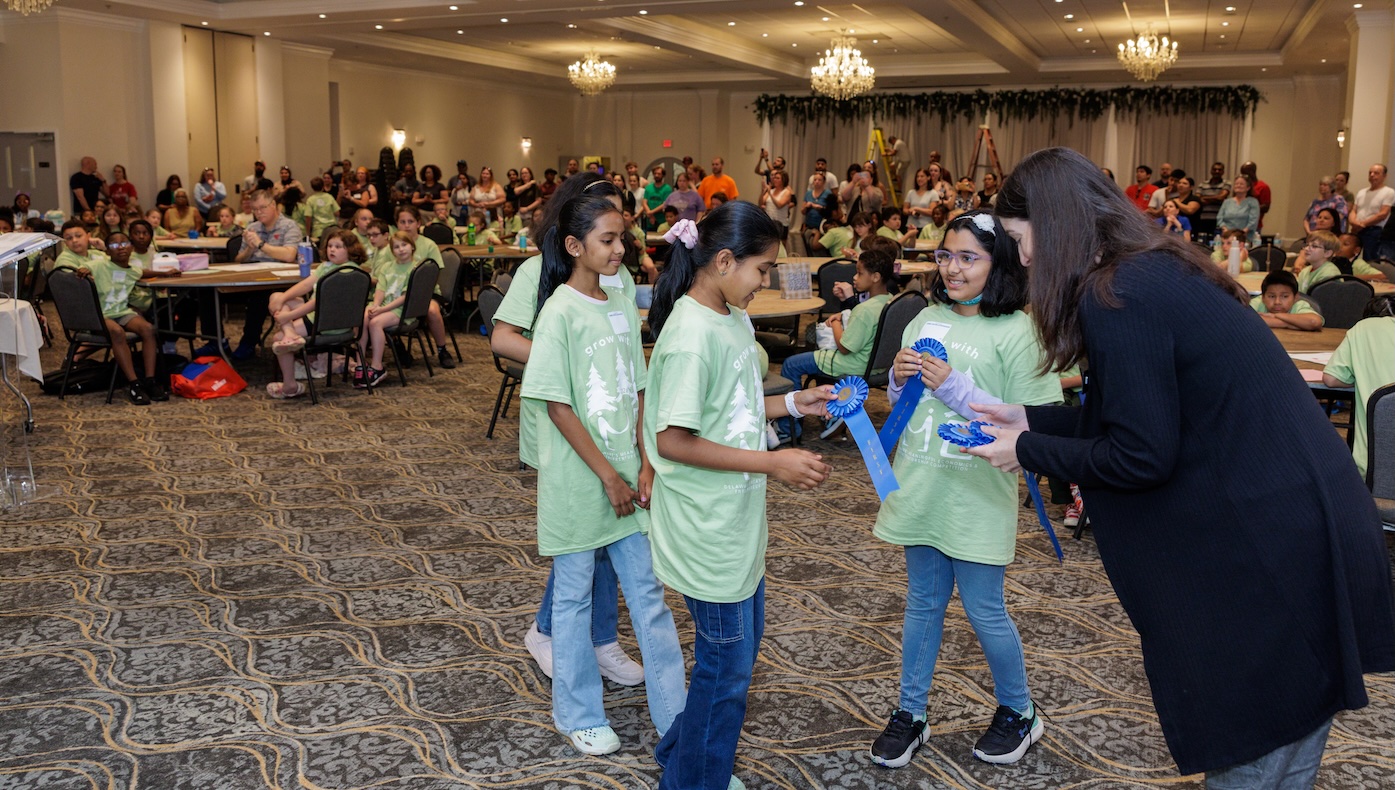
Sponsored by the Delaware Council on Economic Education, Bank of America and Discover Bank, the competition brought more than 400 third-, fourth- and fifth-grade students to the Executive Banquet and Conference Center in Newark for three days of competition, followed by a fourth day in Georgetown for southern Delaware schools.
During the entrepreneurship challenge, students designed a product, created a poster advertisement and delivered a commercial-style pitch before a panel of judges. Fourth graders focused on reducing plastic pollution by reimagining uses for plastic bread tags, which are typically not recyclable.
Some teams attempted to solve the problem by upcycling the bread tags into new, innovative products. Team 422, also from West Park Place Elementary, pitched their product Crafter Nafters, a modeling kit that reuses the tags.
“Have you ever been super bored? Well, you can use the colorful bread tags to make new creations. It’s so fun and easy to make. Crafter Nafters keeps you entertained so you don’t throw them away,” said one student.
Their business plan called for collecting discarded bread tags, packaging them into craft kits priced between $5 and $15 and directing customers to online tutorials. The group developed a product that appealed to both crafters and environmentalists, and provided a solution that transformed harmful trash into eco-friendly art.
Team 409 from William B. Keene Elementary School in Glasgow took a similar approach through their product Cool Bread. Sold alongside loaves of bread for an extra dollar, their idea repurposed bread tags into jewelry with interchangeable gems that fit into the grip and a QR code linking to weekly discounts, rewarding consumers for their continued commitment to sustainability.
“We decided to create Cool Bread because we needed to find a way to keep these bread tags. We made this to make sure people can pass them along for years and years so they don’t get thrown away or go to waste,” said one teammate.
Although the team did not advance to the final round, its presentation demonstrated an understanding of target audiences.
“[Cool Bread] is mostly for children who want to wear it as a bracelet or necklace, and then the rewards are for the grown-ups who can use the discounts at the store where they bought it,” said another teammate, showing how their group considered the needs of two demographics.
Their business model also reflected sophisticated marketing concepts, including collectible products and surprise packaging designed to encourage repeat purchases. While the students may not know the formal terminology, they instinctively applied strategies commonly used in today’s consumer marketplace.
Another team, from Las Americas Aspira Academy in Newark, proposed Clipper Bread, a reusable bread clip created by melting and reshaping discarded bread tags.
“We take your bread tag and then we melt it and turn it into a clip that is reusable for your bread,” said a student from Las Americas Aspira Academy. While Clipper Bread may serve a similar function, it demonstrated how the students used product innovation to develop an eco-friendly alternative to bread tags that could reduce reliance on them and potentially replace them.
Apart from practicing the problem-solving skills of an entrepreneur, the students also gained practical skills from the other challenges.
“My students rarely have opportunities to pay with cash. That basic building block of economics is missing so a hands-on competition is so valuable,” said Thurgood Marshall Elementary School teacher Liles Puleo, who also appreciates that her students get to practice fine motor skills in the production activity given the prevalence of digital learning.
The competition also recognized outstanding performances. Team 423 placed first in the fourth-grade written test and second in the entrepreneurship challenge. In Georgetown, a team from John M. Clayton Elementary School won the production challenge across all three grade levels, demonstrating the value of practice, teamwork and division of labor.
“Students are motivated to come to this competition, to compete with friends and work through hands-on problems. The motivation makes a huge difference,” said Puleo.