


This article was written by UD’s Center for Economic Education and Entrepreneurship staff.
What can an unattended Halloween candy bowl teach students about economics? Quite a bit, it turns out.
From the temptation to take an extra piece of candy to the incentives that shape our decisions, everyday experiences can help students understand economic concepts in unexpected ways.
“I can even apply this to my kindergarten Econ unit,” wrote Karin Corbin, a kindergarten teacher at Lancashire Elementary School, after participating in a Halloween-themed economics activity.
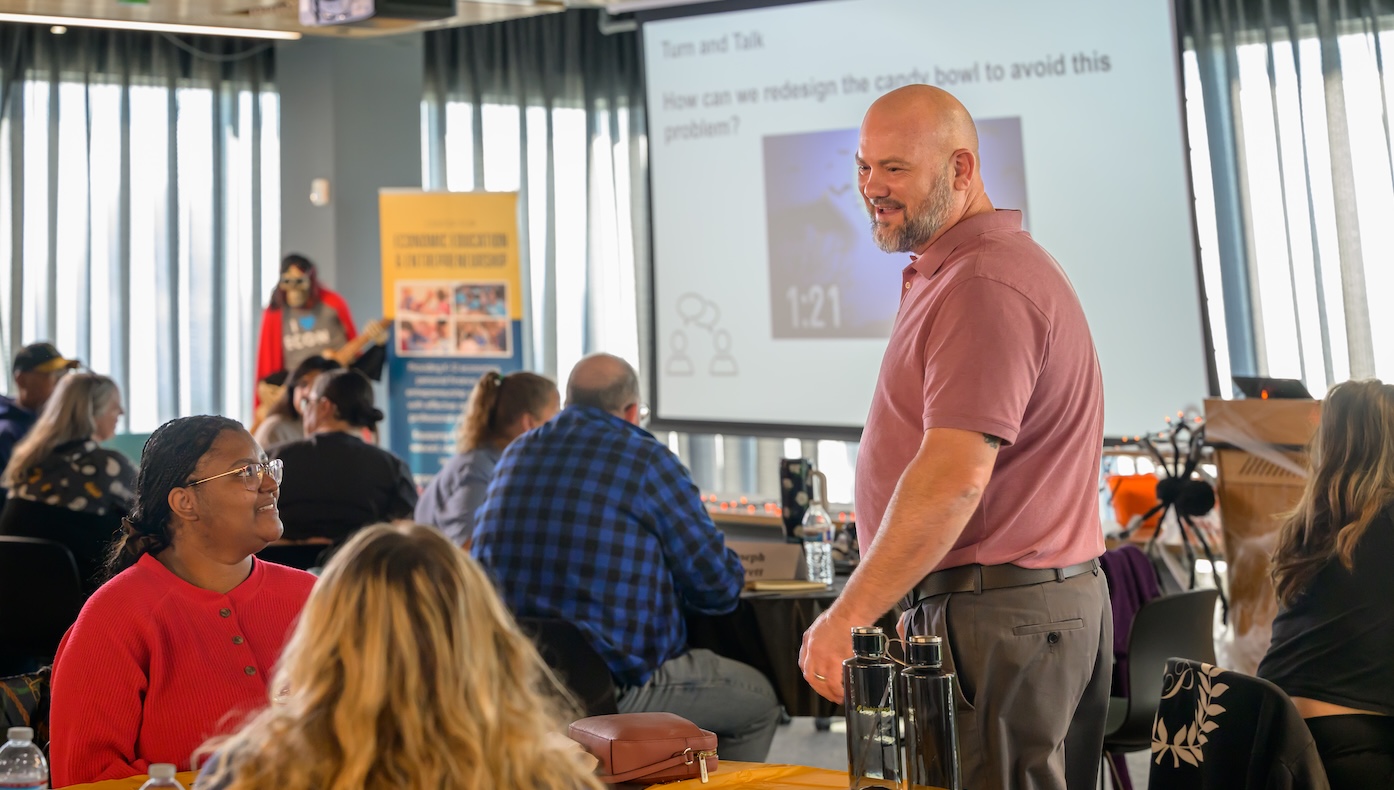
Corbin was among the Delaware educators who attended Econ-O-Ween, a fall mini-conference hosted by the University of Delaware‘s Center for Economic Education and Entrepreneurship (CEEE) to help K-12 teachers bring economics and personal finance concepts into their classrooms.
The conference was sponsored by the Delaware Council on Economic Education, with support from Robinhood, YourMoney101 and the Council for Economic Education.
“Econ-O-Ween was created to give educators at every grade level a professional learning experience they can adapt for their students, from kindergarten through high school,” said Amy Krzyzanowski, CEEE assistant director.
Through interactive sessions inspired by Halloween and other familiar experiences, teachers explored creative approaches to teaching behavioral economics, inflation, purchasing power and other economic concepts.
Mario Tiberi, a teacher at St. Georges Technical High School and a CEEE instructional fellow, led a session titled “Behavioral Economics and the Unattended Halloween Candy Bowl.” Teachers explored the intersection of psychology and economics through a familiar Halloween scenario, examining how present bias, social norms, incentives and the way choices are presented influence decision-making.
For Tiberi, the session also demonstrated the value of educators learning from one another.
“It was so much fun exploring behavioral economics together, exchanging classroom strategies, laughing, and collaborating. It reminded me that some of the best professional learning happens when we learn not only about a subject but also from one another,” he said.
Throughout the conference, teachers experienced activities from their students’ perspectives, allowing them to consider how the lessons might work in their own classrooms.
Xiaolin Huang, a teacher at William Penn High School, appreciated the opportunity to participate in classroom demonstrations as a student would, experiencing a fully developed lesson firsthand.
Sheila Jackson, an educator at Claymont Elementary School, shared that enthusiasm.
“I love the way the session is structured. It is so enjoyable,” Jackson said.
Other sessions demonstrated how hands-on activities can make more complex economic concepts accessible.
Scott Furman, a teacher at Woodbridge Middle School, found practical classroom applications in Elizabeth Bear’s session, “Elasticity: Not-So-Scary.”
“The breakdown of elasticity was really cool. I think the resources are great and definitely something I can incorporate,” Furman said.
In another session, “The Great BOO-rito Debate,” teachers used the example of a $20 burrito to explore inflation, real wages, purchasing power and affordability.
The session, led by CEEE instructional designer Kylee Holliday and Scott Bacon, CEEE’s Bonnie T. Meszaros Associate Director, connected economic principles to a familiar question: Why do everyday purchases seem to cost so much?
Timothy Werbrich, an educator at Leisure Elementary School, appreciated the lesson’s practical approach.
“I thought the burrito lesson and understanding inflation was very helpful,” Werbrich said.
For conference organizers, those connections between economic concepts and everyday experiences are central to helping educators make the subject relevant to students of all ages.
“What makes Econ-O-Ween so engaging is that it takes economics and financial literacy topics and brings them to life through fun and engaging hands-on activities. Teachers get to experience these activities as learners, which helps them see how they will translate in their own classrooms,” Holliday said.