


U.S. Election Day, November 5, 2024, is quickly approaching and every vote will be important. In Delaware, not only will state citizens help elect the next U.S. President, but also Delaware’s next Governor.
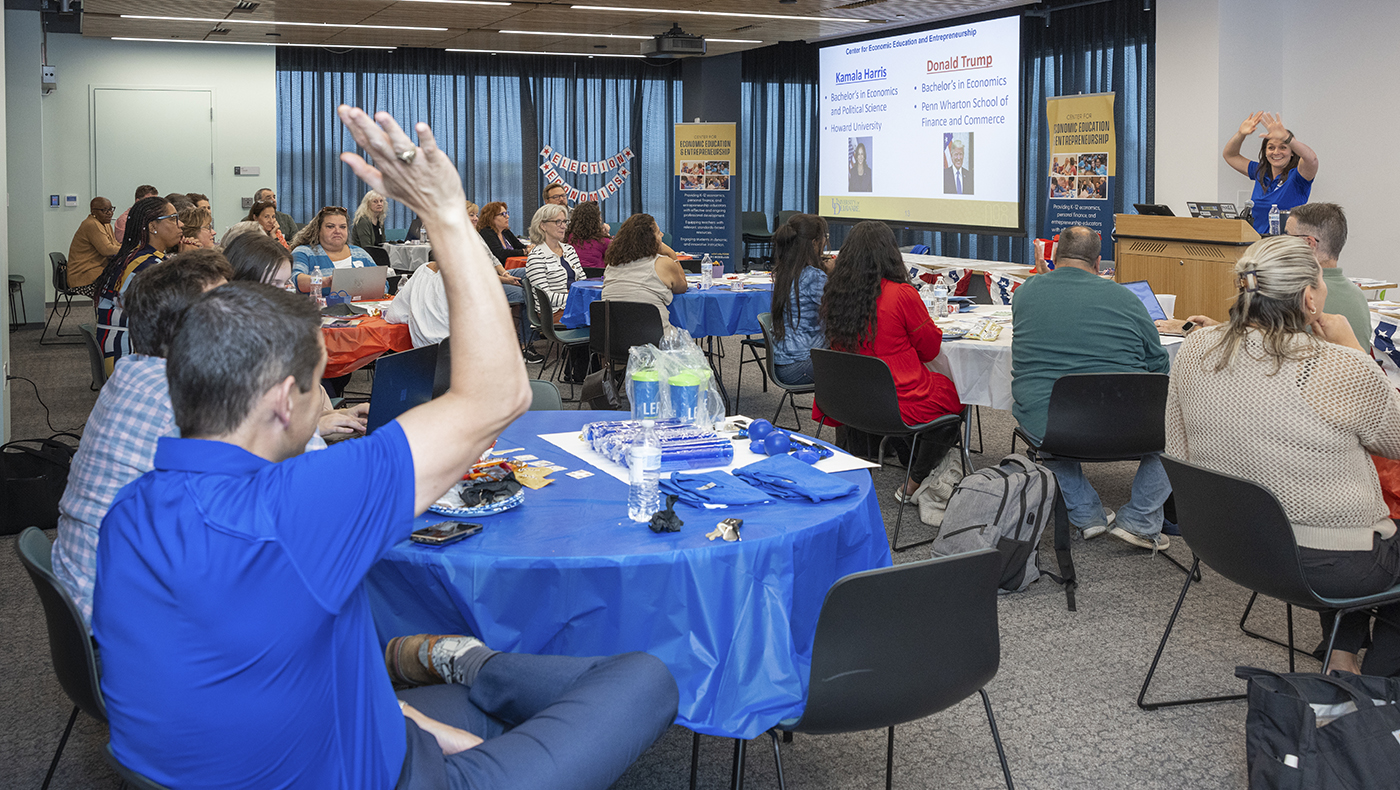
Elections, whether they are at the national level or local level, affect the young and old alike. As a way to help K-12 teachers in the state of Delaware guide discussions with their students about the elections, UD’s Center for Economic Education and Entrepreneurship (CEEE) hosted Election Economics in September, as a way to kick off the school year.
CEEE’s Assistant Director Scott Bacon and Instructional Designer Amy Krzyzanowski led the event, which was attended by 28 teachers.
“By learning more about how economics is tied to our political system, teachers are better prepared to take what they learn and incorporate it back into the classroom,” Bacon said. “Middle and high school students are the next generation of voters, so it is important that they are educated on the relationship between our economy and the politics of our country.”
By utilizing current events such as the upcoming presidential election, CEEE’s objective is to help teachers deliver relevant economic education throughout K-12 schools while simultaneously highlighting how it relates to the political climate. Through these efforts, CEEE hopes to create more informed, responsible voters and citizens. The event gave teachers strategies for talking about elections in relation to economics when they return to the classroom.
First, Bacon and Krzyzanowski asked teachers to name the economic issues that they found to be most important, one of the most common answers being inflation. Teachers in attendance then listed potential reasons for why some citizens choose not to vote, with the main reasons being indifference, inaccessibility and other conflicts.
Information and statistics about voters and economic issues related to voting were then shared with attendees to give them a better understanding of how the economic state of our country is directly tied to the political climate. Teachers in attendance had a chance to openly discuss their thoughts with one another.
Judith Anderson-Bruess, a sixth grade social studies teacher at Las Americas ASPIRA Academy spoke on the importance of teaching students about voting.
“It’s something that they need to know…They need to know how to talk about it civilly,” she said.
Anderson-Bruess also highlighted how some adults do not understand how elections work, and may not have much economic education. Teaching this topic to students can create a generation of people who are able to cast more informed votes.
The lesson is not just for students’ benefit, however. Anderson-Bruess talked about how she chose to attend the Election Economics lesson to gain some tips on bringing economics and elections together into the classroom.
“My students can better understand, so I can better understand, as well,” Anderson-Bruess explained.
Bacon and Krzyzanowski also demonstrated various teaching activities that can be used in classrooms. One of the lessons Krzyzanowski presented was called “Campaign Finance Chat & Chew,” where students are instructed to conduct research on the history of campaign finance in the U.S. This helps portray the extent to which money impacts political campaigns, and students are able to discuss and form arguments within small groups while enjoying snacks.
Bacon and Krzyzanowski also had the teachers participate in the activities themselves to better understand how they could structure them in their own classrooms, then explained how it could be modified for different grade levels. By fostering these discussions within the classroom, students will be more prepared to engage in civil discourse.
Stella Evans, a personal finance teacher to middle and high school students at Silver Lake Treatment Center, stated how students tend to be intrigued by money. According to Evans, “relating topics in school to money are more likely to grab students’ attention. Incorporating economics education into elections can make students more informed, both as future voters and as citizens.
“The more exposure they have, the better off they’ll be,” Evans said.
Joseph Flamer, a teacher at Smyrna Middle School, also shared his thoughts on the importance of CEEE’s presentation.
“Even though our students are not voting at this point it’s important for them to have the foundation of why it’s important to vote,” Flamer said.
Bacon and Krzyzanowski concluded their lesson by summarizing key economic indicators that may be helpful for students to learn and be familiar with: unemployment rate, inflation rate, and real GDP. By teaching students a general understanding of these terms, they are already better equipped to make informed voting decisions once they are of age to vote.
“Economics is directly tied to who they’re going to be electing into office,” Flamer said.