


This summer, students from the University of Delaware’s Alfred Lerner College of Business and Economics discovered new avenues for professional preparation and practical hands-on experience. Lerner College students pursued an array of internships, externships and other professional development opportunities. From MBA scholars to undergraduates entering their second year at UD, students across a spectrum of Lerner programs shared their experiences accomplishing an assortment of projects.
Our “My Summer Internship” series highlights these unique experiences, showcasing how students translated classroom knowledge into real-world success.
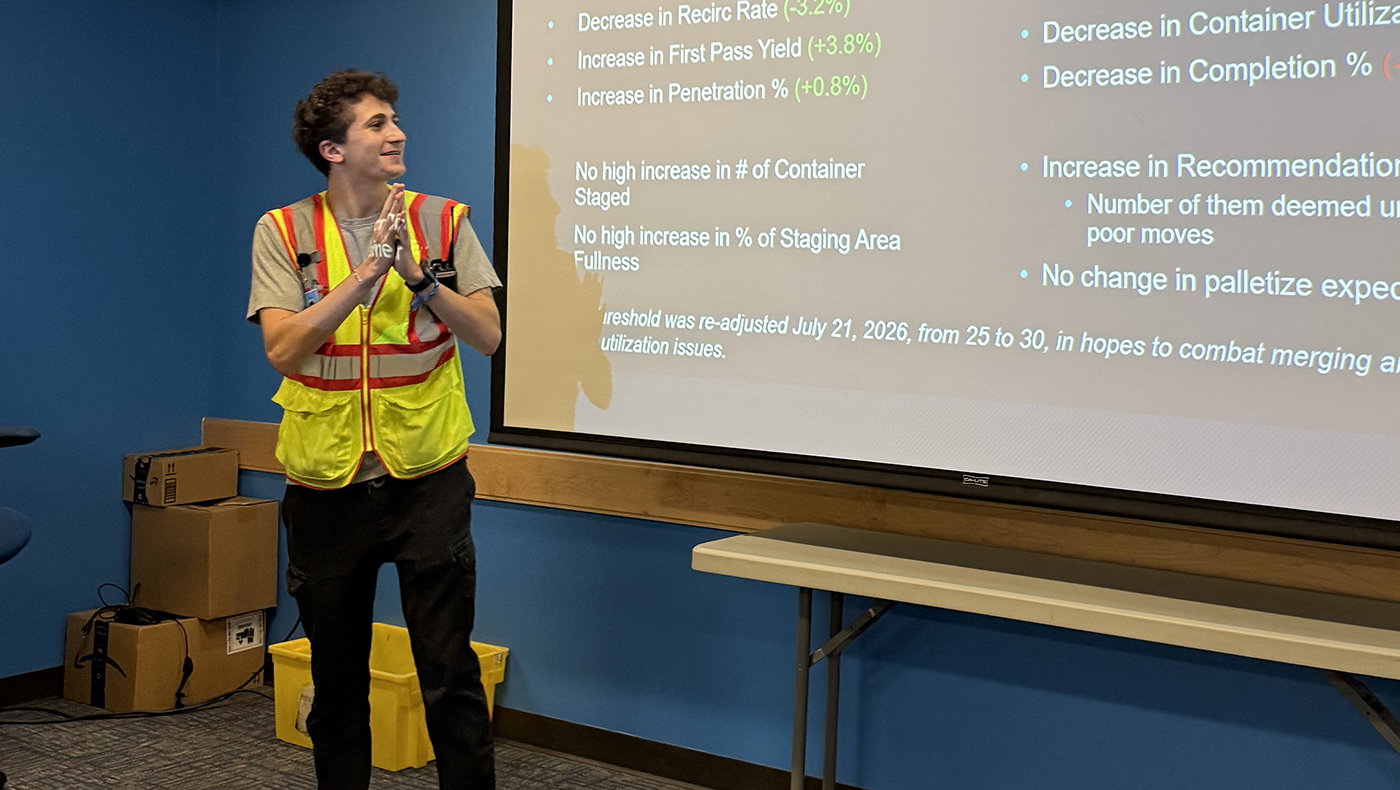
Quinn McCormack, Class of 2027, operations management major with a minor in entrepreneurship, spent his summer as a area manager intern at Amazon.
Lerner: How did you find out about this internship? Why did you pursue it?
McCormack: I initially found the internship on a LinkedIn posting and then applied to it on Amazon’s website. I wanted to pursue this specific opportunity as I had not had direct experience in working in supply chain yet, and figured if I were to start somewhere, why not start with one of the largest companies to do it.
Lerner: What was the most exciting task or project that you completed?
McCormack: For the summer, I was assigned a project that, to put simply, analyzed their AI-driven software that determines where the packages on the conveyor belts in their ship dock (outbound) area need to be directed to. My job was to see why the software was allowing a high number of these packages to be recirculated on the conveyor belt, rather than be directed to the necessary station to be palletized on a cart or loaded in a truck. To do so, I had to shuffle through a ton of data (which Amazon does a great job of tracking for everything you could imagine) and begin mapping out realistic adjustments to either the software or their current operations to increase the package throughput.
Lerner: What did you learn from the internship that you think you would not have learned elsewhere?
McCormack: Throughout the summer, I had to learn how to be very self-diligent and reliable, as this role was very focused on my individual project. The reason why Amazon specifically taught me this so well was because I had to shift my initial assumption going into this role that it would be a shadowing opportunity with my manager or that I would work alongside them all day. Instead, it consisted of me having to problem-solve issues that I had just learned about and somehow come up with an improvement plan for a multibillion-dollar company. I needed to rely on myself to stay on task and speak up if I was stuck on something because, if I sat silently, I would remain stuck; the squeaky wheel gets the grease.
Lerner: What is an example of a time where you were able to apply what you’ve learned at Lerner to your role?
McCormack: I utilized a lot of my learnings from my Operations classes specifically in this role, and was familiar with certain terms and tactics they use at Amazon because of classes I took through Lerner, like Six Sigma and continuous improvement. Many of my business classes helped out in one way or another during this internship as most focus on dealing with data and how to handle that data. So, when I was faced with issues in coding, Excel, decision-making, I could refer back to my learnings from those classes and put them to use while on the job. For example, when attempting to compare a few of my improvement ideas, I created a decision tree to try and understand each of those ideas’ further decisions to come from them and the cost of choosing each one.
Lerner: Did you face any challenges during your internship? If so, what was the issue and how did you overcome it?
McCormack: One of the biggest challenges I faced during my internship was getting ahold of certain individuals I needed to help answer a question, grant permissions, or make adjustments so I could test my idea. This became frustrating because, since Amazon is such a large company, it is hard to pinpoint the exact person you need to contact to get something done, so it can feel like you are running in circles. Regardless, I needed to understand that the people I needed assistance from were full-time employees who definitely had many other tasks at hand and could not assist me immediately. Because of this, I became more diligent, tried different avenues, and reached out to other people for answers until I was able to get where I needed to be. I even utilized my network to connect with an intern in Michigan. Together, we developed an improvement idea that we eventually pitched to the senior operations teams at our sites.
Lerner: What are your career plans, and how do you think the internship will push you closer to your career goals?
McCormack: After I graduate in May 2027, I hope to start a full-time role working in operational logistics. I have a knack for dealing with a ton of issues and roles at once, and overseeing a full operation is something that I’m not only a bit used to, but I am very much interested in doing long-term. This experience has helped me shadow what people in logistics roles do and what their day-to-day looks like, as well as understand what comes with such an important role of trying to juggle a lot at once. I feel much more prepared for what’s to come after this year and in my future, especially now after getting this summer experience working at Amazon.