


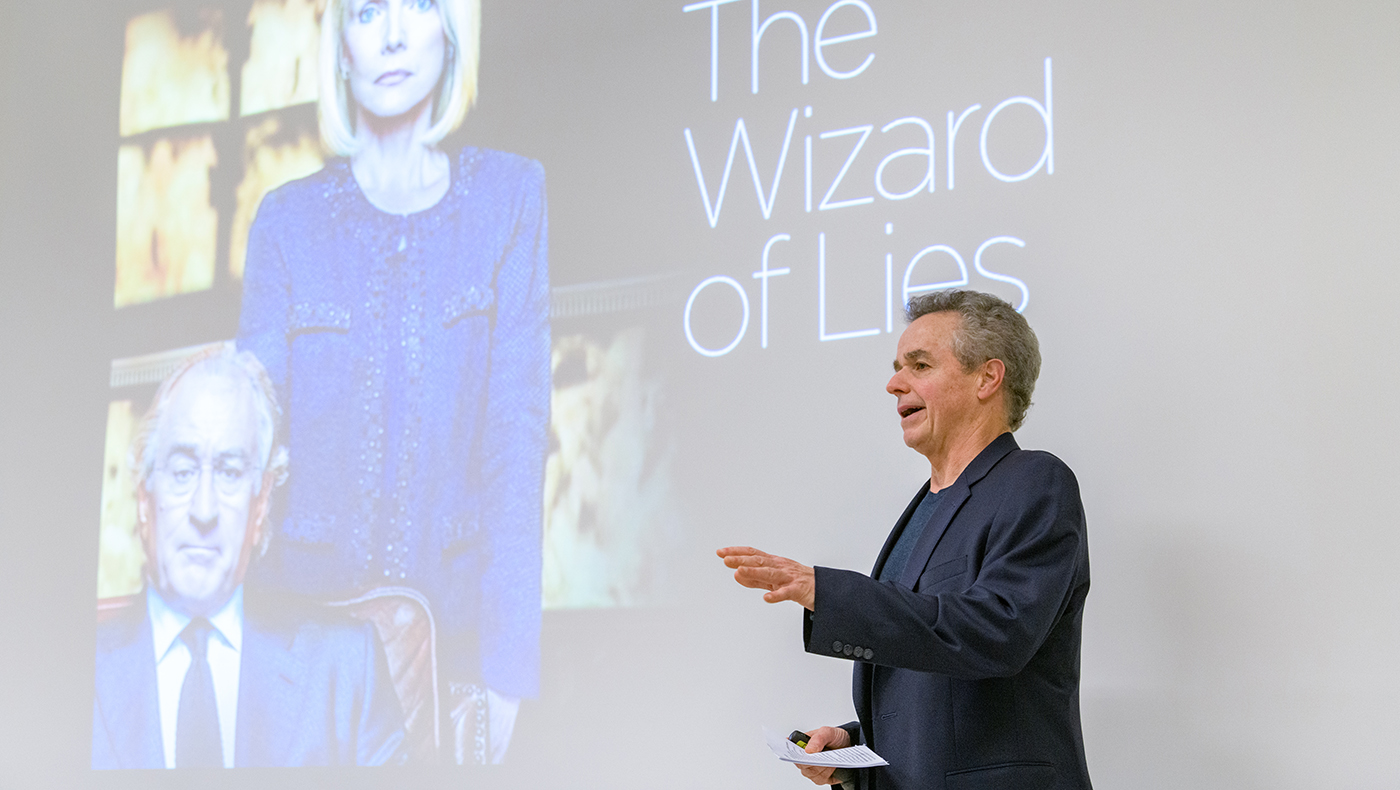
The 2017 HBO-produced film “The Wizard of Lies,” based on the non-fiction book of the same name, tells the true story of the rise and fall of Bernard (Bernie) Madoff, former market maker, investment advisor and financier who is currently serving a federal prison sentence for offenses related to a massive Ponzi scheme that he devised.
The Alfred Lerner College of Business and Economics’ Center for Economic Education and Entrepreneurship (CEEE) at the University of Delaware invited Ron Bruehlman, senior advisor for IQVIA and Quest Diagnostic and UD Class of 1982, to speak to more than 40 Delaware economics teachers as part of their semiannual “dinner and a movie” series tying popular films to economics and financial literacy topics. The educators watched “The Wizard of Lies” and spoke with Bruehlman about his experiences and lessons learned in investing.
Bruehlman believes this film has important practical applications for anyone when it comes to investing.
“I love economics,” Bruehlman said. “I love speaking and teaching about economics, so I was excited for the opportunity to return to my alma mater. The reason I chose this movie for my presentation is because I think it has the most practical application for our everyday lives in terms of investing.”
The economics dinner and a movie program is one of many from the CEEE that uses well-known historical, significant and interesting events to help teachers more tangibly convey sound and relevant economic educational content throughout Delaware schools.
After the screening of the film, Bruehlman explained that there were four major lessons to learn from Madoff’s story. The first lesson is that people need to invest with knowledge and understand the ups and downs of the market. What made Madoff’s results clearly too good to be true was the fact that he never had a down year.
According to Bruehlman, this lesson doesn’t apply just to stocks, but to any asset class. From stocks to bonds to private equity to real estate, assets will never only have up years. All assets will go up and down, and there are no “sure things” in investing.
The second lesson Bruehlman shared was that people should be wary of market fads. Just because something seems to be offering large returns all of a sudden and you hear that others are successfully investing doesn’t mean you should invest. People can easily have a fear of missing “the next big thing” and according to Bruehlman, this is the exact thing that Madoff was able to take advantage of.
Bruehlman also gave the example of the dot-com bubble in the 1990s and early 2000s, where investors were “throwing money at anything with dot-com in the name.” This market peaked in 2001 and took almost 15 years to recover, which shows how these fads can be more risky than they are worth. His advice would be to avoid the latest trends and instead maintain a safer, prudent investment strategy.
Bruehlman’s third lesson was that diversification is the cornerstone of any wise investment strategy. Many of Madoff’s clients put all of their money into his investments, which proved to be fraudulent and caused many to lose everything that they had.
With 20 or 30 different stocks, events within the market begin to balance each other out and the risk level drops. This helps to get rid of non-systematic risk. Other options are to invest in a mutual fund and have a mix of different asset classes, but overall the primary takeaway is to diversify.
The final lesson that Bruehlman shared from the film was to trust but verify. He said that this can be the hardest lesson to follow and was one of the major reasons that Madoff’s scam was able to flourish for so long. Madoff didn’t provide his clients with detailed account statements, the U.S. Securities and Exchange Commission (SEC) didn’t look closely at his records and processes and generally no one bothered to look into his unlikely and unmatched success. Without this due diligence, Madoff was able to continue his fraudulent business for decades.
To avoid this issue, Bruehlman mainly suggests following his first three lessons. After that, it is important to do research on where you plan to invest and ensure that the firm is reputable and registered with the SEC. If something being offered seems too good to be true, it probably is, because there are no guarantees in investments. After this final lesson, Bruehlman answered the teachers’ questions.
“I was hopeful that they would be able to take some very simple lessons that they could bring back to their students,” Bruehlman said about his presentation. “The movie enabled us to draw out these very simple things that all of us can remember, take away and really apply to our day-to-day lives because we’re all investors to one extent or another.”
In addition to the film screening and discussion with Bruehlman, the program provided teachers with lessons and assessments focusing on ethics and how they relate to economics. Scandals in energy, finance and other markets necessitate that students be able to examine moral issues and then learn to analyze the costs and benefits related to different policies designed to address such issues. The CEEE also shared behavioral economics lessons to help teachers illustrate to students how individuals don’t always behave in rational ways.
The CEEE typically produces two Economics Dinner and a Movie programs each academic year. The next program is scheduled for the evening of Wednesday, April 1. Details and registration can be found later this winter on the CEEE’s event calendar.