


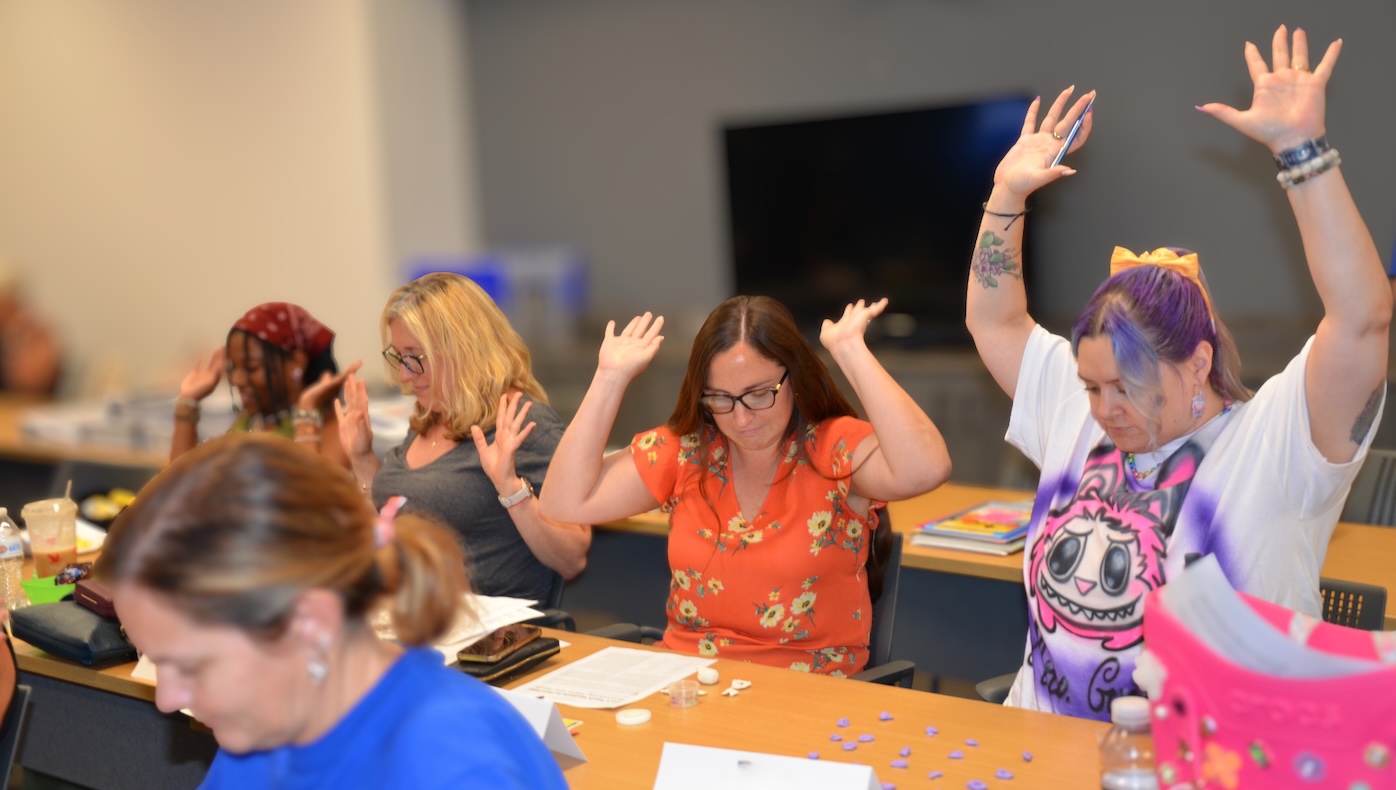
Discussion filled the room as a group of teachers grappled with a seemingly simple task: categorizing “wants” versus “needs.”
It was the opening activity for the University of Delaware’s Center for Economic Education and Entrepreneurship (CEEE) K–5 Content for Confidence workshop — and it quickly proved that basic economics isn’t so simple after all.
“Water is a need,” said one teacher.
Scott Bacon, CEEE assistant director, smiled and clicked to the next slide. He immediately complicated the issue by comparing a $5 case of bottled water to a $755 designer bottle. The teachers murmured as the conversation deepened.
The exercise turned personal when Bacon shared a story about a student insisting that a camera was a need. “My dad is a photographer,” the student explained. “He needs a camera for his job.”
“How do you argue that a tool essential to a family’s livelihood is merely a want?” Bacon asked.
That question underscored why the workshop exists. Economics, helping people make informed decisions, is complex enough to challenge an adult, yet it must be taught to a kindergartener. For many teachers, these concepts can feel overwhelming.
“The best way to teach economics experientially is to experience it yourself,” said Amy Krzyzanowski, CEEE instructional designer. “When you feel the concepts play out, it’s much easier to bring that same energy and understanding back to your students.”
Part of the Alfred Lerner College of Business and Economics, CEEE develops and delivers programs like Content for Confidence to help Delaware kindergarten through fifth-grade educators throughout the state integrate economics and personal finance into their classrooms.
Developed by Bacon and Krzyzanowski, Content for Confidence is built on the principle of learning by doing. The workshop breaks key economic ideas into fun, bite-sized lessons that teachers can immediately use in their classrooms. For many, attending isn’t about becoming an economist overnight; it’s about picking up one clear, memorable concept at a time so they can teach with confidence the very next day.
The goal of the “wants versus needs” activity wasn’t to produce a perfect list. It was to show that the distinction often falls apart under scrutiny. The real lesson is helping children consider costs and benefits, prioritize their wants, and make thoughtful, informed choices based on scarcity, the fundamental economic problem.
Teachers who attended the workshop described a sense of relief and renewed enthusiasm.
“I really enjoyed the content, but more importantly, the hands-on activities help students better understand these concepts, especially since they can be challenging and complex,” said Brook Timanus, a teacher at Immaculate Heart of Mary School.
“Experiential learning really helps me,” added Tammi Schweizer, a teacher at West Park Place Elementary School.
This hands-on, focused approach is why teachers return to CEEE sessions throughout the year.
“We don’t want a once-and-done model,” Bacon said. “The benefits lie in ongoing professional learning. We build relationships with teachers and tailor workshops to their needs.”
That ongoing growth is mirrored in Delaware’s economic standards and CEEE’s Economics Model Lessons, which are designed like stepping stones. The curriculum starts with the basics in kindergarten, such as recognizing wants and understanding scarcity, and builds each year, preparing students to think critically about incentives, trade and opportunity cost in middle and high school.
“Doing the actual simulations and activities and showing how each grade level builds on the next really helps,” said Heidi Miller, a teacher at Maclary Elementary School.
By strengthening teachers’ confidence, CEEE ensures the foundation is solid. When teachers grasp core concepts and feel comfortable teaching them, students develop stronger economic reasoning year after year.
When a kindergartener asks whether a camera is a need or a want, a confident teacher can turn that question into a meaningful conversation about value, choices and tradeoffs, laying the groundwork for every economic decision that student will make in the years ahead.