


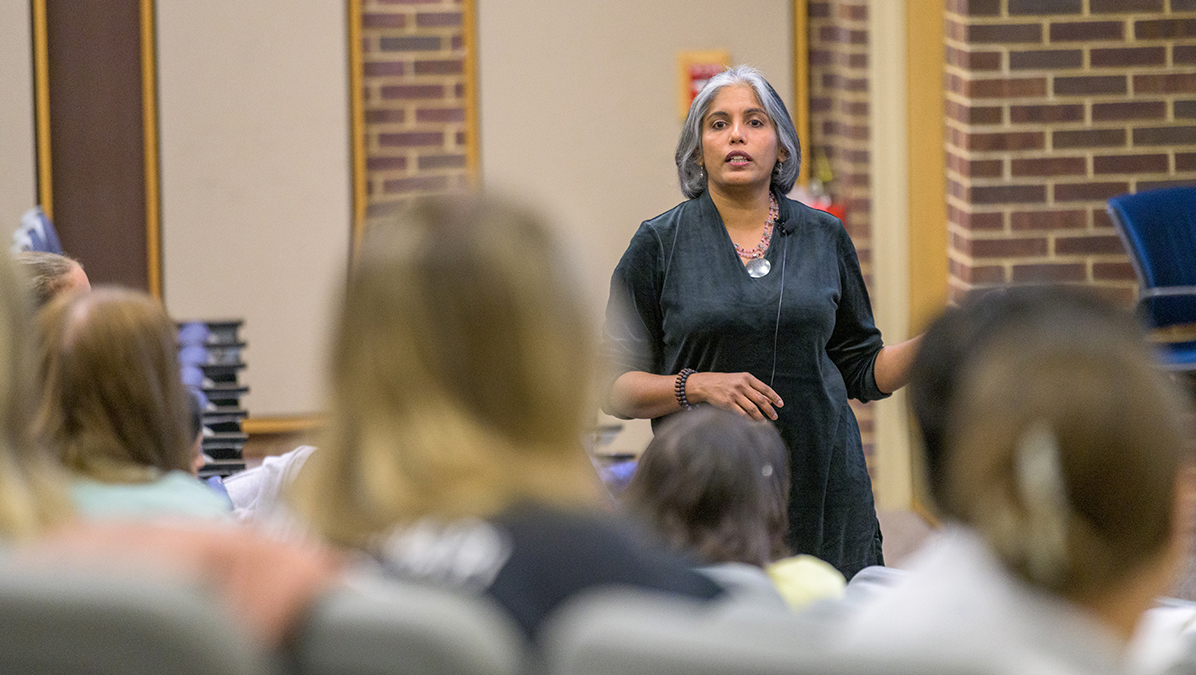
As a young college student, Anu Sivaraman listened to her professor make a comparison using peanut butter and jelly. Newly arrived in the U.S., she was baffled by the analogy — were these foods opposites, or did they go together?
Sivaraman points to that now as an example of the way teaching can include assumptions that leave some students in a classroom at a disadvantage, or feeling that they are outsiders.
She navigated through those cultural barriers and is now an assistant professor of marketing at the University of Delaware’s Alfred Lerner College of Business and Economics. But Sivaraman, director of the college’s Diversity Council, is drawing on her experiences to help remove obstacles for the next generation, by promoting the idea of inclusive teaching.
The concept behind inclusive teaching (or inclusive pedagogy, as it’s sometimes more formally known) is that traditional teaching methods have put some students at a disadvantage, like those of different racial identities or lower income levels. Professors can combat this by being aware of the needs of all their students and the different ways they learn, and modifying the way they teach to account for those differences. This shift aims to promote a sense of belonging and make sure all students are able to thrive, no matter their background.
Sivaraman describes it as providing “a place of belonging for everybody,” regardless of race or identity, and including those with varying learning styles or personalities.
“You’re trying to make sure that everybody comes together and owns every problem in that room,” she said. “And I think those are the mindset or perspective changes that we want.”
Traditional education has followed what has been described as the “banking model of education,” noted Adam Foley, director of diversity education, assessment and outreach at UD. “We’ve had this idea that we as faculty members are responsible for depositing knowledge into students’ brains. And so it’s this one-way flow of information. We stick it in, they regurgitate it out and spit it out in the form of tests and papers.”
In contrast, inclusive teaching is built on the idea that “students not only need to be, but deserve to be active participants in their own learning. And in doing so, they are bringing ideas and skills and experiences and knowledge that can enrich the educational experience for everyone.”
Instructors bring knowledge to class, but also a way of seeing things, Foley said. “We’re always making decisions about what to teach, what not to teach … and so we send messages by the choices that we make, about who matters, about who is valued, about whose voices are significant.”
Sometimes, Sivaraman added, educators don’t realize they’re bringing bias in the way they teach. That’s one reason UD Lerner held a session this fall, led by Foley, to explain inclusive teaching to faculty and staff, especially those new to the college.
How does inclusive teaching play out? It might mean considering examples in class that will resonate with Chinese or Indian students as well as those who grew up in the U.S., Sivaraman said. Or, taking into account that some students from underprivileged backgrounds may have issues with technology, and offering alternative ways to complete coursework.
Teachers can take steps to accommodate different personalities, too. “Our classroom models — in-person classes — are set up to benefit extroverts,” she said, with elements like class participation counted as part of the grade.
Introverts may hesitate to speak in class, but have wonderful input that a teacher isn’t hearing because of the structure, Sivaraman said. “If you can accommodate an online discussion board, where they can go put their thoughts in later, when they have fully formed (them), you could be more inclusive of a student with a different personality type.”
Exams are another example. Traditional education may favor students who are good at demonstrating their knowledge by answering multiple choice or essay questions. But teachers may accidentally shortchange students who know the material but don’t shine in an exam format. Sivaraman compared it to trying to teach fish to fly.
“Am I giving a different way of testing where they can shine and show what they know?” she asked. “Ultimately, isn’t it about showing what they know?”
It’s important that students be comfortable enough in the classroom to make mistakes, Sivaraman said, as college is an ideal place to learn from those errors. “When you provide psychological safety, people learn, they grow, they take a lot of personal risks, they admit to mistakes.”
Some have described these kinds of efforts as trying to create a safe space, but Foley prefers the term “brave space,” or creating an atmosphere where people feel they belong regardless of background, identity and interests.
“We’re acknowledging the fact that it’s disingenuous to say that we can, as instructors, guarantee a safe space for a student or anyone else, because we don’t know their lived experiences, we don’t know what else is going on in their lives,” he said. “ … What we can do is create an environment where people feel empowered to be brave, to share things about themselves,” knowing that what they share will be taken seriously and respected.
This approach is not only the right thing to do, Foley and Sivaraman say, it’s a more effective way to teach.
“If we’re going to be effective educators, then we need to bring to bear the most current knowledge and resources,” Foley said. “… Why would we teach in the same way that we did 20 years ago, if we know that there are better ways?”
Research and assessments back this up, Foley said.
“When content is more inclusive, when educators are more culturally responsive, not only do students retain knowledge, but they make better connections to other content that they’re learning,” Foley said. “We know that their creativity is heightened, we know that their engagement is heightened, we know that … they do better in the classroom.”