


This article is written by Cori Burcham.
During her keynote speech at the annual Personal Finance and Economic Education Conference hosted by the University of Delaware’s Center for Economic Education and Entrepreneurship (CEEE), Shelby Borst, a social studies teacher at William Penn High School in New Castle, shared a story about a teacher whose kindness inspired her to create that same sense of community in her own classroom.
“It was a small act of love and kindness that got me through high school, even if it was so little,” said Borst, recalling how Amy Krzyzanowski, assistant director of the CEEE and Borst’s economics teacher at the time, gave her and a close classmate a joint nickname.
“I felt like as soon as I walked out of her classroom, I was building a community, building who I was. And when I was in that space, I was loved. I was ‘Shelby Squared.’”
These full-circle moments — when former students become leaders in economic education — illustrate the lasting impact educators can have on their students. Just as Krzyzanowski created a classroom community that inspired Borst, the CEEE has built a professional community where Delaware’s K-12 teachers can grow as leaders, support one another and strengthen economics and financial literacy education statewide.
Sponsored by the Delaware Council on Economic Education, with funding support from Robinhood and YourMoney101, the late-July conference featured eight concurrent sessions designed to support economics and financial literacy education across all grade levels. Two sessions were presented by Delaware educators who previously benefited from CEEE programming as professional learners and returned to lead workshops of their own, inspiring other teachers to take action in their classrooms.
Erin Boettcher, an elementary school teacher for the past 24 years and a 2013 graduate of UD’s Master of Arts in Economics and Entrepreneurship for Educators program, knows from experience how impactful hands-on economic and personal finance education can be for young learners.
As the daughter of a high school economics teacher, Boettcher spent days off from school observing her father’s interactive classroom. She later learned that his hands-on teaching style grew from his training at the Center as a 1993 graduate of the master’s program.
“Even as a 13-year-old, I saw how the center brought people from very diverse backgrounds together and supported the learning and growing of educators. Once I became a teacher nine years later, I took every opportunity to sign up for anything the Center offered,” said Boettcher, who said she still uses lessons she gained from professional development led by CEEE Associate Director Bonnie Meszaros in the early 2000s.
Once she began introducing hands-on lessons such as Mini-Society, a simulation in which students design their own market system, Boettcher noticed a significant shift in her classroom.
“All students gain from the experience of Mini-Society, but none more than the students who typically struggle in school, often those who work harder than anyone else in the class, but don’t get the highest test scores. … Hard work, determination, the ability to pivot, rethink your idea and recover from setbacks — those are all things Mini-Society thrives on. My students with disabilities or any academic, social or emotional challenges shined every single time,” Boettcher said.
After seeing Mini-Society’s impact, Boettcher was motivated to make the program more accessible to elementary school teachers. She discovered that one barrier discouraging teachers from using Mini-Society was their own comfort with economics concepts.
As part of her MAEEE implementation project, Boettcher developed a curriculum that unpacked those concepts and allowed teachers to experience the simulation as students, giving them greater confidence to introduce the program in their own classrooms.
At the conference, Boettcher continued sharing her best practices with elementary teachers during her session, “Financial Literacy K-5: It Just Makes Cents,” a 50-minute workshop highlighting the importance of establishing an early foundation that can be expanded throughout elementary school.
Challenging the assumption that young learners need strong math skills before learning financial literacy, Boettcher said early financial education is more about establishing sound financial behaviors, including impulse control, distinguishing wants from needs, goal setting and understanding opportunity cost.
To strengthen K-5 financial literacy instruction, Boettcher shared a chart detailing the grade levels at which individual concepts should be introduced, reinforced and mastered under Delaware standards. She also provided grade-specific resources and strategies.
Elizabeth Bear, a ninth-grade civics and economics teacher at Cab Calloway School of the Arts in Wilmington, acknowledged that economics did not come naturally to her. She struggled in her first college economics course but said that challenge prepared her to work with Delaware’s economic education standards during her early years of teaching.
As she became more comfortable incorporating the standards into her classroom, her passion for engaging students in economics grew and eventually led her to teach a full economics course.
“I was spending an entire semester on economics and I wanted to make sure I was doing right by the students and teaching them strong content. That pushed me to apply to the MAEEE and it was through that program that I gained confidence in my economics knowledge,” Bear said.
For her implementation project, Bear chose to become more familiar with Delaware standards to better understand the curriculum at each grade level. The project strengthened the rigor of her ninth-grade curriculum and gave her opportunities to help other educators do the same through professional development sessions for economics teachers in the Red Clay Consolidated School District and presentations at the Social Studies Coalition of Delaware Conference.
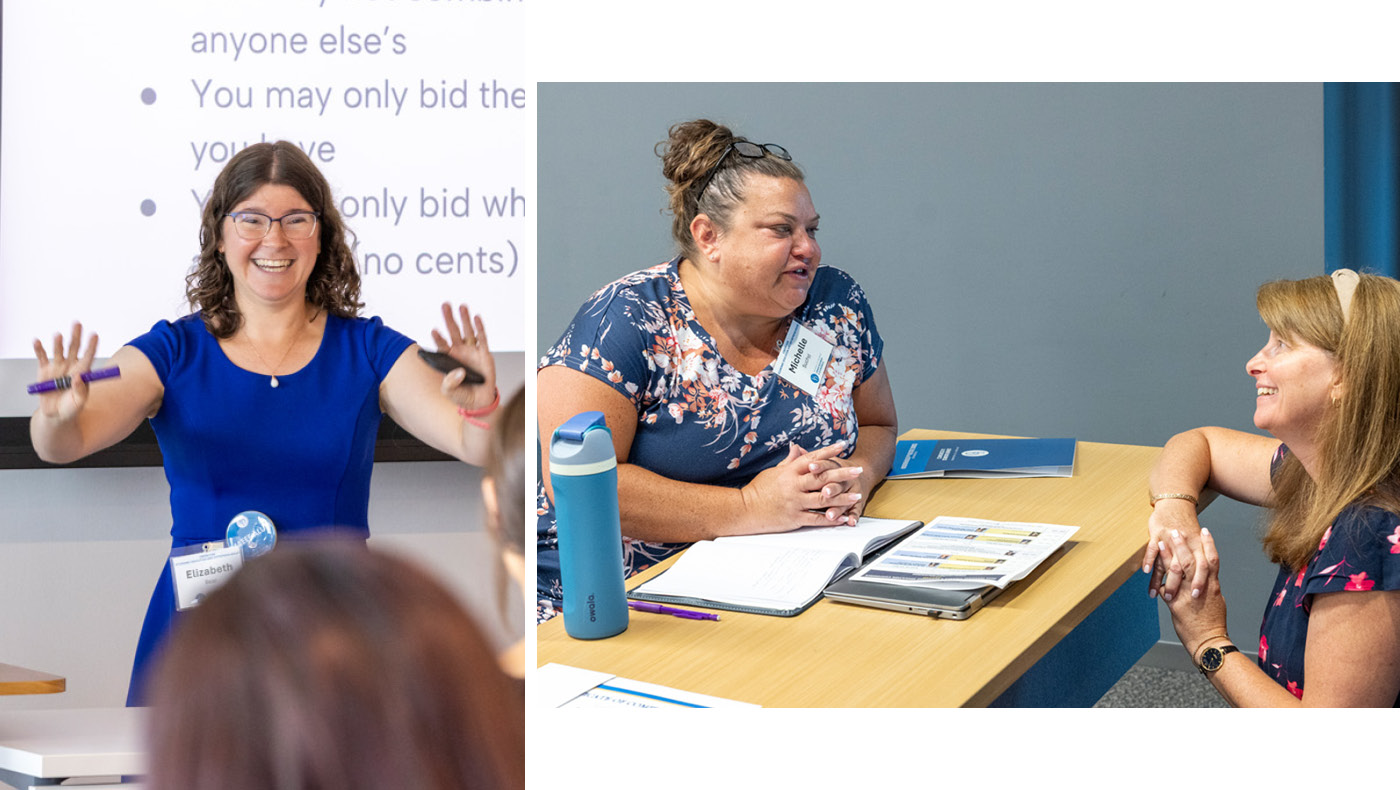
Bear continued that mission at the CEEE conference with her session, “Econ in Action: Building Rigor Through Simulations,” a 50-minute workshop demonstrating classroom-tested simulations that have helped her students grasp difficult economic concepts.
“By participating in simulations, students experience hands-on learning that they can draw on when learning concepts. They aren’t just taking notes and writing words on a page — they’re experiencing market forces, acting as businesses and making game-time decisions that impact their experience,” Bear said, noting that firsthand experiences often provide students with a concrete memory of a new concept.
One example is Federal Reserve Education’s Inflation Auction lesson, a simulation Bear demonstrated to explain inflation. Educators were given between $3 and $6 in fake money to bid on small prizes. After participants received more money in the second round, bids increased sharply even though the prizes remained the same.
“Students used to ask me all the time, ‘Why can’t the government just print more money?’ … Then I started doing the inflation auction lesson and students got it. They saw firsthand how giving everyone more money causes prices to rise,” Bear said.
Like the CEEE programs that shaped their own teaching, Boettcher and Bear had the opportunity to mentor the next generation of economics educators through their conference sessions, continuing the MAEEE program’s “multiplier effect” of educators helping educators.
“I’ve been coming to this conference for the past five years and I always leave with actionable things I can do in my classroom next year,” said Bethann Higley of Padua Academy in Wilmington. One of those ideas is the Inflation Auction lesson, which she plans to introduce to her students in the fall.
“One thing I appreciated about Erin Boettcher’s presentation is that you can see and hear the heart of what she does and believes in as an educator,” said Shayla Gordon, a third-grade teacher at David W. Harlan Elementary School in Wilmington.
“It inspired me to take my enthusiasm for teaching to the next level this year and to continue to strive towards the aspects of education that I’m passionate about, which includes financial literacy.”
Honoring educational impact
In addition to offering professional development, the CEEE community recognized educators who have already made an impact in Delaware schools.
Erica Varites, a fifth-grade teacher at Cooke Elementary School in Hockessin, was named the 2026 recipient of the Bonnie T. Meszaros Economic Educator of the Year Award. Throughout her 20-year career in education, Varites has engaged students through experiential civics and personal finance lessons.
Kylee Holliday, a social studies teacher at Alexis I. duPont High School in Greenville, was named the 2026 recipient of the Ronni K. Cohen Personal Finance Educator of the Year Award. She was recognized for introducing a year-long financial literacy course and advocating for Delaware’s statewide financial literacy graduation requirement. Holliday has since joined the CEEE as an instructional designer.
Both awards honor Delaware K-12 educators who have demonstrated a sustained commitment to economics and personal finance education.