


This article was written by Kim Asarta, UD’s Center for Economic Education and Entrepreneurship
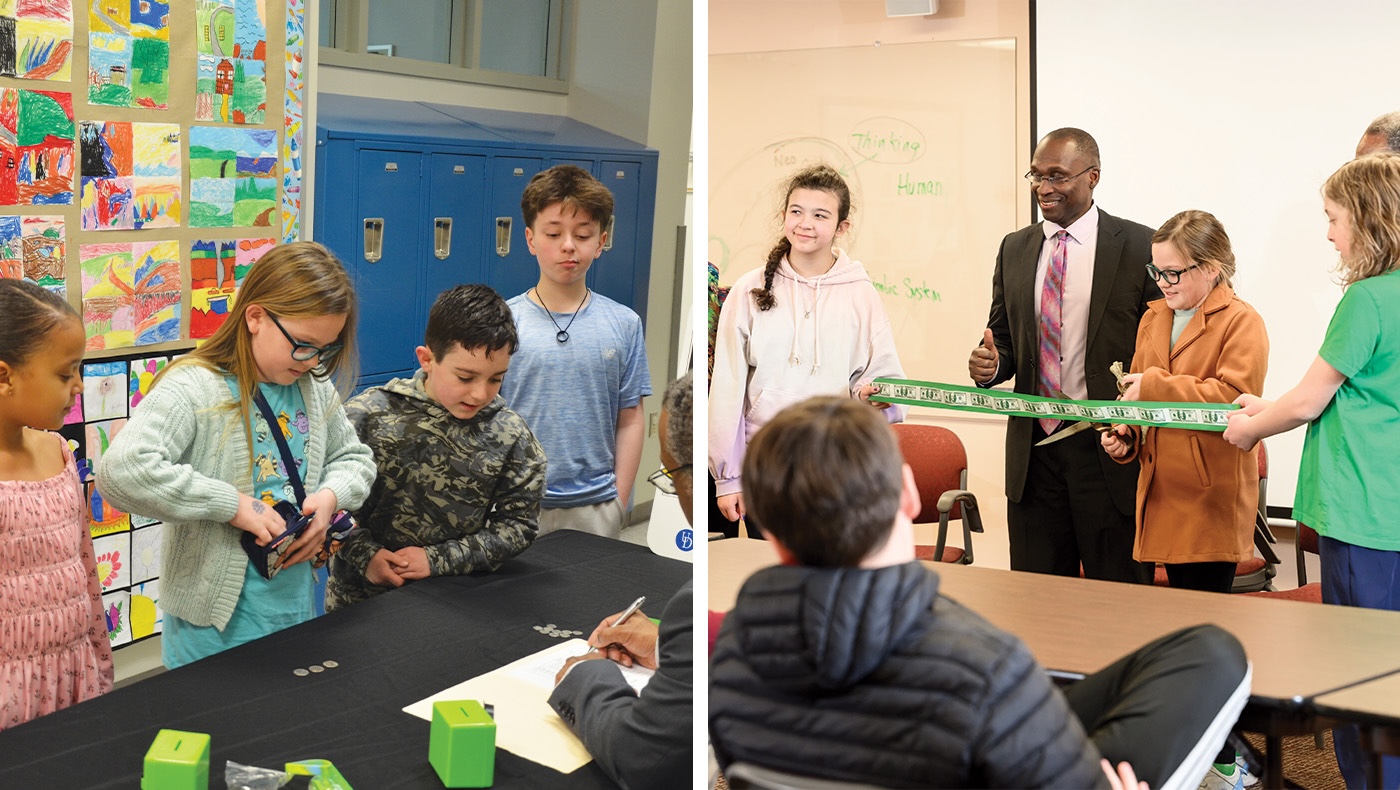
Once a week, kindergarten through eighth-grade students at the University of Delaware College School clutch dollar bills and coins, eager to fill out deposit slips. One by one, they step forward to greet their banker, ask about their balances and proudly add to their savings.
For these students, savings is real-world learning through the Ronni K. Cohen Bank at School (BAS), a program coordinated by UD’s Center for Economic Education and Entrepreneurship (CEEE) at the Alfred Lerner College of Business and Economics. Students open and manage their own savings accounts, earning and depositing money each week as they build lifelong habits.
Their experiences underscore the message of Financial Literacy Month, observed each April in the United States. The month-long event, created by the Jump$tart Coalition, highlights the importance of financial education in areas such as saving, debt management, credit and financial decision-making. Developing financial knowledge helps people make smart decisions and build a secure future.
Since 1992, CEEE’s BAS has helped Delaware students build financial confidence one deposit at a time. The program introduces positive habits just as they begin to take shape, and today it reaches 42 schools statewide. Partnering with five banks and 20 credit union branches across the state, it serves an estimated 22,347 elementary students each year.
Why Financial Ownership Matters
UD’s College School launched BAS in February with a school assembly led by the school’s Director Andrea Glowatz, American Spirit Federal Credit Union Bankers Enrique Campbell and Maurice Dawkins, and CEEE’s BAS Coordinator Judy Austin. Through an engaging skit, students explored the difference between spending and saving and saw how small amounts can add up over time.
In the weeks that followed, the lessons turned into action. Campbell, who served as American Spirit’s BAS officer, visited the school to collect deposits and help students track their balances. Each participating student could open a noncustodial savings account in their own name, with just $1 and a parent’s permission form. The account belongs solely to the student, not jointly with the parent.
“Students come ready,” Campbell said. “They ask about their balances. They tell me what they’re saving for and talk with me about saving for college. It’s exciting to know they’re learning about finances this early.”
Glowatz emphasized that the program gives students real control over their savings, showing them that their financial choices matter and that they can manage something valuable.
“Seeing the impact of their deposits transforms an abstract concept into a lived experience for our students,” said Glowatz.
“The discipline of delayed gratification can be unfamiliar in today’s world, where everything seems to happen instantly. When students watch their savings grow, small deposit by small deposit, they begin to understand that goals are achieved incrementally. There is a great deal of self-esteem that develops when a child realizes, ‘I did this. I built this,’” continued Glowatz.
The Importance of Early Savings Habits
Developing financial knowledge early matters. By age 7, children are already forming money habits that can last into adulthood, and research from the University of Cambridge and the Financial Literacy and Education Commission shows that early hands-on financial education is linked to stronger savings behaviors later on.
BAS Coordinator Austin explained how the program teaches essential savings skills.
“With help from the banker, students learn how to fill out deposit slips and track their money in a BAS record-keeping book so they can watch their savings grow toward short- and long-term goals,” said Austin.
“Students receive official bank statements at home, making the process feel official and providing concrete reinforcement. Students learn that leaving money in their savings account over time will result in even more savings thanks to interest and compound interest,” she continued
“The routine of saving even a small amount each week provides encouragement and excitement for making saving a lifelong habit.”
Through these experiences, children gain practical skills such as tracking deposits, balancing accounts, setting goals, and understanding that money can grow over time.
Bringing Financial Literacy Home
The BAS lessons learned by students extend naturally into the home. Families see how these experiences build financial confidence and habits. Charlee Clark, whose daughter Suriya participated in the program at Lancashire Elementary School, said the program has sparked meaningful conversations at home.
“This gave Suriya so much confidence,” Charlee Clark said. “She was able to save $26 on her own. It has increased the conversations we have as a family about finances.”
That family connection is exactly what Financial Literacy Month is designed to encourage.
“By normalizing conversations about money at home and involving children in small, hands-on savings activities, families can build habits together,” said Carlos Asarta, Bank of America Professor of Business and James B. O’Neill Director of CEEE. “They might set a shared goal for a special activity, talk through everyday spending choices, such as skipping a coffee and adding that $5 to a savings jar, or celebrate small wins by recognizing each deposit or thoughtful decision.”
These shared experiences give children a sense of control and pride, making money lessons tangible and memorable.
All children can start this way:
One dollar.
One deposit slip.
One proud glance at a growing balance.
During Financial Literacy Month, programs like BAS show families that financial education can start early and be simple, beginning with a single coin in a small hand and building the confidence that comes from knowing: “This is mine. And I’m building something.”