


This article was written by Cori Burcham.
Imagine a hospital with five intensive care unit beds and five ventilators, but 20 critically ill patients may need them. Health care teams faced this type of decision nearly every day during the peak of the COVID-19 pandemic.
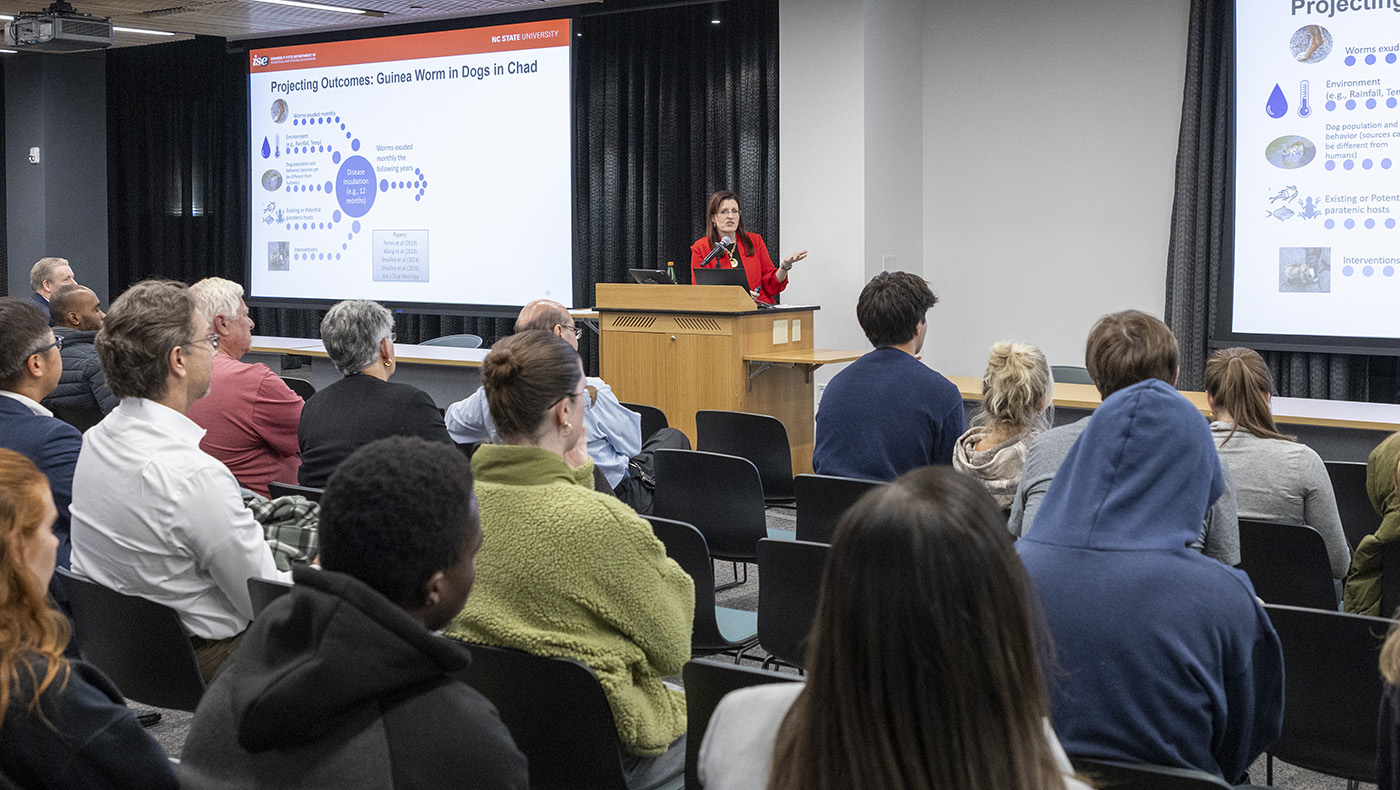
That’s a scenario Julie Swann, an A. Doug Allison Distinguished Professor and head of the Edward P. Fitts Department of Industrial and Systems Engineering at North Carolina State University, shared during the opening of her lecture before University of Delaware operations management faculty, students and alumni in November.
“You can see the stakes in the decisions are really quite significant, and there is often a role for a medical provider, doctor, nurse, as well as the people analyzing data and designing these systems,” said Swann, illustrating how decisions in health and humanitarian systems can be life-saving.
As the featured speaker for the W.L. Gore Lecture Series in Management Science, Swann was invited by UD’s Alfred Lerner College of Business and Economics to discuss how data-driven decision-making can address healthcare challenges, including pandemics, chronic disease and inequities. She spoke at the Fintech Innovation Hub on UD’s STAR Campus.
Sponsored by an endowment from the Gore family, the series spotlights research on probability, statistics and experimental design, demonstrating the real-world impact of operations research beyond the classroom.
“Students don’t often know what academic research looks like in action, so it’s exciting for them to see the importance of this work beyond the university,” said Caroline Swift, assistant professor of operations management and co-chair of the event.
Swann began her presentation by detailing her work as a systems engineer and how she utilizes operations research methods, such as optimization, simulation, statistical modeling, and disease modeling, to transform data into actionable insights. Swann noted analytics can drive change at every level of the U.S. healthcare system, from individual patient care to population-wide policy. Drawing from the diverse sources of healthcare information available today — electronic health records, wearable technology, insurance claims, lab results and disease surveillance — analysts can project outcomes, optimize interventions and evaluate areas for improvement within a system.
“I started working in healthcare and humanitarian systems a number of years ago. It was first motivated by some of the national and international disasters, such as Hurricane Katrina in New Orleans, the tsunami in Southeast Asia and others. We realized the work we were doing with the private sector also had potential for impacting society in the public sector,” said Swann.
Swann became a science advisor for the Centers for Disease Control and Prevention (CDC) during the H1N1 Swine Flu pandemic in 2009. Since then, she’s continued research related to infectious and parasitic diseases, identifying critical problems and enabling good decision-making.
Swann shared examples of past case studies she’s collaborated on that illustrate how models can be used to project outcomes within a system. Along with researchers from other academic institutions, Swann’s team at NC State was chosen by the CDC and the Council for State and Territorial Epidemiologists to join the “COVSIM” Team, a simulation model that supported government agencies by creating projections about the spread of COVID-19 under specific conditions.
Similar to agent-based models, which simulate the actions and interactions of individuals within an environment, Swann’s team developed simulations on COVID-19’s spread within a K-12 school environment by mapping the students’ daily interactions. When designing interventions, her team pursued the competing goals of limiting infection, masking fatigue, testing costs and prolonged absences.
Instead of simulating solutions for each goal, her team used a genetic algorithm to sift through the combinations and identify the most effective trade-offs. Their findings revealed that regular testing and masking consistently reduced infections, which they communicated to the press and school districts to help communities prepare and plan.
Optimizing health systems for over a decade, Swann discovered the most effective models featured certain design principles. During collaborations with health departments, non-governmental organizations and the CDC, she found that stakeholders often struggled to interpret complex forecasting results. This led her to design more accessible simulations that could drive better decision-making. She also uncovered that embedding fairness into the design actually increased a model’s accuracy by accounting for the different risks experienced by vulnerable or marginalized communities.
As new variants emerged during the COVID-19 pandemic, it became imperative to incorporate scalability and adaptability into the design, not only to respond to the current health crisis but also prepare for its evolution.
“As we’re building our models, we’re trying to think about, ‘What are the research questions we care about not only today, but six months or two years from now?’ to build things in a way that’s flexible,” said Swann, whose recent work in surrogate and metamodels has helped support health systems in real-time. Swann describes the process as “a system of systems,” essentially creating a simplified map of a complex simulation to provide faster and clearer insights during a health emergency.
Demonstrating to UD students how operations techniques can shape real-world change, Swann’s lecture challenged students, including UD juniors Kensho Dey and Leena Maharaj, to envision their own future impact.
“In my business and operations classes, I’ve been learning about efficiency and process improvement, and Dr. Swann’s talk gave me a new way to think about applying those ideas to healthcare,” said Maharaj, a management major who plans to launch her own business centered on improving medication adherence.
“In the future, I want to use data and design thinking to create solutions that make health management more personalized and accessible.”
Dey, a double major in international business and operations management, also raised a concern within the analytics community about the future role of artificial intelligence. Suggesting AI alone can’t solve all the problems within a system, Swann estimated that a human element will remain essential to enact change and recommended students approach AI tools as another skillset to learn.
“In the future, I hope to use my own skills to make a meaningful difference, much like Dr. Swann does through her work reducing disease and helping hospitals worldwide,” said Dey, who is optimistic about the future of operations research at the intersection of computer modeling and human-led decision-making.