


For chocolate lovers, choosing a bar can seem like a simple decision.
Dark or milk? Maybe something with nuts. Perhaps caramel, fruit or a familiar flavor.
But the world of craft chocolate offers a much bigger menu of possibilities, which can make choosing a chocolate surprisingly complicated.
Where did the cacao come from? Was it ethically sourced? What flavors does it have? Is the chocolate floral, nutty, fruity or savory? And what if a consumer wants to try something new but doesn’t know where to begin?
Those questions are at the center of a new Chocolate Matchmaker platform being developed through Blue Hen ingenuity.
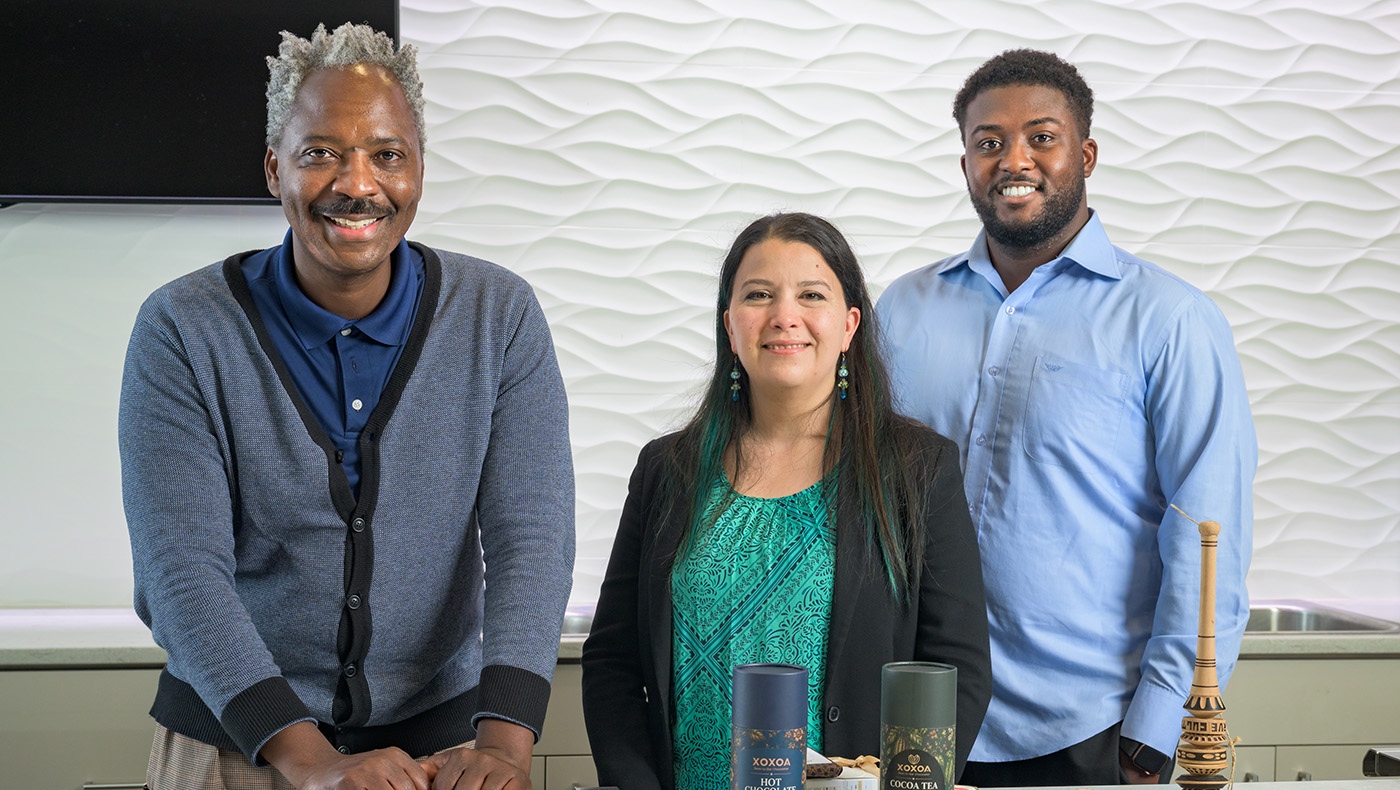
The idea began with Eva Alfoldi, assistant professor of global studies in the Alfred Lerner College of Business and Economics. Her international marketing course includes an interesting component: having students serve as consultants for a different craft chocolate company every semester – this time, for Ebo Nunoo, founder of Philadelphia-based craft chocolate company XOXOA LLC.
One of the undergraduates went above and beyond. During his summer internship with Nunoo, senior Youssouf Drame created the Chocolate Matchmaker digital platform using AI coding tools. The global business major wanted to get beyond simply asking consumers whether they prefer dark or milk chocolate, to allow Nunoo to better understand their tastes, something that has been on the entrepreneur’s mind for a few years.
The result? A personalized “chocolate persona” and “flavor DNA,” which allows Nunoo to generate tailored recommendations that match chocolate lovers’ preferences – not only from XOXOA’s products, but also from a global database of craft chocolate makers.
For Alfoldi, the project is the latest example of how she is bringing real businesses and real business problems into her classroom.
She first became interested in the global craft chocolate industry after meeting chocolate educator Estelle Tracy from 37 Chocolates at a UD cultural event in 2024. That connection eventually led to a series of projects for Alfoldi’s international marketing students working with various craft chocolate companies, from Asian-inspired, Texas-based Kessho to luxury chocolate maker ChocoMe from Budapest, Hungary.
This past spring, Alfoldi’s students partnered with XOXOA and Nunoo, who challenged them to develop marketing ideas for his business.
For Nunoo, the student perspective was valuable precisely because it came from the outside.
“Getting fresh, structured marketing recommendations from students who were approaching my business with no preconceptions gave me perspective I couldn’t have gotten on my own,” Nunoo said. “It was also energizing to see how seriously the students took the work — it didn’t feel like an academic exercise, it felt like a real consulting engagement.”
One of those students was Drame, who entered the course knowing little about craft chocolate but quickly became interested in the industry and the way it could make international marketing concepts more tangible.
After Nunoo visited the class, Drame approached him and offered to help his business if an opportunity arose. The result was a summer internship.
“It was a perfect opportunity for me to get experience under my belt,” Drame said.
Drame initially worked on marketing efforts to create awareness for XOXOA during the 2026 World Cup. With Philadelphia being a host city, he reached out to organizers of Philadelphia fan festivals and explored opportunities involving watch parties for Ghana and Ivory Coast, two countries where Nunoo sources chocolate.
But another project soon emerged.
Nunoo had been thinking for more than two years about creating a platform that could help consumers navigate the increasingly diverse world of craft chocolate.
“I decided to hand Youssouf a project I’d had on the back burner for over two years,” Nunoo said. “He took that vague concept and built it into a real, working consumer platform.”
Drame was intrigued, as earlier in the year he had started learning about AI on his own and exploring what the rapidly developing technology could do.
“I thought it was a really cool idea,” he said. “I didn’t know if I could bring that idea to fruition, but I just gave it a try.”
The concept began with an eight-question quiz.
Instead of asking the basics: whether someone prefers dark or milk chocolate, the Matchmaker explores a range of taste preferences. Consumers might indicate whether they enjoy floral, nutty or savory flavors, among other characteristics.
Their answers create a visual “chocolate persona,” represented through a spider graph. The system is designed to become more useful and refined over time, learning from individuals’ additional quiz responses and purchasing behavior.
Drame combined information Nunoo had already collected about chocolate with emerging AI tools as he developed the platform. The project quickly became a crash course in technology as Drame had to think about design, user interfaces, user experience, testing and iteration.
“My work this summer with Ebo has given me a lot of skills and a lot of development working with this new technology that I wouldn’t have gotten otherwise,” Drame said.
Perhaps most strikingly, he was learning to build technology while using technology that itself was rapidly changing.
“It’s mind-blowing to me how fast AI is revolutionizing a lot of different things,” Drame said. “I didn’t have any coding experience six months ago, but now everyone can become a coder.”
The Matchmaker is now being piloted with Alfoldi’s students this fall. Drame and Nunoo are using student feedback to refine the platform, with students taking the quiz at different points to help evaluate how accurately it captures their preferences.
Customers would receive a shareable visual representation of their chocolate persona — something Drame believes distinguishes the platform from other tools in the industry.
“There’s nothing like it in this industry, and I think it’s something really cool,” he said.
The experience has reinforced for Drame the value of experiential learning. He credits both Nunoo and Alfoldi with helping create the opportunity.
For Alfoldi, Drame’s experience illustrates exactly why she has incorporated real companies into her international marketing courses.
“I’m really excited about the Matchmaker because it’s the perfect tool I can use in all forthcoming chocolate projects on my course,” she said. “It’s also inspiring for incoming students to see that they’re actually testing something that was developed by one of their peers.”
Students aren’t simply discussing marketing concepts. They apply them to companies, receive feedback from business owners and, in Drame’s case, continue the work after the semester ends.
“It was really valuable experience I was getting,” said Drame, whose long-term goal is to work on frontier AI development and the infrastructure that supports it. Over the next few years, he hopes to help shape the decisions behind these systems while remaining hands-on in building and implementing them.
For Nunoo, the story comes full circle.
A classroom visit led to a student reaching out, that initiative led to an internship, and the internship gave Drame the opportunity to take Nunoo’s unfinished idea and build it.
“Youssouf’s work over the summer has given us a real, functional foundation rather than just a slide deck,” Nunoo said. “It is a nice full-circle moment too — a project that sat dormant for two years got its breakthrough because a UD student asked for a shot.”