


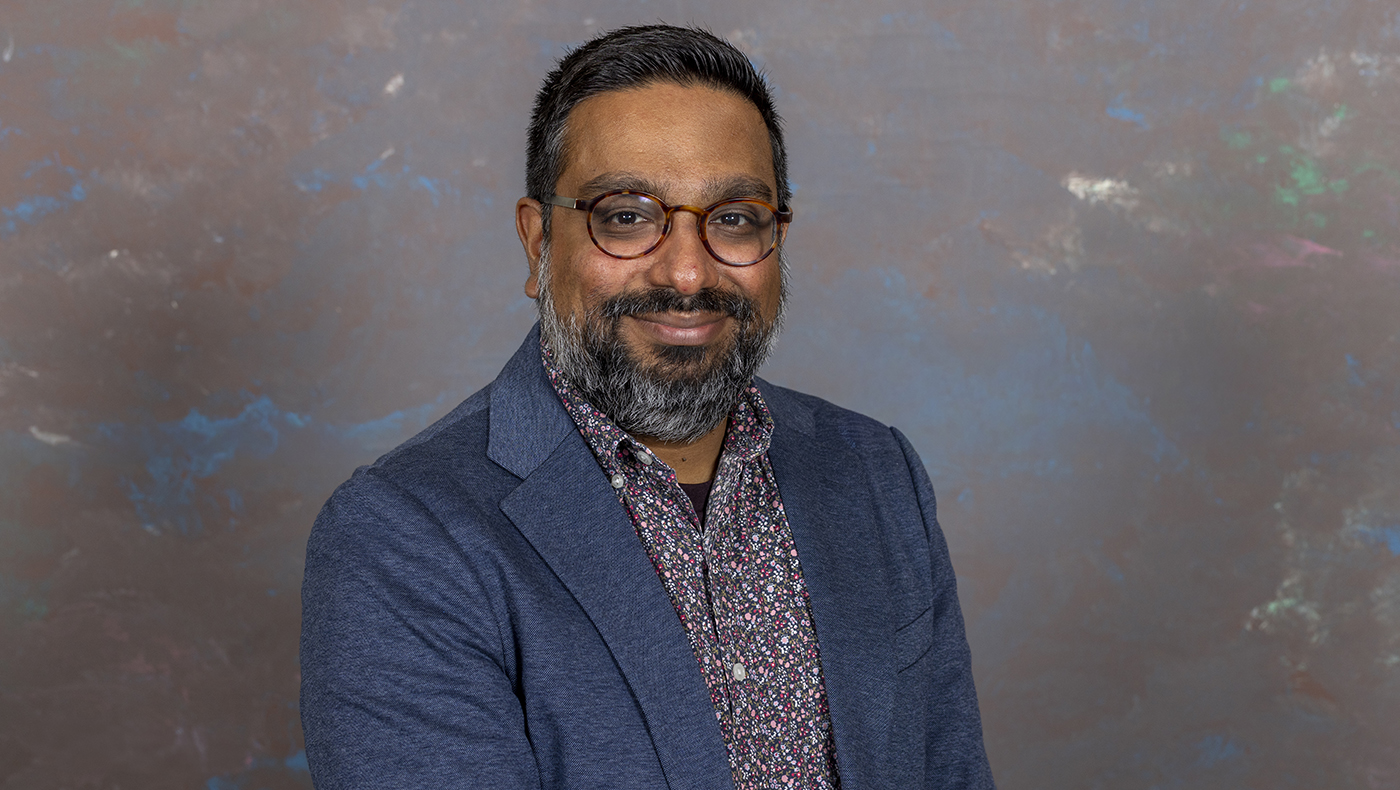
This year, the UD Alfred Lerner College welcomed several new faculty members into its community. Amit Kumar is an assistant professor of marketing and psychological & brain sciences; he spoke with Lerner about his research focus and how he got into this career field.
Lerner: What is your professional and academic background?
Kumar: I received my A.B. in psychology and economics from Harvard University, my Ph.D. in social psychology from Cornell University, and completed a postdoctoral fellowship at the University of Chicago’s Booth School of Business. Before joining the Lerner faculty, I was previously assistant professor of marketing and psychology at UT Austin’s McCombs School of Business.
Lerner: What is your research focus?
Kumar: My research focuses on the scientific study of happiness. Much of my work has examined the distinction between experiential and material consumption (that is, money spent on doing, such as on meals out, tickets to performances and outdoor activities versus money spent on having, such as on clothing, furniture and jewelry). These empirical investigations have found that experiences tend to lead to enhanced anticipatory pleasure, result in more happiness in the moment, provide benefits in retrospective evaluations through utility derived from storytelling and have downstream consequences with respect to fostering social connectedness, gratitude and prosocial behavior. Another, related stream has studied people’s beliefs about prosocial behavior and how this understanding squares with the actual happiness individuals glean from these other-oriented actions. Many of my new faculty colleagues at the Lerner College of Business & Economics would likely argue that wise decisions are based on the expected value of a given action. My research on the consumer in a social context suggests that interpersonal mis-predictions can serve as a barrier to achieving well-being. People might sometimes behave rationally – that is, in accordance with their expectations – but if their expectations are misguided, then they may still not act optimally. Systematically misestimating the costs and benefits of positive social engagement could cause folks to not focus on others enough, standing in the way of maximizing both their own and other people’s well-being.
Lerner: What inspired you to work in your field/research/subject area?
Kumar: I started out studying economics when I was in college but, after being exposed to psychology courses, ended up being especially interested in what behavioral science could teach us about some of the questions economists spend their time thinking about. The intersection between these disciplines led to my broader interest in understanding how people think, feel, and behave–as well as why they think, feel, and behave in the ways that they do. I’m particularly fascinated by trying to better understand the decisions people make in their everyday lives, with an eye towards informing simple ways by which those daily lives can be improved. I try to work on research that I think has important real-world applications for advancing people’s happiness.
Lerner: What is it about UD that made you want to work/teach/research here?
Kumar: Any decision one makes is multiply determined–but, to be honest, the figuratively biggest (but literally smallest) factor that led to my deciding to move to UD was my daughter being born. I grew up in New Jersey and I wanted her to grow up with lots of family around. As someone who has collected lots of data that makes the importance of relationships very clear, I figured I should practice what I preach when making big life choices of my own! Of course, I’m also glad to have the supportive colleagues and enthusiastic students that UD is super fortunate to have.
Lerner: What course are you most excited to teach at Lerner?
Kumar: Here at Lerner, I teach Consumer Behavior. Students at the business school are future leaders and policymakers, and so it’s exciting to know that they will go on to use the insights they learn from this course to actually help solve real problems.
Lerner: What is something unique about you that may surprise your peers/students? (hobby, talent, experience etc.)
Kumar: My research somehow made its way into an SAT question. You can find it here, as well as more information: https://www.kumar-amit.com/