


This article was written by Cori Burcham.
For many young people, imagining a successful future is easier than knowing how to achieve it. At the Siegfried Youth Leadership Program’s (SYLP) fall event, Delaware students learned how everyday decisions, financial habits and a positive mindset can help turn their aspirations into reality.
Co-hosted by the Center for Economic Education and Entrepreneurship (CEEE) at the University of Delaware’s Alfred Lerner College of Business and Economics, the Siegfried Group, Horn Entrepreneurship and Junior Achievement of Delaware, the event brought students in grades eight through 12 to UD for a day of workshops focused on financial literacy, mental resilience and personal development.
Centered on the theme “Live Well, Be Well in Your Bigger Future,” the program encouraged students to reflect on what it means to live well, envision their ideal futures and identify steps to achieve their goals.
“I wish my future could be stress free, but I know I’m probably going to stress about some things. That’s definitely my ultimate goal: to be financially stable and happy,” said Litzzy Ayala, 17, a student at Howard High School of Technology in Wilmington.
For Ayala and her peers, the workshop “Money Moves: Decisions That Shape Your Future” offered practical strategies for making financial decisions that support long-term goals.
Building financial confidence
Kylee Holliday, instructional designer at CEEE, spoke with 10th- and 12th-grade students about the stress associated with managing money and the importance of financial literacy education — something she said was missing from her own high school experience.
“Your peers in the auditorium right now are lucky. Thanks to House Bill 203, they’re going to be required to take a financial literacy class before they graduate. You are the last group who don’t have to take that as a class. … but there’s a reason people fought so hard to make that a law,” Holliday said.
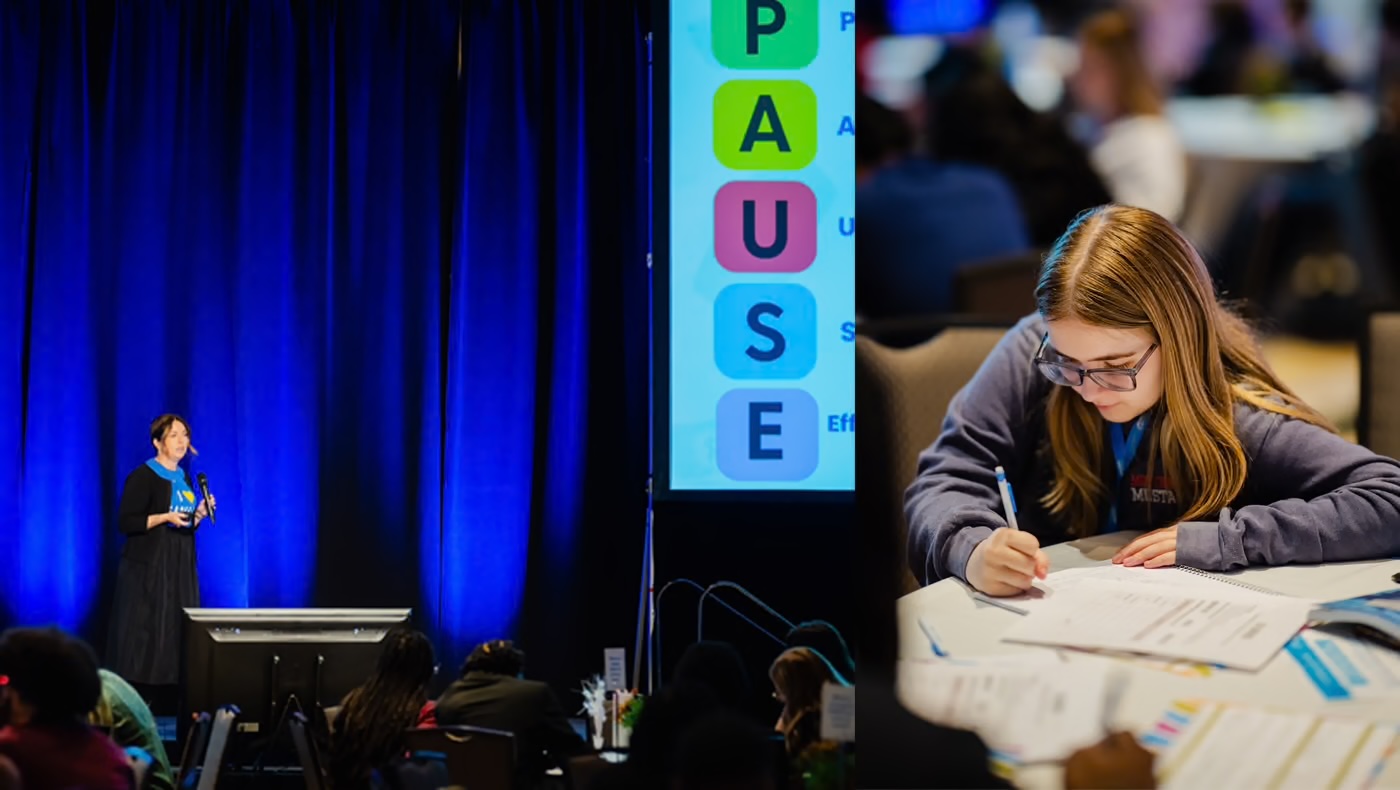
Holliday introduced “PAUSE,” a strategy designed to help students make thoughtful spending decisions without compromising their long-term financial goals.
Students then put those skills into practice through a budgeting exercise that challenged them to imagine life at age 22, working their first full-time jobs. They developed monthly budgets based on their lifestyle choices, navigated unexpected expenses and worked toward saving for a major financial goal within five years.
For Naomi Evans, 16, a student at Odessa High School in Townsend, the activity reinforced that managing money requires flexibility, patience and a willingness to learn from mistakes.
“If I realize, ‘Oh, I spent too much money this month,’ then I’ll save a bit more next month and keep learning from it. It’ll never be perfect, so I’ll just learn from my mistakes,” Evans said.
Fellow Odessa High School student Jessi Salaria said the exercise highlighted the importance of preparing for unexpected expenses.
“One thing I learned is that unexpected life events are going to happen and it’s important to plan for that so you can be prepared. You don’t know if your phone is going to break or if you’re going to get a flat tire … so it’s important to prepare for that financially,” Salaria said.
The power of perspective
While financial stability was an important goal for many participants, students also emphasized the value of happiness, meaningful careers, relationships and making a difference in their communities.
“Living well to me means doing something I love, no matter how much money I make, and having an impact on those around me,” Evans said.
That broader definition of success was reinforced during a keynote presentation by comedian and motivational speaker Mike Paramore, who encouraged students to recognize how their mindset can influence their experiences and responses to life’s challenges.
Drawing on his own experiences with stress, loneliness and the responsibilities of adulthood, Paramore shared humorous personal stories to illustrate the importance of perspective, independent thinking and resilience.
In one story, Paramore described a misunderstanding during a visit to the Bahamas. After spotting a man who appeared to be unconscious on the beach, Paramore rushed over to perform CPR despite having no training.
“The problem was I wasn’t close enough to make a seal, so I ended up blowing air on the man’s face like he was hot soup. I thought that’s how you did it because he got up immediately,” Paramore said.
Believing he had saved the man’s life, Paramore recalled telling him, “Sir, you’re welcome. You didn’t make it. I breathed life on your face.”
Instead, the man called the police.
Through humor and storytelling, Paramore encouraged students to reconsider their assumptions, embrace their individual perspectives and look for positive lessons in difficult situations.
Shane Henry, 16, a student at Odessa High School, said Paramore’s personal stories made his message especially memorable.
“Mike’s [presentation] stuck with me because he used his real, personal experiences to teach us these lessons about the power of perspective,” Henry said.
For Salaria, the lesson was immediately relevant. She recalled arriving at school that morning only to realize she had forgotten about the field trip and was worried she might miss the opportunity to attend.
“I had actually forgotten about this field trip, hence why I’m wearing sweatpants. I was really upset and worried that I wouldn’t be able to come, but — with everyone supporting me and reminding me that what I’m going to learn here is really valuable — I changed my mindset from being scared and nervous to being excited and hopeful,” Salaria said.
Her experience reflected a central message of the day’s program: Building a brighter future begins not only with the decisions students make, but also with how they approach the challenges and opportunities ahead.