


This article was written by Kim Asarta.
In April, University of Delaware’s Center for Economic Education and Entrepreneurship (CEEE) celebrated Financial Literacy Month, with the the focus on bridging the gap between the classroom and the living room. While schools teach financial concepts, research shows a critical piece is missing at home: conversation.
A FinanceBuzz study reports that 70% of Americans believe parents should not share personal financial details with children under 14. At the same time, FRBservices.org reports that nearly 88% of transactions are now digital, meaning children rarely see money in action. Without these everyday moments or intentional conversations, children are left to navigate financial decisions on their own. Yet when families talk about money, the impact is clear: children are three times more likely to say they would invest a $100 gift rather than spend it immediately, according to a T. Rowe Price Survey.
To address this gap in Delaware, CEEE associate director Scott Bacon emphasized turning students’ curiosity into meaningful family conversations through Family Financial Literacy Fun Nights.
“Survey after survey shows that kids want to know more about money” said Bacon. “ Our priority is to provide students and the adults in their lives with tools that will open up their home lives to conversations, helping them learn and grow together.
That goal is already resonating with educators. Michelle Suchyj from Maurice Pritchett Sr. Academy emphasized the value of making financial learning a shared experience between students and caregivers.
“As I work with schools in the inner city of Wilmington, I love the idea of a Family Financial Literacy Fun Night, as guardians, along with their children, are learning the concepts together, making it so much more meaningful, and I believe the takeaway for the adults will be as big or greater.”
For years, CEEE’s Bonnie Meszaros and Judy Austin brought that vision to life by leading Family FinLit Fun Nights at schools across Delaware, with support from TD Charitable Foundations and YourMoney101. These interactive evenings sparked discussion, curiosity and learning that continues at home. When CEEE Assistant Director Amy Krzyzanowski joined in 2023, she saw firsthand how powerful they were — while also recognizing a logistical challenge that limited how many schools could participate.
“We are only so many people at the CEEE, which limits the number of schools we can reach,” Krzyzanowski explained.
That idea led the CEEE team to create the Family FinLit Fun Night Kit, a comprehensive “program in a box” built around tested activities, and repackaged for broader use, so schools can bring financial conversations to their communities. While the format is new, the goal is the same: helping families learn, talk, and connect around money.
“By creating a Family FinLit Kit, we are hoping more teachers can host these events themselves to keep the conversations growing,” said Krzyzanowski.
The turnkey kit includes 10 interactive stations, complete with:
- Volunteer-Friendly Guides: Pictures and setup instructions so any volunteer can run a station with minimal training.
- Passports & Stamps: To track student progress through the activities.
- Universal Access: Editable PDFs and forthcoming Spanish translations to ensure families feel welcome and included.
- Beyond the Box: Digital access to activity procedures, slide decks, and even advice on how to secure funding for food or recruit volunteers.
Teachers can reserve a kit online, and it is mailed directly to their school, making it simple to host a Family FinLit Night while allowing more time to focus on creating meaningful financial conversations.
The kit was tested by Alyssa Ratchford, a student in the Master of Arts in Economics and Entrepreneurship Education (MAEEE) program and high school teacher at Delaware Military Academy, as part of her MAEEE implementation project. Ratchford hosted a FinLit Day in which she used the kit during the school day, with high school students facilitating stations for younger learners.
Her implementation provided valuable feedback to refine the experience, including adding calculators for younger students and developing Spanish translations to better serve Delaware classrooms.
Her approach also demonstrated a flexible use of the kit, shifting it from evening, family-facing events to a school day instructional experience, highlighting how the materials can be adapted across grade levels and scheduling needs.
That flexibility is already inspiring educators like Suchyj.
“I have plans to run a Financial Literacy Family Game Night in the fall of 2026 at Pritchett Academy for our elementary students. Our middle school business students will be facilitating each station, with the help of their teacher Ms. Lucus. This idea was based on the PD in which the high school students went and ran a day for the elementary school.”
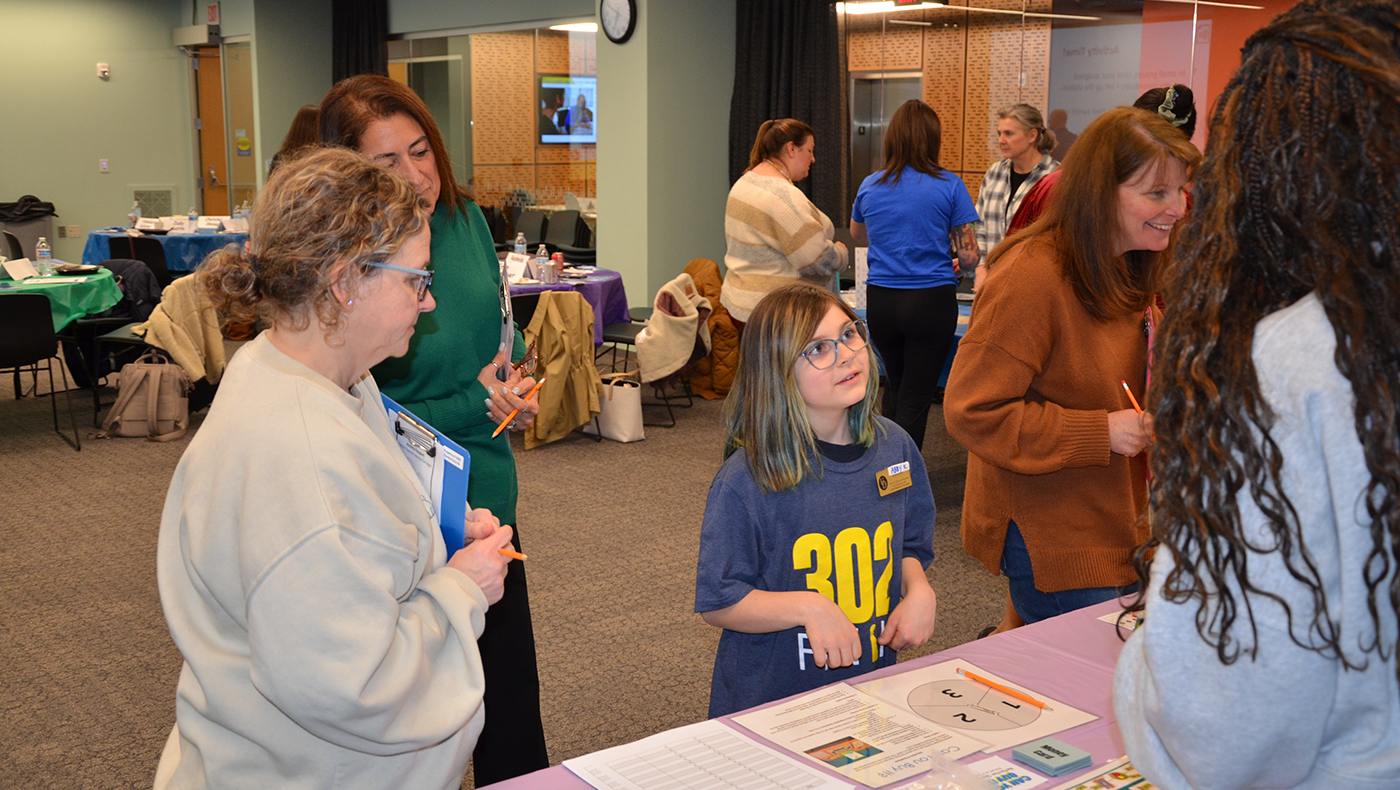
At a recent professional development session led by Bacon and Krzyzanowski, Delaware teachers experienced the kit by rotating through different roles as volunteers, students and families. .
Middle school educator Gabriella Bryce, who teaches at Serviam Girls Academy, attended the training with Principal Heather Brooks, immediately saw the family-focused design as a strength. Bryce recently introduced a financial literacy course for sixth graders and sees the kit as a natural extension of classroom learning.
“I’m excited to bring this to our families,” said Bryce. “It takes what we are doing in the classroom and makes it a shared experience for the whole family.”
And that is the goal: to ensure that learning doesn’t stop when the school day ends. With QR codes, take-home resources, built-in discussion prompts and planning support, CEEE’s Family FinLit Night Kit makes it easy for educators to host these events. Most importantly, it gives families a starting point to talk about money together.
Because when those conversations begin, the impact can last a lifetime.