


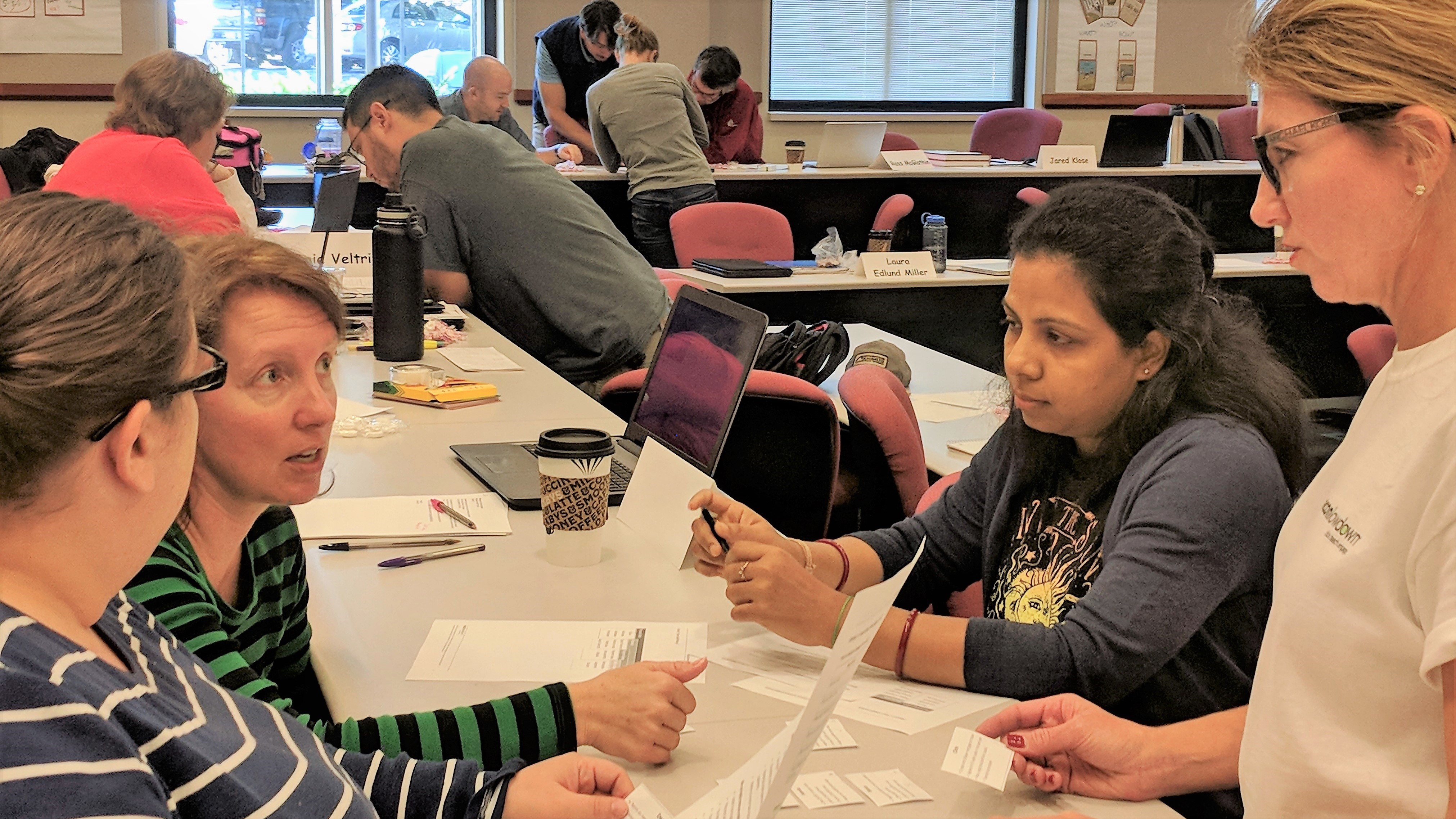
For the last two years, 24 economics educators, from as far away as South Africa and as close as Middletown, Delaware, headed back to school at the University of Delaware this summer with a deceptively simple task: to inspire and transform consumers to make better choices.
It’s important to note that many of these educators, ages 29 to 58, are teaching students, ages 10 to 18, who are also consumers controlling nearly $40 billion in purchasing power of their own, and influencing tens of billions more in family buying decisions, according to the CDC. To educate this group, these teachers are learning the latest economic and financial literacy concepts in their Master of Arts in Economics and Entrepreneurship for Educators (MAEEE) degree program through the Center of Economic Education and Entrepreneurship (CEEE) at UD’s Lerner College.
“The MAEEE degree is one of the most impactful economic education teacher-training programs in the world,” said CEEE Director Carlos Asarta. “Participating educators receive exposure to the latest economic content, pedagogical resources and teaching techniques, allowing them to become agents of change in their schools, communities and regions.”
The program began in 1981 and approximately 500 educators have completed the degree. Alumni are recognized leaders in their school districts, as well as in prominent universities, local governments and even the Federal Reserve.
Educators in the MAEEE program, with backgrounds in social studies, family consumer studies and business, said that they feel the degree’s curriculum provides the tools needed to teach students to best harness their buying power, and gives teachers a needed perspective to better connect with students and understand and address societal pressures.
“The course set-up helped me get into the same frame of mind that my students might be in,” said Jeff Sims, a teacher from Longview, Texas. “Being a student myself reminded me of what it is like to prepare for a test, and the importance of a teacher providing more information, not leaving things open ended.”
Jared Klose, a teacher from Wilmington, Delaware who oversees 150 students during the school year, said that he feels the program helps teachers inform basic decision-making analyses that students will need to use as adults. Klose was one of 11 Delaware educators who attended this program.
During their time at UD, educators learned teaching tools from:
- Lerner economics professors Michael Arnold and Jim Butkiewicz,
- Jim Charkins, the award-winning director of the Center for Economic Education at California State University and a former economics editor of the Wall Street Journal Teacher Guide, and
- Mary Suiter UD MAEEE Class of ’89 and assistant vice president for research-economic education at the Federal Reserve Bank of St. Louis.
The cohort also attended training at the Federal Reserve in Philadelphia and heard from 10 alumni who shared their experiences.
“Economic education is important: Kids are fascinated by money,” said Charkins during his workshop with the educators. “They need to understand the consequences of choice. They read about money issues in the newspaper, see it in social media, hear about it on the radio, their parents talk about it, they need to understand what it means.
“How do you balance life issues?” Charkins asked. “What is the difference at the margins — is it less or more than what you had before?”
During her workshop, Suiter discussed her perspective as a UD MAEEE alumna: “I believe that the MAEEE program develops ‘econevangelists’ who can help ensure that other teachers recognize the value of economic education, and that those teachers have a better understanding of economics and how to teach it.
“We want students to understand that economics is about people—as individuals, as employers and employees, and as government leaders—making choices about the use of scarce resources. All of those choices have costs and consequences,” Suiter continued. “The MAEEE program helped me focus my teaching and my message on the importance of economics as a framework for decision making.”
For Zeb Blum, also from Wilmington, the immediate value of the lessons he learned was apparent: “There are multiple lessons you can take away from these sessions that are applicable,” he said. “We are taking abstract concepts and making them interesting through hands-on demonstrations – you can only learn so much from a text book.”
As part of the program, the educators are also focusing on implementation projects to bring back to their own communities.
Christine Orzechowski of Wilmington, for example, plans to work with Horn Entrepreneurship at UD to develop an entrepreneurship course. Others such as Jamie Veltri from Butler, Pennsylvania, are looking to tailor economics and personal finance content to kindergarteners, understanding that this learning can and should begin at an early age.
“I am looking to take this learning back into the classroom to evangelize the importance of economic education,” said Vicki Fuhrop, from Troy, Illinois, who also teaches personal finance and economic education. “My students are making decisions that affect their lives and our economy. I want them to make decisions that they understand.”
The application period is now open for the Class of 2021 (which starts study June 2019).