


For many college students, the path from classroom to career is measured in short bursts: a summer internship, a few weeks of job shadowing or a part-time position squeezed between classes.
The University of Delaware’s Alfred Lerner College of Business and Economics is creating a different pathway for its students.
Since launching the Lerner Co-op Program in January 2025, it has connected students in 62 extended, meaningful positions with local employers. The program has surpassed its original goal of reaching 50 by the end of 2026. Five students have already converted their co-op success into full-time employment.
For Lerner Co-op Program Coordinator Brandon White, the early results are encouraging — not only because of the numbers but also because the program has created opportunities for students across Lerner.
“Having every major represented in the co-op program proves just how broad the demand is for business talent,” White said.
Lerner College Dean Oliver Yao said the program advances the college’s ability to provide real-world experience for students.
“Experiential learning is at the heart of the distinctive Lerner education that we’re trying to accomplish,” Yao said. “The co-op program gives students the opportunity to take what they learn in the classroom and apply it in real-world settings, while giving employers across the state access to talented students who can contribute to their organizations.”
The program was designed to give students more than a line on a résumé. Co-ops generally last at least six months, allowing students to spend substantially more time with an organization than they would in a traditional summer internship
Preparation begins even before students step into the workplace. Through the Lerner Edge Connect Program, students preparing for co-op interviews meet with recent alumni for mock interviews to polish their interviewing skills and enter the hiring process with confidence.
Participating co-op students also enroll in Business in Practice, BUEC 364, where they reflect on their experiences while developing professional communication and other professional development skills.
That combination of real-world experience and a dedicated professional development course is one of the program’s defining characteristics.
“It allows them to go deeper in that experience, provides a space for reflection and pushes students to actively build communication habits and professional development skills,” White said.
For students, that depth can make a significant difference.
TyShawn Elzey, who earned a degree in management information systems this spring, is pursuing a master’s in business analytics and information management. He participated in the program while balancing academics and work responsibilities.
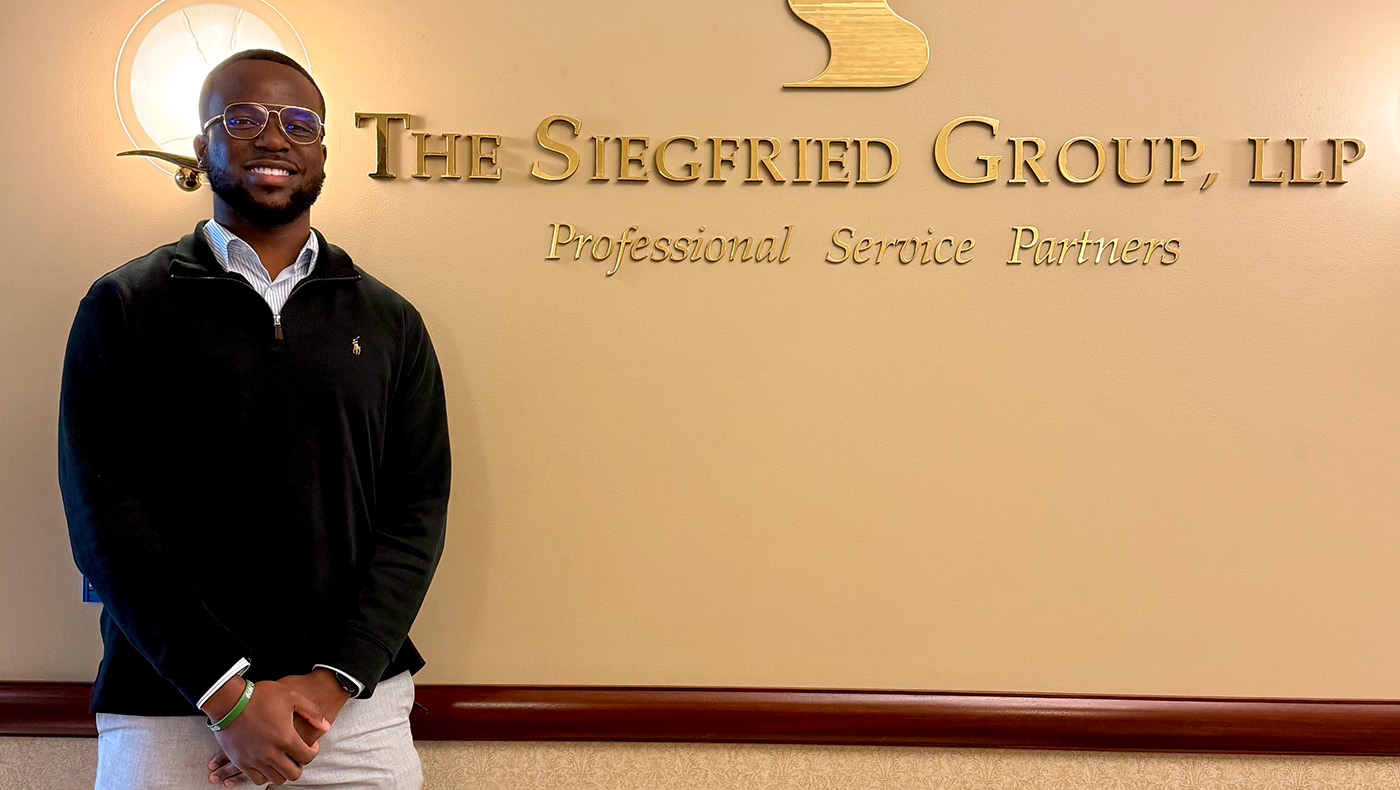
Last fall, Elzey supported CSC’s sales enablement team by cleaning data, identifying leads through the company’s customer relationship management system, updating metrics and trackers and creating presentations. In June, he began a second role as an operations analyst with The Siegfried Group in Wilmington.
The experiences taught him more than workplace mechanics; they showed him how his academic preparation could translate into professional responsibilities.
Coursework in data analytics prepared Elzey to clean data and use Excel, skills he later applied at CSC. Classes in client and project management also gave him a foundation he could use in the workplace.
The co-op experience gave Elzey something employers increasingly seek: experience that goes beyond the classroom.
“Looking at job descriptions, a lot of them require you to have two years of entry-level experience,” Elzey said. “So now, because I’m involved with this program, I have that experience in the job force.”
For Thomas Ciborowski, the co-op program provided a different but equally valuable opportunity: a way to complete his academic requirements while gaining extensive professional experience.
Ciborowski, a double major in finance and financial planning and wealth management graduated in the spring. Last fall, he joined Exelon’s revenue requirements team at Delmarva Power in Newark. He was attracted by the opportunity to work while continuing his studies.
“I thought it would be awesome to have the ability to both work an internship and complete my schoolwork at the same time,” Ciborowski said. “I thought it was the perfect opportunity to get two things done at once.”
The co-op’s flexibility made that possible. Ciborowski built his class schedule around his work responsibilities, used Exelon’s remote-work options and adjusted his schedule as his academic load changed. At one point, he worked about 25 hours a week while taking four classes. He also completed an asynchronous course during the Winter Session while working full-time.
Over time, his responsibilities at Exelon grew.
What began with organizing materials for a major regulatory filing eventually developed into more substantive financial and analytical work. Ciborowski prepared filings, worked with depreciation schedules and amortization and completed a 12-month rate-of-return filing that he presented to managers and the team director.
The role also exposed him to an area of business that he had never encountered in the classroom.
“There isn’t an electrical utilities or public utilities class you can take to learn how to do this stuff,” Ciborowski said. “So it was a lot of learning on the job.”
That progression ultimately led to a full-time offer. Ciborowski now serves as a financial analyst on the revenue requirements team.
Ciborowski’s experience illustrates one of the program’s most important potential outcomes: transforming an academic opportunity into a career.
White said that outcome is becoming more common as students and employers become familiar with the model. The program has evolved into a flexible, year-round hiring system, allowing employers to bring students aboard when they have openings rather than being limited to traditional semester timelines.
That flexibility benefits both groups. Students gain extended opportunities to develop skills and build relationships, while employers gain access to students who can become productive team members over time.
White said the goal is not simply to increase the number of co-ops. Program quality remains central, including whether students receive full-time offers after completing their experiences.
“I wish I’d had something like this when I was younger,” he said. “What’s a good fit for you? Where are you going to feel like you’re giving yourself a chance to be happy in a role and an industry?”
For Elzey and Ciborowski, the Lerner Co-op helped clarify what came next, both during undergraduate studies and after graduation. It turned their remaining time on campus from a simple series of classes into a clear, intentional launchpad for life after graduation.
Organizations interested in partnering with top student talent can learn more about hiring through the Lerner Co-op Program here.