


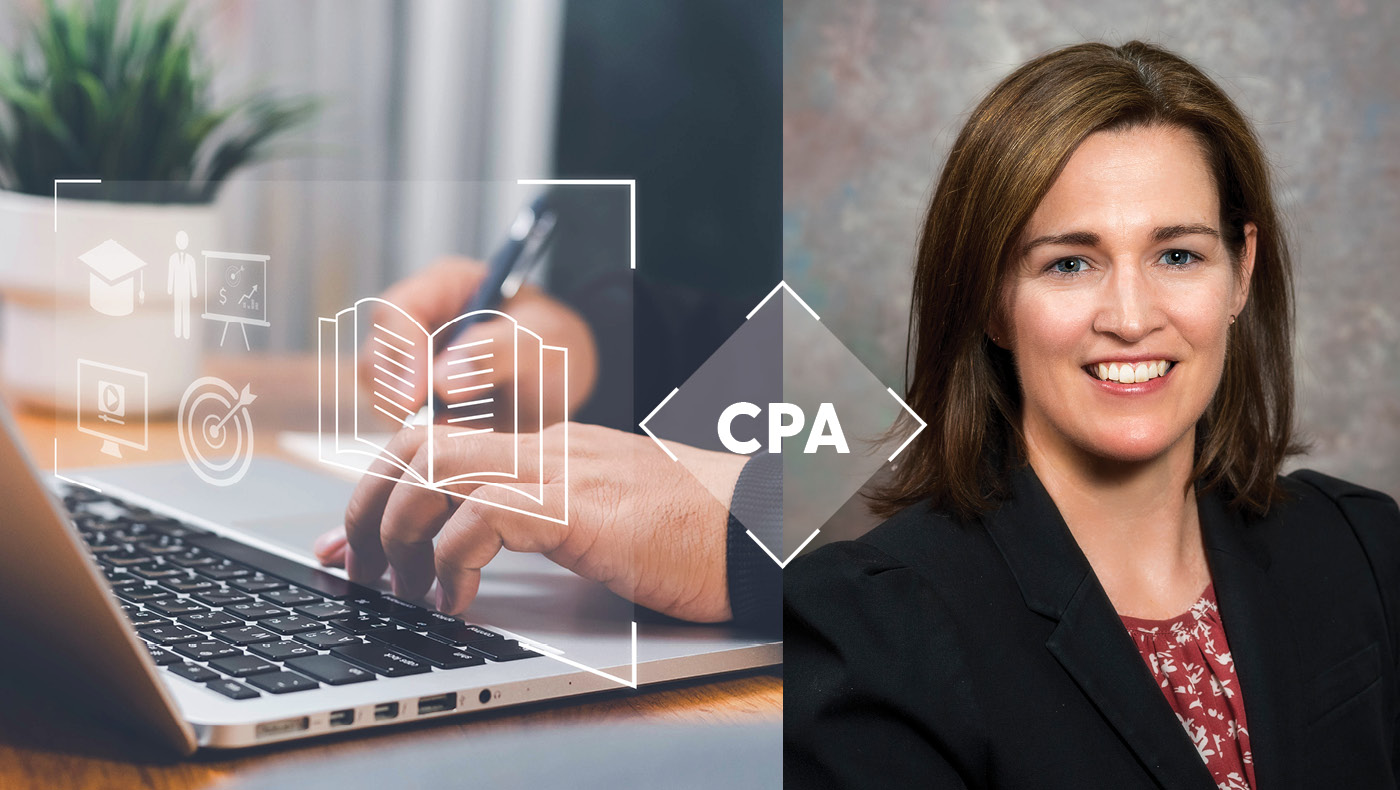
In addition to their regular coursework, accounting majors in the University of Delaware’s Alfred Lerner College of Business and Economics have the option to begin preparing for the Certified Public Accountant (CPA) exam before graduation.
Candidates must pass the Uniform CPA Examination, a four-section, 16-hour assessment required for licensure. While some students wait until graduation to begin the process, Lerner students wanting to get an early start can receive assistance from Associate Professor of Accounting Amanda Convery.
Convery, who assumed the advising role in 2023, created what she calls a coaching platform that provides videos and resources for two of the four sections of the exam that students commonly take first: Financial Accounting and Reporting (FAR) and Audit and Attestation (AUD).
Convery combines Canvas, UD’s online learning management system, and Becker, a well-known CPA review platform, to provide informational tips for instructional support and study guidance.
“My videos are coaching toward some of the technical questions, and also how to get yourself organized for the exam and plan your study,” Convery said. “These are four, four-hour exams, which for most of our students will be the longest exams they’ve ever taken. They cover everything they’ve learned as an undergraduate, and then a lot more.”
In addition to the videos, Convery also holds office hours for students who need one-on-one guidance throughout the process.
For Lindsey Hallett, who graduated from UD last year with an accounting degree and now works at Ernst & Young, the program provided her the opportunity to begin the CPA process earlier than she otherwise would have. “Without the program, I probably wouldn’t have started looking into it until after I graduated and started working,” Hallettsaid. “But given that it was a program set up at UD, that’s when I started to look into it, and I’m glad I did.
Hallett said Convery first helped her navigate the application process, which can be confusing because of the varying state requirements and strict guidelines.
Convery’s videos broke down difficult topics and offered tips that went beyond the material. Some would feature technical nuances, but others would cover something simpler like structuring a study schedule.
Matt Parente, a senior accounting and finance double major, remembered being a bit overwhelmed with all the rules, and admitted that without Convery’s program he wouldn’t have started at all.
“I used it over the summer before I even had access to Becker (through my internship),” Parente said. “It gave me a huge jumpstart. I never planned on being this far ahead.”
Instead of waiting until after graduation, Parente passed the FAR section, during the summer, and then AUD section during winter session. He passed his third section, Regulation (REG), in March.
“I never planned on being this far ahead. But once you pass one it clicked, you realize you can actually do it. I’ve caught the bug of trying to get it done,” said Parente, who interned last summer at EY and got a return offer following graduation.
Convery admitted there are many roadblocks that can get students stuck, so she removed as many as possible.
The program is free, which alone made it unique. At many universities, similar support exists only as paid elective courses. At Lerner, students can begin preparing while still undergrads, often studying 10 to 15 hours a week alongside their classes.
About one- quarter of the students she works with, about 40 to 50 per year, are alumni, continuing the process after graduation. It’s not unusual for her to stay connected with students for a full year or more.
“That’s one of the best parts,” Convery said. “You see them grow, not just academically, but professionally.”
For Richie Weissenborn, a 4+1 graduate student who earned his bachelor’s and master’s degrees in accounting and will begin working at KPMG this fall,, that connection makes a critical difference.
During winter break, Weissenborn prepared for the AUD section of the exam. Like many students he relied on Becker, but it was Convery’s guidance that helped him avoid costly mistakes.
“There are things you wouldn’t even think about, like making sure your name is entered exactly right when you apply. Even coming out of UD’s undergrad program, I didn’t really understand the CPA procedure very well, so Professor Convery’s program definitely helped,” Weissenborn said.
The CPAprocess can be long and demanding. CPA candidates have 18 to 30 months after passing their first section to complete the remaining three. The clock adds pressure, and initial failure was part of the process for many. But again, Convery was there to help.
“I think the people it helps the most are the ones who don’t pass the first time,” she said. “They might think about giving up, but we sit down and figure out what needs to change.”
The results have been strong. While the 2025 pass rates nationally for these sections are around 45%, the students participating in Covery’s program had a 65% rate. When factoring in second attempts, over 80% of students in the program passed one of their sections.
“So it’s cool to see that jump,” said Convery. “Because without the help some of them would have said forget this.”
For Hallett, the biggest impact wasn’t just passing exams, it was confidence.
“(The program) gave me the foundation for the first two sections, and the strategies to get through the rest,” Hallett said. She also mentioned that once she graduated, it became harder to get back into studying mode.
Parente and Weissenborn agreed. For Parente, the motivation was simple: finish as much as possible before real life takes over.
“The idea of having a summer without worrying about it,that’s a big motivation,” Parente said.
“It becomes harder to pass the longer you wait out of college, because you want the material fresh in your head,” Wasserman added.
For Lerner students pursuing the CPA credential, the coaching platform provides a headstart, through a rigorous process that’s as much about discipline as knowledge.
And for the students making that early progress, the long, difficult and demanding journey feels worthwhile.
“It’s a lot of work,” Hallett said. “But it’s worth it.”