


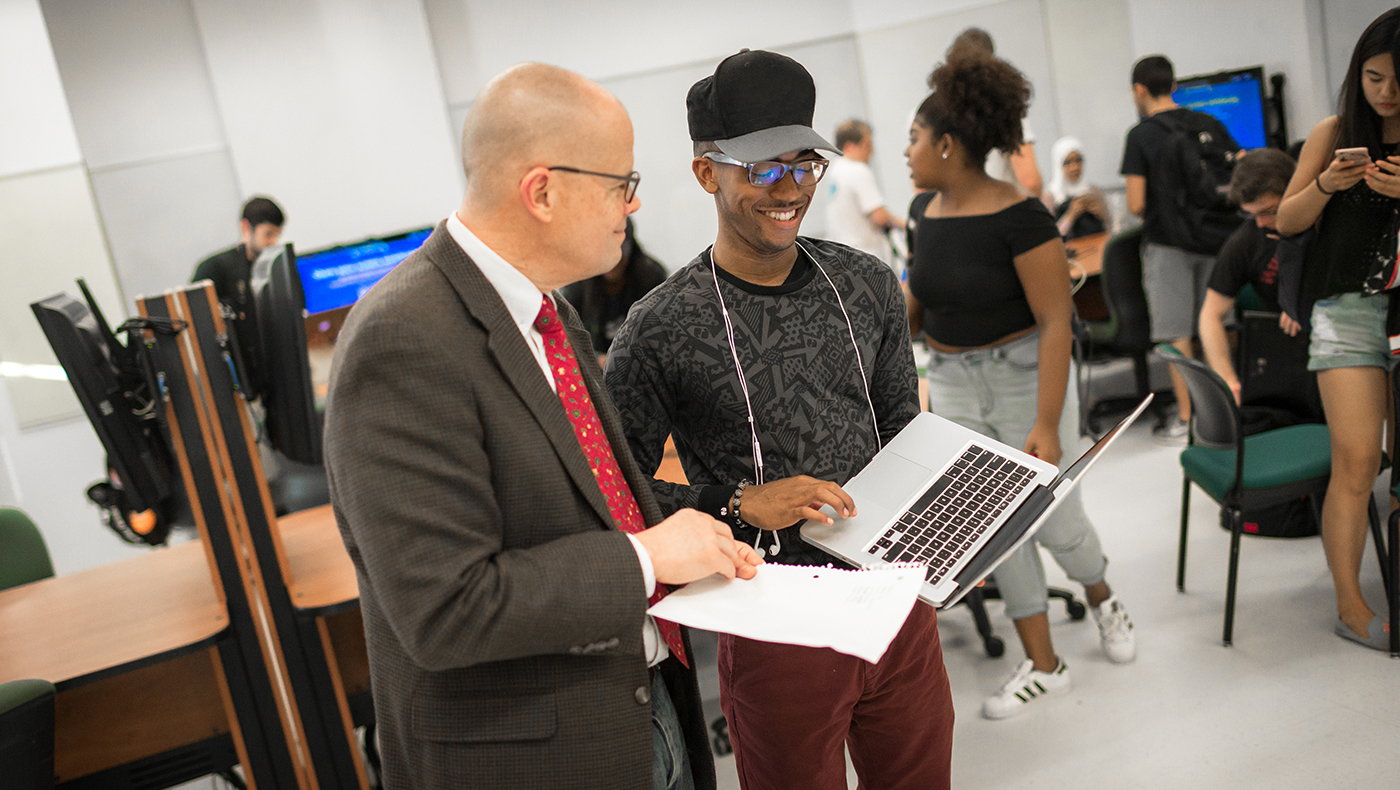
Research has consistently found that students who are engaged in their learning develop a deeper understanding of material. To encourage college instructors to implement an established pedagogy of engagement in their classrooms, Mark Serva, associate professor of management information systems at University of Delaware’s Alfred Lerner College of Business and Economics, presented “Developing and Revising Problems” at UD’s Problem-Based Learning Workshop in January 2024.
Serva, a member of the Institute for Transforming University Education (ITUE) Board of Leaders, notes that problem-based learning (PBL) encourages students to engage more actively in the material, because the concepts are presented as a problem or puzzle to solve. The problem must also have a successful “hook” to spark student interest and motivate them.
While problem-based learning originally emerged in the United States from medical school education in the 1970s, Serva noted that PBL is an established, global phenomenon, with prominent universities in Europe (Maastricht, Aalborg), South America (PUCP), Asia (Singapore Polytechnic), and Canada (McMasters) adopting the pedagogy. PBL can be used across disciplines, but–like any other teaching approach–it must be adapted by professors according to their discipline’s needs and goals.
The goal of the January 2024 ITUE workshop was to inspire professors from UD and other institutions to implement PBL within their own classrooms, as well as aid them in constructing their first problem. Serva noted that ITUE has found that writing one’s first problem is the most difficult aspect for instructors implementing PBL in their courses, so ITUE workshops often focus on supporting the instructors in their problem-writing efforts.
Serva implements PBL within his own classroom in a variety of ways. For example, he requires students to take a quiz on the first day of class before there is any teaching to encourage students to discuss, debate, and reinforce fundamental concepts. In addition, students in Serva’s introduction to programming business applications class are given collaborative exercises to work on, which are later discussed as a class. Students build the foundation for learning on their own–and then the concept is reinforced later by the professor. To Serva, these critical thinking processes build a more comprehensive understanding of material.
For almost 30 years, UD’s ITUE has encouraged instructors to implement approaches that require students to play an active–rather than passive role–in their learning. When such approaches are effectively implemented, deep learning is achieved. ITUE has also worked to enable teaching approaches that enable students to find significance in the content and connect the concepts to their future professional career.
Serva attended one of ITUE’s workshops in 2003 and was immediately impressed; he had always been passionate about teaching and was delighted to find a group of like-minded educators. Since then, Serva has been an active member, as well as director of the organization for over twenty years. ITUE is a completely volunteer program run solely by faculty with little administrative assistance. “All members work together,” Serva said. “Collaborative work is the norm.”
To Serva, being an ITUE member is incredibly rewarding because of the opportunity to work with passionate and innovative teachers: “Just listening to other members’ ideas improves my own effectiveness in the classroom.” In addition to Serva, the ITUE Board of Leaders includes Phil Duker (Music), who is ITUE’s Director; John Jungck (Computational Biology and Bioinformatics); Jacqueline Fajardo (Chemistry and Biochemistry); Agnes Ly (Psychological and Brain Sciences); Adebanjo Oriade (Physics); and Lydia Timmins (Communication).
Any UD faculty member interested in learning more about ITUE can contact Serva at servam@udel.edu.