


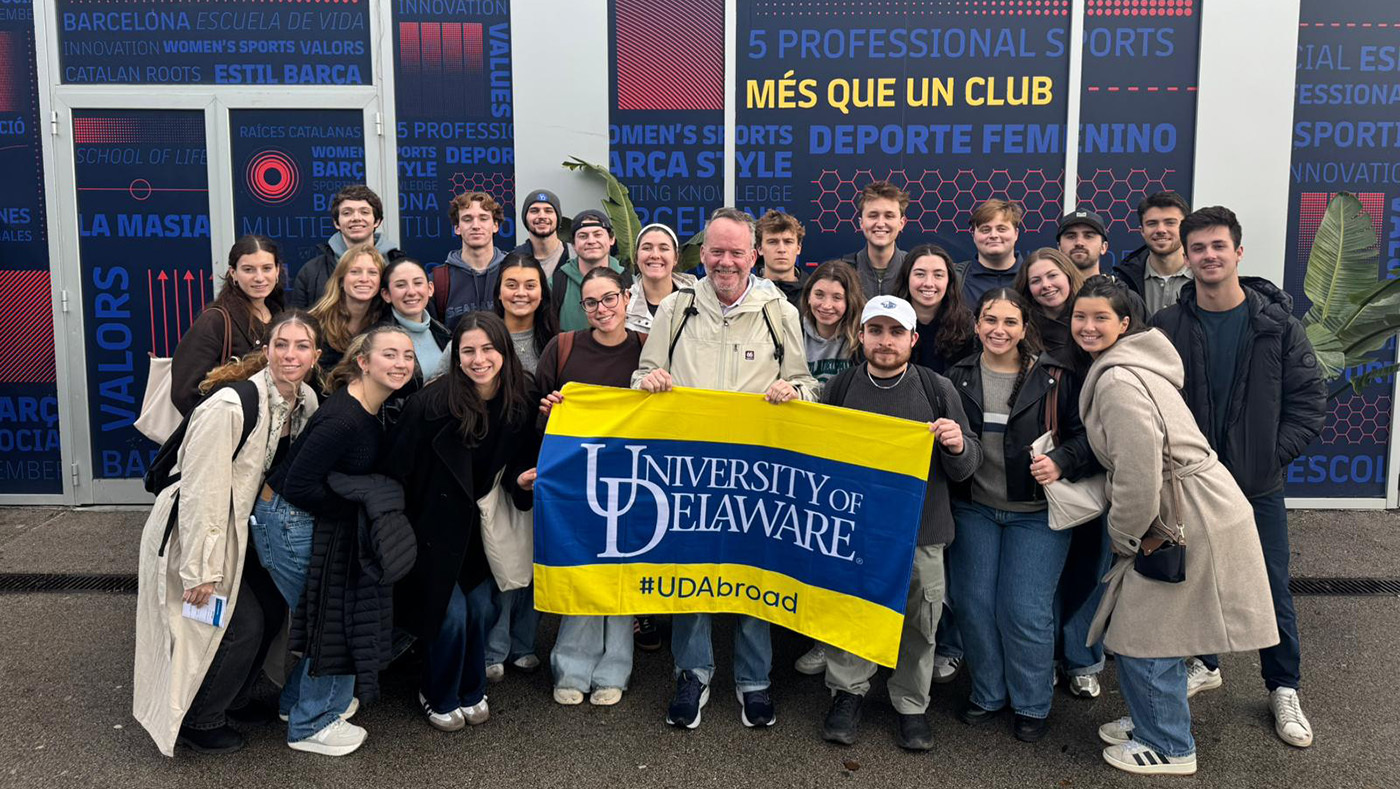
Experiential learning took center stage as sport management students in the University of Delaware’s Alfred Lerner College of Business and Economics traveled abroad during the Winter Session for a study abroad program focused on global sport event management. This program, led by Instructor of Sports Management John Allgood, was one of nine study abroad courses offered by Lerner this past winter session. Students were immersed in four of Europe’s most influential sports cultures in the Netherlands, Belgium, Germany and Spain.
The program began in Amsterdam, with visits to Topsport Amsterdam and the Amsterdam University of Applied Sciences. Students also explored sport media and production at ESPN Netherlands and toured Johan Cruijiff Arena, home of AFC Ajax. The group then traveled to Brussels where students visited the University of Brussels and learned how public-private partnerships support athletic facilities and operations. A visit to RSCC Anderlecht taught the groups about innovative premium seating strategies, corporate partnerships and the growth of women’s soccer. The program continued to Cologne with a visit to the German Olympic Museum and a live soccer match, before concluding in Barcelona. There, students attended lectures at the Blanquerna School of Health Sciences, toured Cam Nou and the Barcelona Olympic Stadium.
“Experiential learning is at the heart of sport management,” said Allgood. “This program allowed students to learn directly from international executives while experiencing global sport culture firsthand.”
Lia Samuels, a senior sport management major and Grant Lutes, a senior sport management major with a minor in event management, discussed their key takeaways and lessons from the trip.
Lerner: What was your favorite part of the trip?
Samuels: My favorite part of the trip was the cooking class in Barcelona because it combined culture, connection and fun in a really meaningful way. Being able to cook together, laugh and learn something new created a relaxed environment where everyone could bond and reflect on our shared experiences. After spending three weeks traveling, learning and growing together, the class felt like a celebration of everything we had experienced as a group. It was the perfect ending to the trip and left me with the memories that I’ll always associate with study abroad and the friendships I built along the way.
Lutes: My favorite part of the trip was how we got the opportunity to visit four different cities/countries in our short time away. I feel like we got to see so many different things and places, and only having a few days in each city really pushed us to constantly be doing something, to take full advantage of the time we had in each city. I feel it was the perfect mix of having time to learn the culture while also doing all of the touristy activities.
Lerner: Which stadium or venue did you enjoy touring the most, and what did you get out of that experience?
Samuels: My favorite venue that we toured was the 1992 Olympic Stadium in Barcelona! We took a cable car up to Montjuic where the Olympic Museum and stadium were. I learned so much about the history of the Olympics and the original Olympic games and how it has evolved to what it is today. I also learned about the impact that historical events had on the Games, like WWI and WW2, and how it served as a way to bring the world together. Barcelona also took advantage of hosting the Olympics and used it as a way to rebuild the city with its infrastructure and turned it into a place that people would want to visit. It was also very exciting to see a stadium where the Olympics was actually held!
Lutes: Johan Cruyff Arena in Amsterdam is the home of the soccer team Ajax and was one of my favorite stops on the trip. Our tour brought us through the locker rooms, onto the field, showed us where press conferences take place and much more. I wasn’t super familiar with soccer and especially Ajax going in, but throughout the tour, we got to see all the exclusive areas throughout the stadium while learning the very deep history of not just their club and stadium, but also soccer legend Johan Cruyff who the arena is named after. This is something that even people in other countries we visited were jealous of us getting.
Lerner: What were some key takeaways from the lectures and/or presentations you attended?
Samuels: One of my key takeaways from the lectures and presentations was the difference in how sports are viewed in Europe compared to the United States. In Europe, sports are not treated as a massive commercial industry in the same way they are in America. There is no college sports system like the NCAA, where athletics generate a lot of revenue, media attention and brand value for universities. Instead, athletes typically develop through club systems or national training programs, with a strong emphasis on long-term skill development instead of entertainment or profit. Many athletes train with the goal of competing professionally or representing their country in international competitions such as the Olympics. This structure highlights how European sports culture prioritizes development and participation over commercialization, which differs from the business-driven model of American sports.
Lutes: There are so many different jobs and roles open in the sports industry, not just working for a school or team. Many of the people we spoke with had jobs in different business fields or for companies that I had never really known existed, or how much they connected to sport. It was also really cool to learn more about how each country views the Olympics and how their national teams are organized. This was a topic that we covered everywhere we went, but the answers were very different in each place, which is something I had never realized. One thing that we did at almost every lecture was compare and contrast the ways that sports operate or are organized here in the U.S. against whatever country we were in. It was truly eye-opening as I think many of us had just kind of assumed things would be similar to the U.S., but that was definitely not the case.
Lerner: What were your favorite activities during your free time?
Samuels: My favorite activities during my free time were tasting the food of the city and experiencing different cultures through their cuisine. Trying local dishes allowed me to learn more about the traditions and history of each place, since food reflects the values and lifestyles of the people who live there. Exploring markets, restaurants and cafes became a way to connect with the city beyond tourist attractions. Each meal felt like an opportunity to understand the culture on a deeper level and made my free time both enjoyable and meaningful.
Lutes: We spent a lot of our free time exploring the cities we were in by experiencing the culture first hand, trying local restaurants and going to museums. It was really cool to go with such a large group, as no matter what you wanted to see or do, you could always find people willing to go along. The highlight of each place for me was the Heineken experience in Amsterdam, trying authentic Belgian waffles in Brussels, going to the Lindt chocolate museum in Cologne, or having an authentic Spanish cooking class in Barcelona. No matter where we went, it was such an amazing experience to dive into these different cultures and experience these things with others on my trip.
Lerner: How did this trip enhance your Lerner education as a sport management major? Did it solidify your intention to enter the sports field after graduation?
Samuels: This trip greatly enhanced my Lerner education as a sport management major by giving me real-world exposure to how sports systems operate outside of the United States. Seeing first-hand how European sport structures differ from the American model helped me better understand concepts we learn in class, such as governance, athlete development and the role of sport in society. The lecture and site visits connected theory to practice and challenged me to think more globally about the sports industry. This experience also solidified my intention to enter the sports field after graduation, as it confirmed my interest in learning how different models can influence athlete development, business decisions and the overall culture of sport.
Lutes: This trip made me realize that sports are meaningful all around the world and there are so many jobs and people involved that I had no idea about beforehand. I feel like this trip not only reinforced my intention to enter sports after graduation, but also opened my eyes to many different jobs that are out there, and also made me realize that there are opportunities to work in sports in all parts of the world. I also learned a lot of helpful information about networking and how to get into the industry through the lectures, which also helped reinforce my intention.