


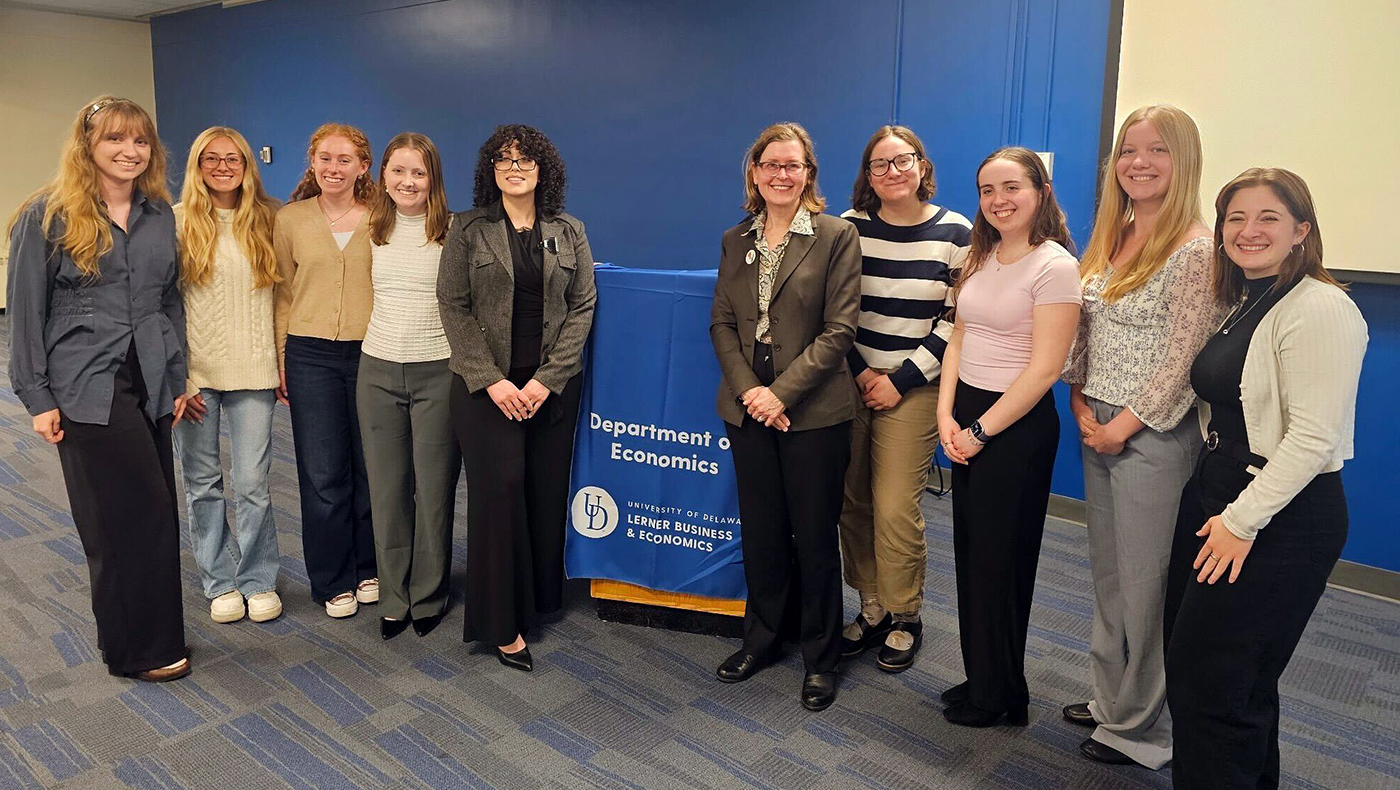
The University of Delaware’s Alfred Lerner College of Business and Economics, in collaboration with Women in Economics, hosted the 2026 Hutchinson Lecture on April 20 in the Perkins Student Center.
This year’s lecture, Investing in Children to Address the Youth Mental Health Crisis, featured economist Janet Currie, the David Swensen Professor of Economics at Yale University, whose work focuses on child development and public policy.
This year’s topic of youth mental health resonated deeply with students and organizers alike.
“Women in Economics was especially motivated to help organize this year’s Hutchinson Lecture because of its focus on youth mental health, an issue that directly affects students and is often under-discussed,” said club president Madeline VanBuren. “It was an opportunity to show how economic tools can be used to understand and address deeply human challenges.”
Currie’s lecture framed youth mental health not only as a public health issue, but as a significant economic concern. Approximately 13% of youth in the United States experience mental health conditions, contributing to an estimated $31 billion in annual healthcare spending. Beyond these direct costs, the effects ripple outward – impacting parental productivity and shaping long-term outcomes in education, employment and overall well-being.
One of the most compelling aspects of the lecture was its challenge to common misconceptions. While many believe youth mental health has sharply declined in recent years, Currie explained that rates of psychological conditions have remained relatively stable since the 1970s. The apparent increase in diagnoses is largely due to improved screening, expanded insurance coverage and reduced stigma.
VanBuren noted that this reframing was particularly impactful.
“A key misconception that stood out was the tendency to view mental health issues as purely individual rather than influenced by structural and environmental factors,” she said. “The lecture really emphasized how policy, access to resources and socioeconomic conditions play a major role.”
The lecture further emphasized solutions, including early childhood interventions, school-based mental health services, anti-bullying initiatives and expanded access to care. These strategies, Currie argued, offer meaningful long-term benefits for both individuals and society.
For Women in Economics, the event aligned closely with its mission to broaden how students understand the field.
“The Hutchinson Lecture series exposes students to influential voices while showing how economics applies to real-world issues like policy and equity,” VanBuren said.
The event drew strong student engagement, sparking thoughtful discussions that extended beyond the lecture itself. According to VanBuren, this kind of conversation is exactly what makes events like the Hutchinson Lecture valuable.
“Even for non-majors, it shows how economics connects to public health, education and social policy. It makes the field feel more relevant and accessible,” she said.
Behind the scenes, organizing the lecture required collaboration across faculty, departments and student organizations. From securing a speaker of Currie’s caliber to coordinating logistics and promotion, the process was extensive, but rewarding.
“The most fulfilling part was seeing everything come together, especially the strong turnout and meaningful conversations that followed,” VanBuren shared.
Ultimately, the 2026 Hutchinson Lecture helped students see economics not just as markets and data, but as a way to improve people’s lives. By highlighting youth mental health as both a social and economic issue, the event encouraged students to think more broadly about the challenges facing their generation and the role they can play in addressing them.
The Hutchinson Lecture in Macroeconomics was established in 1990 in memory of Professor Harry D. Hutchinson, who served in the economics department from 1959 to 1989. Over the past three decades, the series has built a strong tradition of bringing leading scholars and policymakers to campus each spring, giving students the opportunity to engage directly with influential voices shaping the field of economics.