


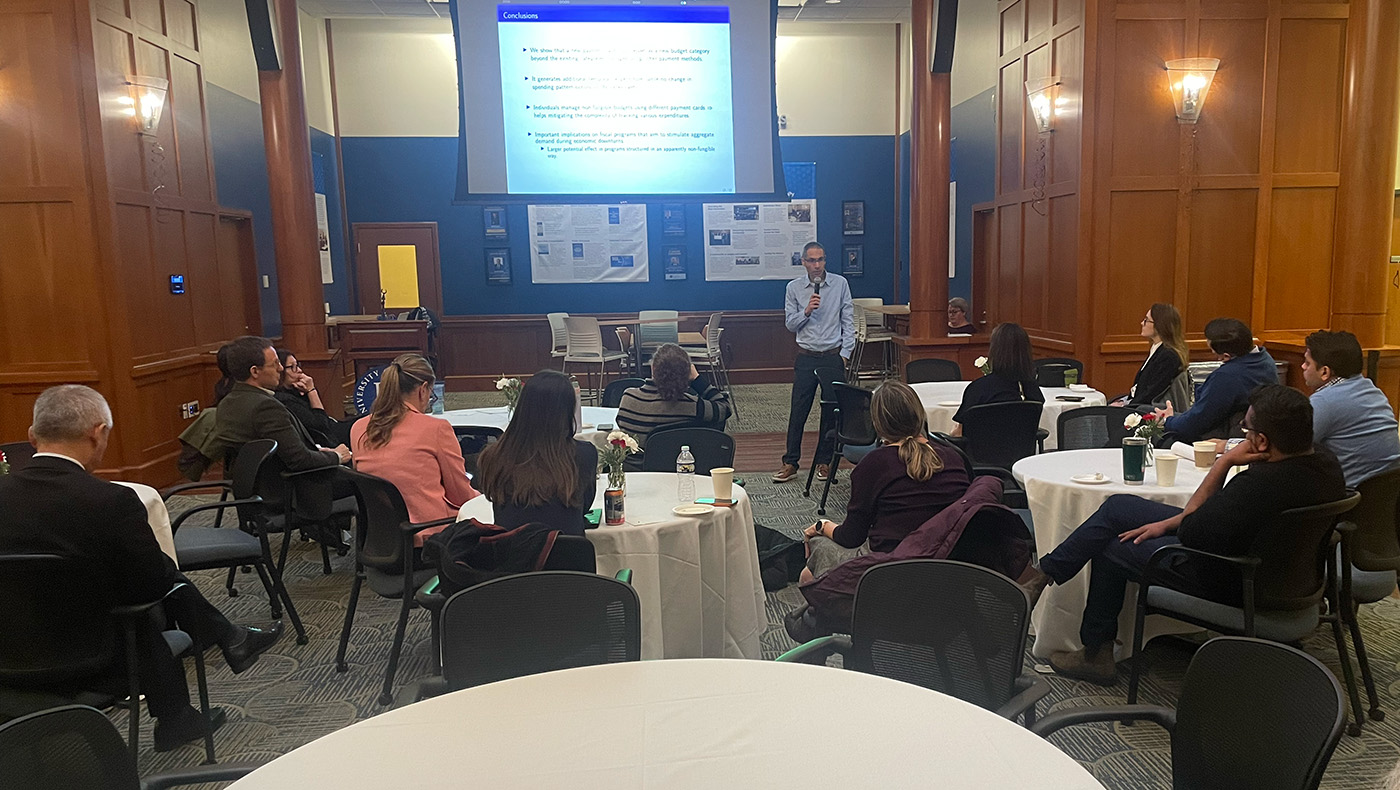
Earlier this month, four distinguished professors in University of Delaware’s Alfred Lerner College of Business and Economics presented their recent findings and research methods during Lerner’s Faculty Research Showcase held in the Lerner Atrium. Below are summaries of the presentations:
Beth Schinoff, Assistant Professor of Management
“A window into coworkers’ worlds: The relational outcomes of learning vivid, unintentional, and nonwork-related information about coworkers.” Academy of Management Journal
Schinoff’s research examined how remote video meetings shape coworker relationships by revealing vivid, unintentional glimpses into colleagues’ non-work lives. Although remote work often reduces opportunities for informal interaction and can increase social distance, video calls create boundary-blurring moments – such as children, pets, or home environments appearing on screen – that allow coworkers to learn personal information in a more authentic, less curated way. Across multi-method studies, Schinoff found that learning non-work information in this vivid, unintentional manner made coworkers seem more authentic, human, and trustworthy. These perceptions increased employees’ motivation to invest in both work and personal aspects of the relationship. Her work challenges the view that remote work weakens relationships, showing instead that spontaneous personal disclosures can strengthen them.
Barton Willage, Associate Professor of Economics
“The effect of labor market shocks across life cycle.” Journal of Labor Economics
Willage’s research examined how involuntary job loss – measured through mass layoffs and firm closures – affected workers differently across the life cycle using Norwegian administrative data. By comparing long-tenured workers in firms experiencing large employment shocks to similar workers in stable firms, the study identified causal impacts on employment, earnings, education and labor-force exit. Job displacement led to immediate and persistent losses in both employment and earnings, but the magnitude and mechanisms varied sharply by age: younger workers commonly returned to school and eventually recovered more strongly, middle-aged workers reattached to employment relatively quickly, and older workers experienced the largest long-term earnings declines and frequently exited the labor market through disability or early retirement. These findings highlighted the need for age-targeted labor-market policies, as uniform unemployment insurance systems fail to address the heterogeneous consequences of job displacement.
Leting Zhang, Assistant Professor of Management Information Systems
“Does sharing make my data more insecure? An empirical study on health information exchange and data breaches.” MIS Quarterly
Zhang’s research examined how joining a Health Information Exchange (HIE) affects hospitals’ data-breach risk, addressing concerns that increased data sharing may heighten cybersecurity vulnerabilities. Using data from over 3,000 U.S. hospitals (2010–2015) and a difference-in-differences design, she found that HIE participation actually reduces breach risk by about 43%, largely because HIE governance mechanisms improve overall security practices. The benefits are strongest for hospitals with strong pre-existing IT security and for those in states with enforced HIE security laws, showing that both internal capacity and external regulation matter. Notably, HIEs reduce IT system and hacker-related breaches, but have little effect on physical or accidental disclosure incidents. Overall, the study demonstrated that effective governance and preparedness enable data sharing initiatives to enhance rather than jeopardize cybersecurity.
Michael Gelman, Assistant Professor of Finance
“Managing mental accounts: Payment cards and consumption expenditures.” The Review of Financial Studies
Gelman’s research showed that households use mental accounting to guide spending decisions, treating new payment tools as distinct budget categories rather than as part of a unified pool of resources. Using a natural experiment in Israel, where customers were unexpectedly required to adopt a new credit card, he found that simply receiving the new card led to a temporary 30% increase in spending, entirely concentrated on that card while leaving existing card usage unchanged. This behavior occurred without any change in actual income or credit limits, demonstrating that families perceived the new card as a new “account” and increased consumption accordingly. The results challenge traditional economic predictions such as the Permanent Income Hypothesis and highlight how the labeling and structure of payment instruments can meaningfully influence short-run consumption.