


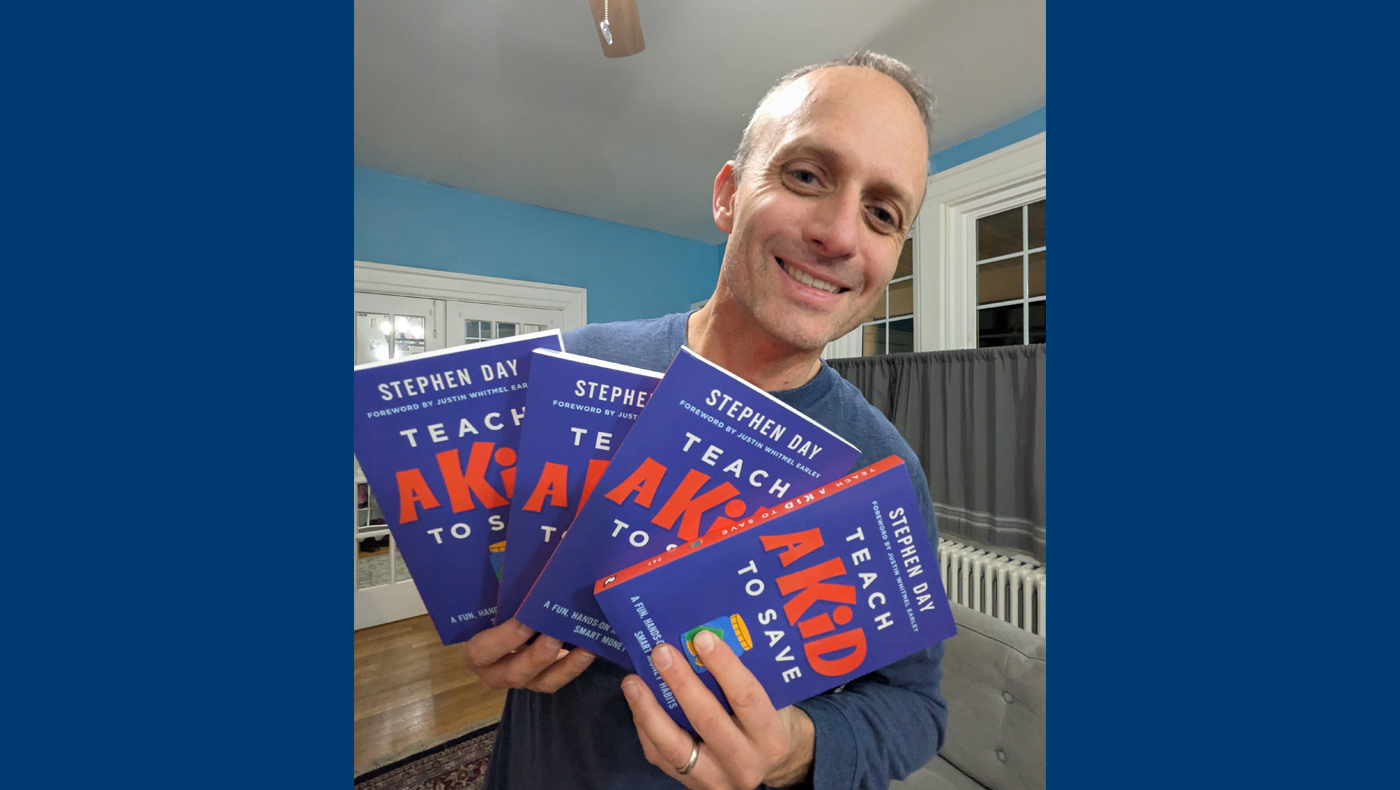
Stephen Day, Director of the Virginia Commonwealth University Center for Economic Education, is a 2009 graduate of the Lerner College’s MAEEE program whose career spans teaching, curriculum development, and national and global economic education work. He is the author of Teach a Kid to Save, a hands-on guide to helping families build strong money habits, and continues to lead teacher training, research and outreach efforts through the Virginia Council on Economic Education. Day credits MAEEE with shaping his teaching direction and expanding his impact across classrooms, communities and beyond.
What is your job title and name of school, district, or organization?
Director, Virginia Commonwealth University Center for Economic Education
What exciting news or accomplishments have you been a part of?
I wrote a book! It’s called “Teach a Kid to Save: A Fun, Hands-on Approach to Building Smart Money Habits.” I used what I learned in the MAEEE program to bring the classic mini-economy program home to parents. Parents really want to teach their kids about money, but most don’t know how. The book shows how to build money habits, not just knowledge. It shows parents how to give their kids practice with money. Besides that, I work for the Virginia Council on Economic Education, running the center at VCU. I do lots of teacher training workshops, curriculum writing, research and publications. I love this job! I have a Substack blog called “Paper Robots: Helping Families Talk About Money and Work.”
Why is this news valuable to your colleagues or educators considering the MAEEE program?
I’m still in the middle of the Econ Ed world. I owe so much to this community, and I want to keep them updated.
What did you learn through your MAEEE experience that you wouldn’t have learned anywhere else?
I remember Day 1 hearing the Economic Way of Thinking lecture by Professor John Brock. I was pretty good with economics already, but the teaching plus the whole environment really motivated me to go in a new economics direction. (I had been mainly a world history teacher before this). I also remember all the tough conversations about monetary policy with Professor Jim Butkiewicz, and the trips to the Fed and other think tanks in D.C. Our MAEEE class straddled the 2008-2009 financial crisis, so these conversations were real! Most shockingly, the Fed economists seemed about as confused by the crash as we were – real-world learning, for sure.
Describe an important connection you have made through your graduate program (personal, professional, peers, mentors, professors, etc.)
I think I made the #1 best connection in all of MAEEE history. It went like this: I was doing a teacher training workshop as part of my Implementation Project. In the post-workshop evaluations, one of the comments was “Loved the workshop! Also, would you like to meet my niece? She’s an art history professor, loves to travel, likes coffee, is pretty, and a Christian.” I agreed to meet her … and ended up marrying her. We’re celebrating 16 years and four children in 2026! I can’t guarantee this outcome for all MAEEE graduates – but it could happen!
What other opportunities has the MAEEE degree provided you?
Being plugged into an awesome network of scholars and teachers. I’ve gotten to travel to Tanzania and (soon) Peru for econ teaching and study.
If you were to describe your classmates in one word, what would that be?
Congenial!
Fill in this sentence: “The MAEEE graduate program helped me become…”
The professional that I am today – someone who loves to go to work each day.
What piece(s) of advice would you give to current MAEEE students or prospective applicants?
Use the Implementation Project to build momentum for future connections and projects. It makes your job more fun and your impact greater. It opens the door to more opportunities.
Read more about Stephen Day’s work: www.drstephenday.com