


This article was written by Cori Burcham.
Lessons learned through storytelling have a way of staying with us, as if the lived experiences of a beloved character become our own. This was the premise behind Econ Dinner and a Movie: Wonka, a professional development program that used the latest film adaptation of Charlie and the Chocolate Factory — Roald Dahl’s renowned example in marketing and brand storytelling — to help educators teach economics in the classroom.
Offered by the University of Delaware’s Center for Economic Education and Entrepreneurship (CEEE) in the Alfred Lerner College of Business and Economics, the program was designed to help Delaware’s K-12 educators engage their students in economics education through familiar stories. The event featured a screening of Wonka, a dinner sponsored by the Delaware Council on Economic Education with support from Robinhood, educational resources curated by the CEEE and complimentary gift cards from Your Money 101. From supply and demand to market structures, Wonka provided opportunities for K-12 educators to address economics topics aligned with Delaware’s educational standards.
“I have attended several CEEE Econ Dinner and a Movie nights. My favorite part of the event is gaining knowledge that is useful both personally and professionally, and being able to have immediate conversations with other educators about what we’ve learned,” said Jennifer Gould, a second-grade teacher from Thurgood Marshall Elementary School in Newark. “I appreciated that the experts shared real-life economic data and used the movie to relate those facts in the classroom.”
Offering insights on the chocolate industry, featured speaker Anu Sivaraman, associate professor of marketing in the Lerner College, highlighted some of the marketing and economics lessons in the film. According to Sivaraman, Willy Wonka’s chocolates illustrate radical innovation and product differentiation. Hoverchocs and gobstoppers — Wonka creations that other chocolatiers couldn’t replicate — demonstrated how true innovation can change market dynamics.
Using To’ak Chocolate as a real-world example, Sivaraman explained that the luxury chocolate brand offers rare, ethically sourced Ecuadorian Nacional cacao beans for which conscious consumers are willing to pay extra.
“The marketing takeaway is that it justifies premium pricing and direct competition in an industry that looks pretty saturated at this point,” said Sivaraman. The educator angle is that true differentiation shifts the curve, and higher prices and higher quantity can be demanded even in a mature industry — and that’s the golden ticket.”
To help educators apply these concepts, Kylee Holliday, a personal finance teacher at AI duPont High School and a member of the CEEE support team, introduced a classroom activity on “Skimpflation,” when companies reduce product quality while introducing changes as innovation to cut costs.
Referencing a February 2026 Planet Money article, Holliday highlighted a controversy involving Hershey’s product formulation. Educators conducted a taste test and discussed how students could role-play as company decision-makers using the PACED model to address rising cocoa prices. Hershey’s has reverted back to the original recipe.
Sivaraman also highlighted competitive rivalry, comparing the film’s fictional chocolate cartel to real-world market competition. With approximately 70% of the world’s cocoa originating from politically and environmentally unstable regions in West Africa, the global chocolate supply chain is fragile, intensifying competition among major chocolate brands when cocoa prices rise worldwide.
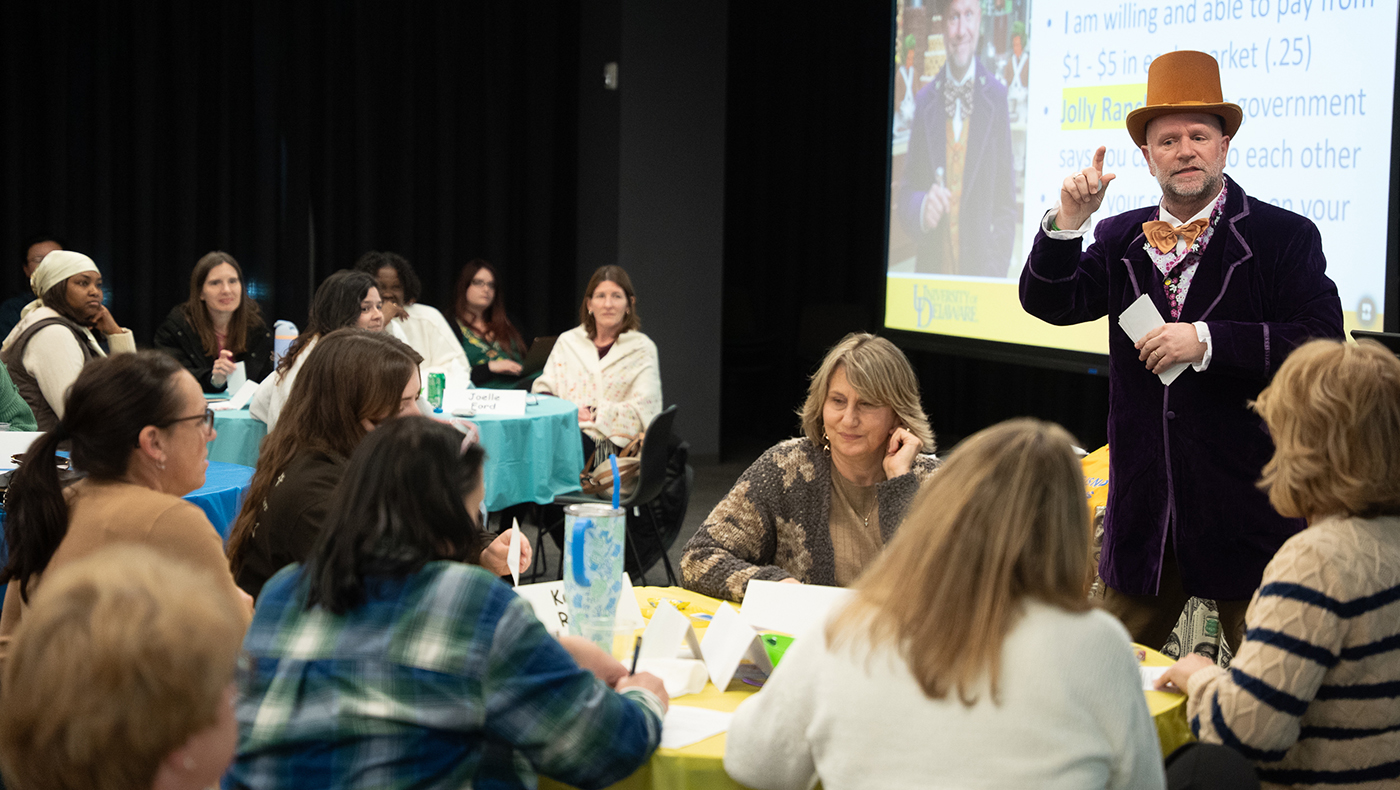
To demonstrate this concept in the classroom, Scott Bacon, the Bonnie T. Meszaros associate director of the CEEE, led an experiential activity geared toward high school students, illustrating various market structures.
He gave teachers different types of candy representing the four market structures: a single large candy bar as a monopoly; three slightly differentiated Jolly Ranchers as an oligopoly; five similar mini candy bars as monopolistic competition; and small identical goods, like Dum-Dum lollipops, as perfect competition. Teachers acted as firms and set prices, while Bacon played the consumer. Each group experienced a different price, with the monopoly charging the highest price, while the lowest price resulted in the perfectly competitive market structure. The game ultimately helps students intuitively understand the varying degrees of market power.
Beyond the structured activities, the lessons from the film also inspired new ideas for the classroom. Similar to the real-world chocolate industry, creating a demand for limited-time flavors and immersive experiences at chocolate factories, Sivaraman noted how Wonka utilized scarcity and exclusive branding to create an intense demand for the golden tickets.
Joelle Ford, a kindergarten teacher from Leasure Elementary School in Bear, developed her own activity on the topic of wants and scarcity.
“Referencing a movie makes the lesson more memorable for students. When we talk about scarcity, I can show them the beginning of the film where Wonka wastes his money buying little things and doesn’t have enough later on to pay for a room,” said Ford, who noted CEEE’s economic movie nights often help her reflect on new ways to explore Delaware’s economic standards.
In another instance of film imitating life, Jennifer Twardowski, a fifth-grade teacher from Thurgood Marshall Elementary School, found community, much like Wonka, at past Econ Dinner and a Movie events.
“By conversing and collaborating with other educators at these events, I’ve made connections in the education world. They are people I can contact if I have questions or want to bounce ideas off of,” said Twardowski, who has attended three CEEE movie nights. “It’s always nice to break bread with fellow educators.”