


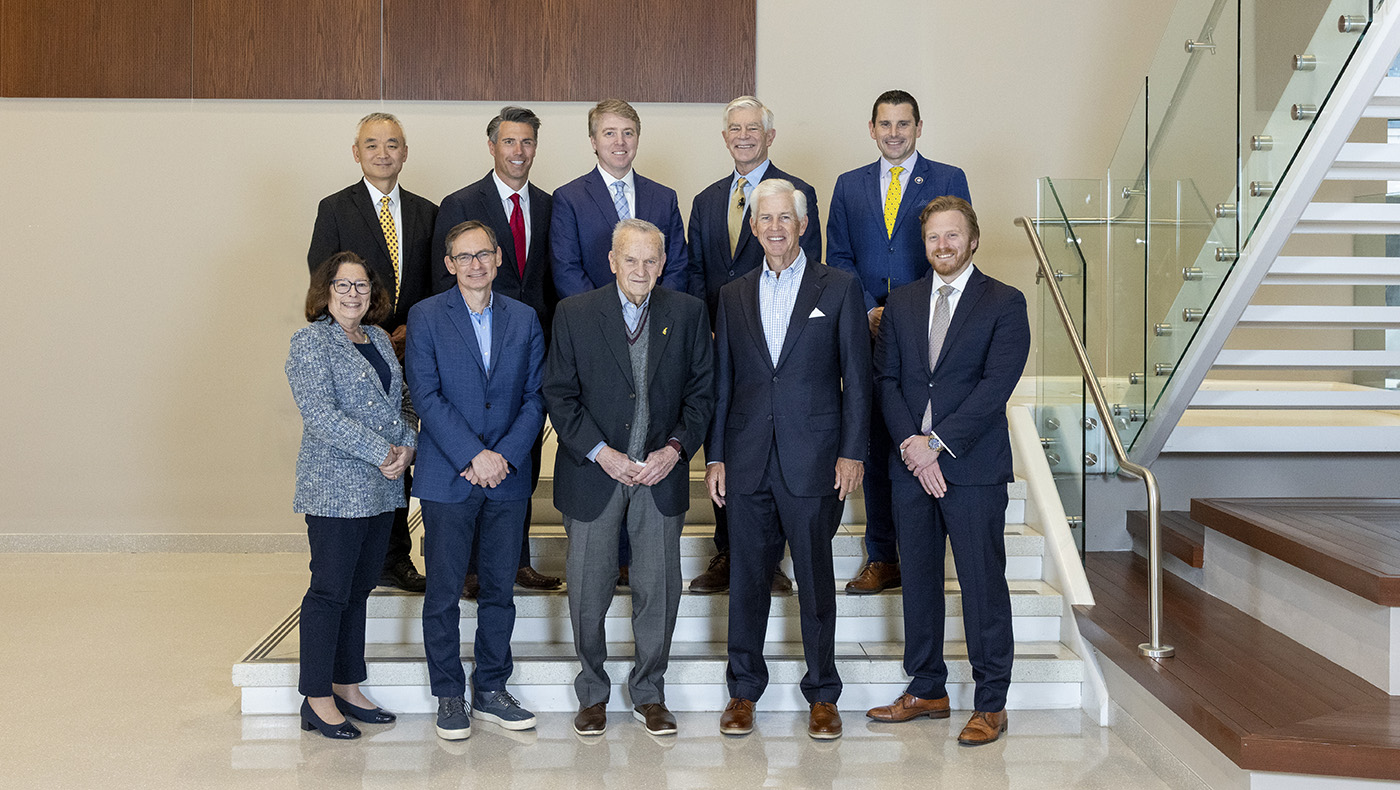
University of Delaware and Lerner College leadership joined speakers and partners at the 2026 Economic Forecast hosted by NFP and the Center for Economic Education and Entrepreneurship. Back row, from left: Oliver Yao, Leland Vittert, David Lyons Jr., Patrick Harker and Carlos Asarta. Front row, from left: Sheryl Kline, William Farquhar, James B. O’Neill, Michael Farr and Tim Lyons.
This article was written by Cori Burcham.
Michael Farr, chairman of FarrCrest Capital, raised questions about personal responsibility at the University of Delaware’s 2026 Economic Forecast in late February.
“My son challenged me the other day. He said, ‘Dad, you have this abiding sense of optimism. … When is it more cowardly to reside in the comfort of that optimism and not face the real challenges at hand?’” said Farr.
The exchange posed a broader question for the audience, Delaware’s business and economics education communities: whose responsibility is it to confront the risks in the American economy?
That topic, along with other economic predictions for the coming year, was discussed by Farr and his fellow panelists, Patrick Harker, Rowan Distinguished Professor at the Wharton School of the University of Pennsylvania, and Leland Vittert, host of NewsNation’s On Balance with Leland Vittert. The event, now in its 19th year, was cohosted by NFP, formerly Lyons Companies, and UD’s Center for Economic Education and Entrepreneurship in the Alfred Lerner College of Business and Economics.
The Economic Forecast was created in 2006 by Lyons Companies founder David F. Lyons, Sr., and UD Professor Emeritus of Economics James B. O’Neill. They were driven by a shared responsibility to promote economic literacy and to create a forum to discuss current economic trends.
A strong, but uneven economy
Harker offered an assessment of the U.S. economy, highlighting conflicting economic data from late 2025. Gross domestic product (GDP) grew above 5% in the fourth quarter, and the Atlanta Federal Reserve’s GDPNow model estimated 3.7% growth for early 2026.
Labor market data, however, revealed a narrow base for job growth. While the January report showed employers added 130,000 new jobs, most were concentrated in the healthcare and social assistance sectors.
“We’ve been in what some economists have called a ‘jobless boom,’ strong output without corresponding job creation,” said Harker. “Hiring has been weak. Layoffs are contained, which is good, but not matched by new hiring. That’s unusual and uncomfortable.”
Echoing Harker’s concerns, Farr suggested the uneven growth is due to narrow forces. The major economic drivers last year were artificial intelligence investment and consumer spending, driven by the top 10 percent of earners.
“Now, that’s an argument you wouldn’t think was possible, that goes to the velocity of money. When you put so much of it in so few hands, do they really have the ability to move it effectively? Last year, they did,” said Farr.
At the same time, many lower- and middle-income households lived paycheck to paycheck while combating inflation. In an economy with concentrated growth, Farr warned the expansion may be more fragile than one supported by broad-based demand.
The risk is fiscal, not monetary
Harker addressed a fiscal policy issue that’s often misunderstood: the Federal Reserve is not the sole driver of the economy.
He reviewed what the Fed can do — influence financial conditions, cushion downturns and fight inflation — and what it cannot do: fix structural issues like housing shortages and supply chain constraints.
“Monetary policy cannot substitute for a coherent, sensible fiscal policy strategy,” Harker said. “The federal government ran a deficit of $1.8 trillion in fiscal year 2025. That’s a crisis-level deficit in what should be a stable period.”
He warned that the federal debt now equals the size of the U.S. economy, with net interest payments crossing $1 trillion last year.
Reinforcing Harker’s point, Farr argued that even after the Fed lowered short-term rates, long-term borrowing costs remained elevated, with roughly a 220-basis-point spread between the federal funds rate and the 10-year Treasury yield. Farr suggested this was an indicator of “fiscal dominance,” when rising government debt limits the effectiveness of monetary policy.
While the pandemic response was necessary, Farr stated Americans are now reaping the long-term consequences as debt crowds out productive investments in infrastructure, research and education.
Referring to projections in the Penn-Wharton budget model, Harker mentioned sensible reforms are possible, but they’ll require action beyond the Fed’s control.
“What we lack is not economic insight, it’s political follow-through. … The Fed can do its job, but it cannot do everybody else’s,” said Harker.
Incentives as economic drivers
On the subject of political accountability, Vittert explored the unprecedented ways political forces are shaping the economy.
“The reason for everything that’s happening in Washington — the division, partisanship, paralysis or complete absence of leadership — is not because of politics and political views. It’s because of money,” said Vittert, suggesting Washington is powered by politicians and the media.
According to Vittert, policymakers in Congress and media members are making decisions in their own best interests, not America’s. Politicians optimize for reelection by appearing on the news, sharing extreme positions and avoiding compromise with the other side. When outrageous soundbites lead to more fundraising, there’s no incentive for politicians to solve America’s problems.
The media, long tasked with holding politicians accountable through balanced reporting, are instead monetizing the demand for narrowcasting, where content is tailored to audiences whose views it reinforces rather than challenges.
“When outrage dominates content, emotions become economic drivers and the division between political parties grows wider,” Vittert said.
To assuage uncertainty, Vittert referred to his experience as a war correspondent, claiming countries collapsed not from division, but from the profit of war.
“America’s version of that war is not fought with bullets, missiles or bombs,” Vittert said. “It’s fought with cable news hits and politicians’ fundraising emails.
“If there is an answer to all of this, it will not come from Washington,” he added. “It’s going to come from people who understand economic incentives, and who understand how to change [them].”
Farr’s contributions to economic education
Before the economic forecast, Carlos Asarta, the James B. O’Neill Director of the Center for Economic Education and Entrepreneurship, joined David Lyons Jr. and Timothy Lyons in presenting the 2026 James B. O’Neill Award to Farr, continuing their father’s legacy of supporting economic education. Asarta praised Farr for his commitment to the Center’s mission, highlighting his excellence in economic education and entrepreneurship, his longstanding role as an Economic Forecast panelist and his support of the Center’s 50th anniversary fundraising efforts.
“Farr’s belief in our mission has strengthened our work and supported our goal to see students graduate as informed and productive citizens, contributing to their own prosperity and to the well-being of the world,” said Asarta.
Accepting the award, Farr was honored to be associated with O’Neill’s name.
“Jim’s legacy is powerful. He understood that the most enduring impact in economics does not come from a single lecture or publication, but from equipping teachers, strengthening institutions and expanding access to economic understanding,” said Farr. “If my work has contributed in some way, I’m grateful for the opportunity to continue that effort alongside all of you.”