


Editor’s note: First-year students, prospective students (and some of their parents) wonder and worry how they will handle the academic transition from high school to college. In a series of stories, UDaily speaks with University of Delaware professors who teach courses commonly taken by students during their first year on campus. In this story written by Diane Stopyra, Associate Professor Julia Belyavsky Bayuk explains how she teaches Basics of Business, an introductory course designed to help first-year students choose their path. This story originally appeared in UDaily and is reprinted with permission.
Some degree programs leave little to the imagination, at least in terms of career forecasting. Elementary education? Your future likely involves lesson planning, recess and the occasional spelling bee. Print journalism? Prepare to write and edit stories. Culinary arts? Break out the pots and pans.
But business? For the uninitiated, this course of study and its outcomes are a bit more mystifying. An umbrella term for a wide array of specializations, a business degree translates to careers that are creative in nature… or more analytical. Careers that involve crunching numbers… or connecting with people. Careers that follow your typical 9-to-5 schedule… or not.
At the University of Delaware’s Alfred Lerner College of Business and Economics, there are 16 majors on offer, which means incoming Blue Hens need to figure out the business specialization for which they are best suited. On one’s own, this can be a daunting task involving puzzling acronyms (HBM? MIS? HIM?!) and many questions: What is the difference between finance and accounting? Is marketing the same as advertising? Is it silly to study sports management if I have never been an athlete? And what the heck does management information systems even mean?
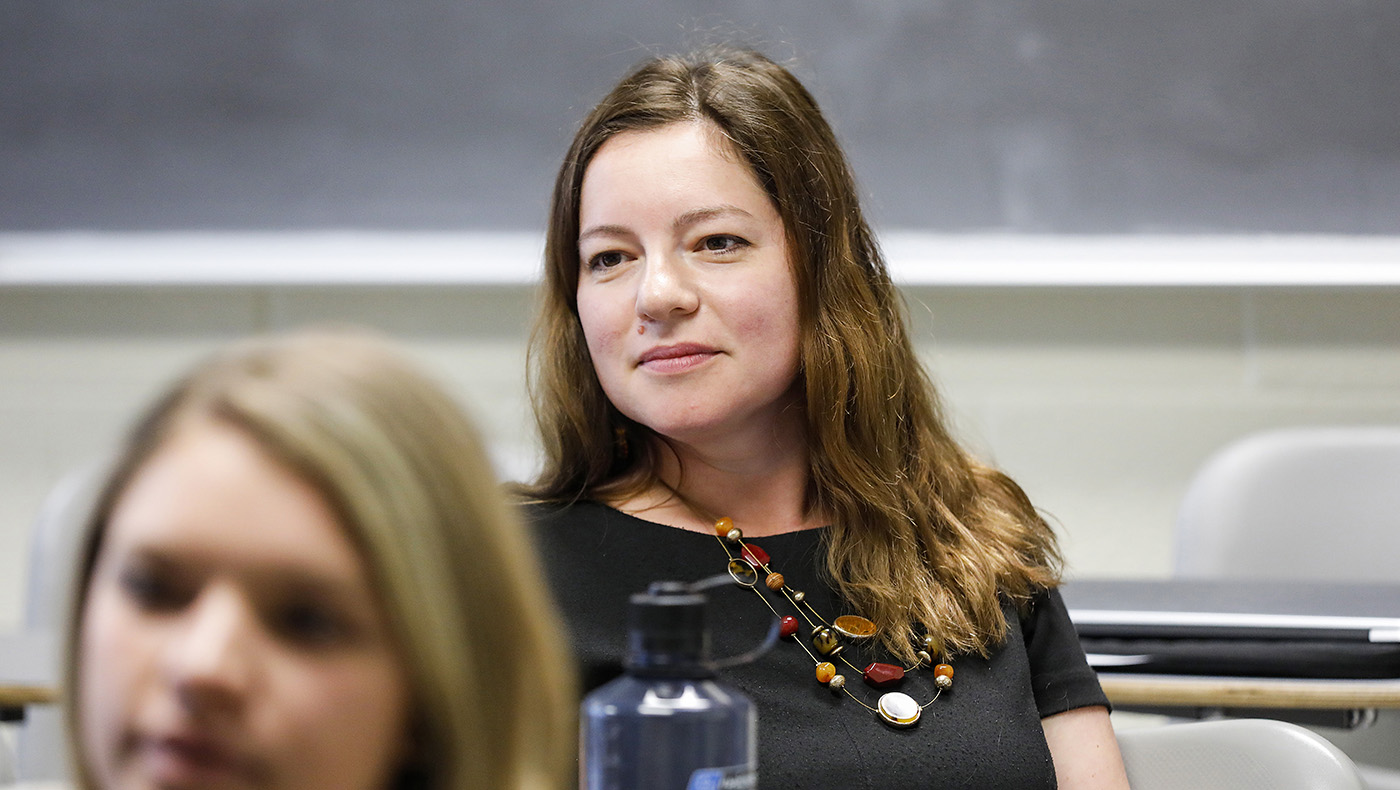
Luckily for overwhelmed first-year students, there is Julia Belyavsky Bayuk, an associate professor and one member of faculty who teaches the Basics of Business, otherwise known as BUAD 110. (BUAD is a catalog code for Business Administration courses in Lerner College.) This class offers first-year students a crash course on what business is as well as an introduction to all majors on offer and resources available for success in each. The end goal: helping students narrow their focus early, so they can graduate on time.
“For me, the mentoring component is very important — I think of it as a mothering component,” Bayuk said. “Many students enter the business school unsure of what they want to do or which classes to take. We are here to guide them through it.”
Throughout the semester, students view a series of 30-minute videos in which a faculty representative from each department offers a primer on their area of focus, whether that is economics or entrepreneurship or hospitality management. Each video is followed up with a classroom activity that helps students further understand (and decide if they enjoy) the material. During the finance module, for instance, Blue Hens are given a stock project in which they have to determine, based on a variety of metrics, which of two competing companies in a given industry is the better investment option. Through it all, Bayuk offers helpful strategies for time management and academic planning.
“I email them after every class to say: Here is what we covered, here is what you need to do for next time and here is what you need to be thinking about,” Bayuk said. “I want to do what I can to keep them from missing deadlines. And I tell them straight up: This is not going to happen in every class. But I hope to make their lives a little bit easier at the beginning.”
Students are also given a so-called Lerner Passport, a curated list of opportunities for narrowing one’s business interests and connecting with like-minded peers. This alerts the class to chances for, say, listening to high-profile speakers from the hospitality world, like Sam Calagione of Dogfish Head Craft Brewery fame, or sitting in on a meeting of the Blue Hen Investment Club, a group of undergraduates responsible for managing a portion of the University’s endowment.
For Sanika Nawathe, a first-year marketing major and Honors College student who took BUAD 110 in the fall of 2020, entering the business school proved overwhelming at first. But by the end of a semester in Bayuk’s class, she felt better equipped to navigate UD’s course catalog and, ultimately, her own future.
“I had this preconceived notion that accounting was boring — just staring at numbers all day, working alone with a calculator,” she said. “But in BUAD 110, I realized there is so much more to it than that. After being introduced to a case study in which a person was stealing money out of a nonprofit’s account, I felt especially drawn in by the field of forensic accounting. Now I’ve declared a second major in accounting.”
Grace Zhang, a junior honors student, had a similar experience as a first-year student. She enrolled in Lerner thinking she wanted to study only marketing, but she soon discovered a passion for data science. If not for Bayuk’s guidance in BUAD 110, she said, she may not have realized her true calling — a triple major in finance, marketing and management information systems — until much later in her academic career.
“Professor Bayuk is so accessible, and being able to approach her with questions — whether about scheduling or advice on my internship search process — has been a pivotal part of my experience in the business school,” Zhang said. “Future students should know they are not on their own. All you have to do is reach out.”
Right from the start, these Blue Hens are offered opportunities for real-world experience. Through one project, all members of Bayuk’s class (and the other sections of BUAD 110) are paired with a company — restaurant, engineering firm, publisher, etc. — with a problem to solve. The students conduct research to see how these businesses can, for instance, better attract clients or ramp up their marketing efforts. In many cases, the solutions are implemented. Nawathe’s group, for example, worked for an LA-based recording label on developing social media campaigns to promote two emerging artists (those names are confidential, due to a non-disclosure agreement).
“I would never have considered the music industry or thought to look into a record company for a business internship,” Nawathe said. “But thanks to this class, I now know this is an option. I am grateful to have had this exposure so early on.”
Throughout the semester, students interact with TAs, teacher assistants who are veterans of the course, for additional help or clarification on assignments, as well as an all-important student perspective on the business school experience. Because BUAD 110 doubles as a First Year Seminar, peer mentors are also a major part of the course, and they shed light on broader issues pertaining to the college experience — topics range from alcohol abuse to the University’s academic honesty policy to registration and course choice.
“We have a really cool program that allows for coffee dates with underclassmen,” said Summer Kehl, a senior honors student in the business school who serves as both a TA and a peer mentor for the BUAD 110 set. “You never know what’s going to come up. Sometimes, it’s ‘How do I study?’ Other times, it’s ‘I’m homesick.’ We are really there for whatever they need.”
Part of Kehl’s motivation for taking this on, she said, is paying forward the exceptional experience she had as a student herself in Bayuk’s course. Because the class allowed her to determine her operations management major early on, she is set to graduate on time even after taking one semester off. And she has already applied some of what she’s learned to the family business, a tree farm in Honey Brook, Pennsylvania.
“When I was going through the college decision process, I didn’t want to be just a number,” Kehl said. “I wanted to actually be something at school — I wanted to make an impact — and I also wanted the school to have an impact on me. BUAD 110 really gave me that ability to be something more than a number, to connect with my peers and professors. It changed entirely the course of my college experience.”
More than anything, Bayuk said, these relationships are the thing she tries hardest to facilitate for her students.
“You might not remember the specific details of each class you take,” she said. “But the personal connections you make in college will last a lifetime. I strive to build those, because that’s exactly what I would want someone to do for my own children.”