


Economics (Ph.D.)

Program Status
Admission to the Ph.D. in economics is open for the 2027-2028 academic year.
Our doctorate in economics focuses on developing applied research skills that are increasingly in demand in consulting, business, government and academia.
Because of our small class sizes, you can count on receiving the personal attention of our highly qualified faculty. Our programs emphasize applied, policy-oriented economics and the development of strong econometric skills.
Economics that really matters – student-centered and research-focused. That’s the Lerner difference.
Program Highlights
Fields of specialization include development economics, labor economics, household finance, public policy and environmental economics.
Program Requirements
In addition to courses for the doctorate, you must complete the requirements for the M.S. in economics and applied econometrics at the University of Delaware or satisfy the equivalency requirement (see below).
You can expect to finish all required coursework within three years, with two additional years typically needed to complete the dissertation.
See the courses, prerequisites and minimum grades required to earn your degree. For the most accurate and up-to-date degree requirements, visit the program page on UD’s course catalog.
Additional Requirements
Examinations in microeconomic and macroeconomic theory are required.
Ph.D. students must register for and attend the weekly department seminar (ECON 890) in their fourth semester of study.
M.S. in Economics Equivalency
If you have earned a master’s degree in economics at an institution other than UD, you will probably not need to complete the full 51 credits for the doctorate in economics. Courses that are deemed equivalent can substitute for required course credits for our M.S. in economics and applied econometrics. The graduate committee has sole authority to award equivalency.
STEM Business Program
This STEM-designated business program builds the quantitative, analytical and technical skills employers prioritize today, such as data analysis, AI fundamentals, financial modeling and technological proficiency. STEM occupations are high earning, with a median wage double that of non-STEM fields, and are projected to grow faster than overall employment, according to the U.S. Bureau of Labor Statistics.
Career Opportunities
The economics doctorate prepares you for a leading role in economic research, education, consulting or government agencies. The economics faculty provides job interview coaching and guidance.
Where Our Graduates Work
Academic positions:
- American University, Dubai
- Bucknell University
- Chowan University
- Otterbein University
- Pacific University
- Rowan University
- Skidmore College
- St. Mary’s University – Halifax, Canada
- SUNY – Oneonta
- West Chester University
Government and International Organizations:
- Bureau of Economic Analysis
- Delaware Department of Labor
- Federal Reserve Banks of Philadelphia and Richmond
- U.S. Bureau of the Census
- U.S. Environmental Protection Agency
- U.S. Social Security Administration
Consulting and Industry:
- A2F Consulting
- Deloitte Economic Consulting
- Ernst & Young (Washington, NY and Atlanta offices)
- KPMG
- PriceWaterhouseCoopers
- PEPCO
Banking and Financial Services:
- Bank of America
- Barclays
- Capital One
- Charles Schwab
- Citibank
- HSBC Financial Corporation
- J.P. Morgan Chase
- Morgan Stanley
- Northern Trust Corp.
- Optionmetrics
- PNC
- Santander Bank
- TD Bank
- Wells Fargo
Economics FAQ
Program Overview
What is distinctive about your programs?- A Personalized Approach: Our program is small enough that every student receives individual attention.
- Real-World Application: We emphasize applied economics and offer a robust array of econometrics courses. Our graduates are consistently placed in meaningful roles that demand practical, data-driven skills.
- Communication & Teaching: Funded Ph.D. students often teach departmental courses. This provides valuable experience in public speaking and complex communication—skills that are highly prized in both academia and the business world.
- Master’s Degrees: These are three-semester programs. Students typically take three courses per term. In the third semester, students may either complete a research paper (ECON 868) or opt for a tenth elective course.
- Ph.D. Program: Students generally require two years for coursework and an additional three years to complete and defend the dissertation.
While you cannot use credits from another degree to earn a UD Master’s, some prior graduate work may reduce the credits needed for a Ph.D.
- Direct Entry (with prior Master’s): If you earned an Economics Master's from a comparable university, you may only need the 21 Ph.D. credits.
- Combined Program (without prior Master’s): Students complete our M.S. in Economics & Applied Econometrics (30 credits) plus the Ph.D. requirements (21 credits), earning both degrees upon completion.
Note: The Graduate Committee evaluates these requests individually.
Admissions & Prerequisites
How can I increase my chances of being admitted?A strong mathematical foundation is the best predictor of success.
- Minimum Requirement: A two-course undergraduate calculus sequence that includes multivariate calculus.
- Highly Recommended: Courses in linear algebra and differential equations.
No. A three-year degree is not considered equivalent to a U.S. bachelor's degree. Applicants must complete one additional year of post-graduate study in their home country before applying to our graduate programs.
Financial Aid & Funding
How does financial aid differ between the Master’s and Ph.D. programs?Financial support is structured differently depending on the degree level.
Ph.D. Funding (TA/RA Positions)
- Availability: We fund a limited number of incoming Ph.D. students via Teaching or Research Assistantships.
- Minimum Scores: To be eligible, applicants must have a TOEFL iBT of 4.5 (on the new 1–6 scale) and a GRE Quantitative score of 156.
- Duration: Most Ph.D. students remain funded for five years, contingent upon satisfactory academic performance.
- Availability: Master’s students are not eligible for TA or RA positions.
- Support: We offer a limited number of tuition discounts for highly qualified Master's applicants.
- External Support: Because aid is limited, we strongly advise international Master's applicants to secure an outside sponsor.
Decisions for the fall semester are finalized in February. We cannot provide specific feedback on an individual's chances of funding until the full application is reviewed by the Graduate Committee.
News
- How to Choose a Graduate Business Program That Delivers - Lerner graduate admissions and recruitment director Patrick Cahill shares practical advice for evaluating graduate business programs, from career outcomes and flexibility to teaching quality, helping professionals navigate a changing workforce with confidence.
- Lerner College Celebrates the Class of 2026 Graduates - The University of Delaware’s Lerner College celebrated more than 1,500 graduates from the Class of 2026 during Convocation and Commencement ceremonies honoring undergraduate, master’s and doctoral students.
- Outstanding Lifelong Lerner: Jason Christie - Christie is a 2025 Ph.D. graduate in economics from Lerner, is now a digital fraud innovation strategist at Bank of America.
- Graduate Student Stories: Anxhela Beluli - Anxhela Beluli is expected to earn her PhD in economics from Lerner in 2026. She shared why she chose to continue her studies at Lerner, and how her time in the program has impacted her as a professional.
- Lerner Career Lab Prepares Students for Real-World Careers - Lerner Career Services introduces Career Lab, a monthly workshop using employer-designed job simulations to help undergraduate and graduate business students gain hands-on experience, explore career paths and build job-ready skills.
Admissions Information
Learn more about economics Ph.D. admissions requirements, deadlines, tuition and financial aid available to you.

Job Market Candidates
Lerner Ph.D. in Economics students have the quantitative skills needed to conduct applied economic research and are ready for careers in consulting, government or academia.

Lerner STEM Business Degrees
Explore Lerner STEM-designated programs and their career advantages.

Hutchinson Lecture in Economics
The Hutchinson Lecture in Macroeconomics brings distinguished scholars and policy-makers to campus each spring semester.
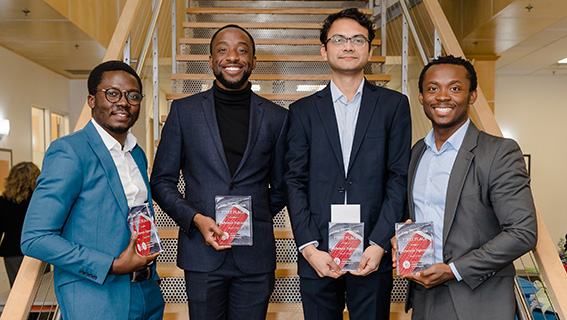
Carol A. Ammon Case Competition
Graduate student teams present their solutions to current issues faced by the competition’s focal company.